
Biography
Natori Shunsen (1886-1960) was one of the most distinguished portraitists of the shin-hanga movement, celebrated above all for his compelling depictions of kabuki actors. His work in the yakusha-e (actor print) genre revitalized a tradition that stretched back to the great ukiyo-e masters of the Edo period, bringing to it a modern sensibility grounded in careful observation, psychological depth, and the exquisite technical craftsmanship that defined the best shin-hanga publications.
Born in 1886 in Yamanashi Prefecture, Japan, the son of a silk merchant, Natori Shunsen (whose given name was Yoshinosuke) displayed artistic talent from an early age. From around the age of eleven he trained under Kubota Beisen, a painter and designer of the Japanese-style nihonga tradition, learning the fundamentals of brushwork, composition, and the careful study of subject matter from life; it was Beisen who gave him the artist name Shunsen. He later studied at the Tokyo School of Fine Arts. This grounding in traditional Japanese painting would serve Shunsen well throughout his career, providing the technical foundation upon which he built his distinctive portrait style.
Shunsen was an avid devotee of kabuki theater from his youth, and this passion became the defining focus of his artistic career. He spent countless hours attending performances, sketching actors in their roles, and developing an intimate understanding of the conventions, gestures, and emotional expressions that characterized different kabuki characters. This deep knowledge of the theatrical tradition gave his actor portraits an authenticity and immediacy that set them apart from the work of less dedicated contemporaries. He understood not merely the surface appearance of a kabuki performance but the inner spirit of the roles and the individual interpretive qualities that distinguished one actor's portrayal from another's.
Shunsen's most significant body of work was produced in collaboration with Watanabe Shozaburo, the publisher who was the driving force behind the shin-hanga movement. Between 1925 and 1929, Watanabe published Shunsen's landmark series of thirty-six actor portraits, "Shunsen Nigao-e shū" (Collection of Portraits by Shunsen), which would become one of the most celebrated achievements of the entire shin-hanga era. Lavishly produced in a limited edition of 150 impressions and sold only by subscription, the series depicted the leading kabuki actors of the day in their most famous roles, capturing both the physical likeness of the performer and the dramatic essence of the character portrayed. Each print was produced using the traditional collaborative method championed by Watanabe, with Shunsen providing the design, expert carvers translating it into woodblocks, and master printers applying colors through multiple impressions on fine Japanese paper.
The series showcased Shunsen's remarkable ability to convey character and emotion through subtle means. His portraits typically depict the actor in a moment of dramatic intensity — a fierce glare, a contemplative pause, a coy sideways glance — frozen with an almost photographic precision yet imbued with the stylistic elegance of the Japanese woodblock tradition. The backgrounds of these prints are often simple, usually a plain mica ground or a subtly graduated wash, which serves to focus all attention on the face and its expression. The carving is extraordinarily refined, particularly in the rendering of hair, eyebrows, and the fine lines around the eyes, where the slightest variation in line weight conveys volume, texture, and emotional nuance.
Among the most celebrated prints in the series is his portrait of Ichikawa Sadanji II as the priest Narukami, and each design demonstrates Shunsen's sensitivity to the distinctive qualities of the individual actor. His depiction of Sadanji as Narukami captures the explosive fury of the character with bulging eyes and dramatically contorted features, while his portraits of onnagata — the specialists in female roles — convey a delicate, refined beauty that reveals the performer's skill at that demanding art.
Technically, Shunsen's prints are among the finest produced in the shin-hanga movement. The printing employs multiple blocks with carefully registered color applications, often including metallic pigments and mica backgrounds that give the prints a luminous, jewel-like quality. The bokashi (gradation) effects in the backgrounds and costumes demonstrate the printer's art at its highest level, and the overall harmony between design, carving, and printing reflects the collaborative ideal at the heart of the shin-hanga philosophy.
Beyond this landmark series, Shunsen continued to produce actor prints throughout his career, including a supplementary group of designs issued into the early 1930s and a further series of actor portraits in the early 1950s. He also worked as an illustrator for the Asahi Shimbun newspaper. His prints were exhibited internationally, including at the Toledo Museum of Art in the United States, and gained recognition among collectors of Japanese prints, particularly in the United States and Europe, where the dramatic intensity and technical beauty of his actor portraits found an appreciative audience.
Shunsen's contribution to the yakusha-e tradition was unique in the twentieth century. While the great Edo-period masters such as Sharaku, Toyokuni, and Kunisada had established the genre as one of the pillars of ukiyo-e, the tradition had largely declined by the end of the nineteenth century. Shunsen's work, produced under the aegis of the shin-hanga movement, represented a genuine revival and modernization of the genre. He brought to actor portraiture a degree of psychological realism and individual characterization that went beyond the more formulaic approaches of many of his Edo predecessors, while retaining the essential stylistic qualities — bold composition, expressive line, and the interplay of pattern and color — that made the best yakusha-e such compelling works of art.
Shunsen's legacy extends beyond his individual prints to his influence on the broader understanding of kabuki as a subject for fine art. His portraits serve as an invaluable visual record of the golden age of early twentieth-century kabuki, documenting the appearances and characteristic performances of actors who are now legendary figures in the history of Japanese theater. For scholars of both printmaking and kabuki, Shunsen's work provides an essential bridge between the artistic traditions of the past and the modern era.
Natori Shunsen died in 1960, leaving behind a body of work that is regarded as one of the crowning achievements of the shin-hanga movement. His actor portraits are held in major museum collections worldwide, including the Museum of Fine Arts, Boston; the British Museum; the Brooklyn Museum; and the Honolulu Museum of Art. They remain among the most celebrated prints of the shin-hanga era, prized for their technical brilliance, their dramatic power, and their insight into the world of kabuki theater at its early twentieth-century zenith.
Key Facts
- Active Period
- 1886–1960
- Nationality
- 🇯🇵Japan
- Movement
- Shin-hanga
- Works Indexed
- 76
Frequently Asked Questions
Natori Shunsen (1886-1960) was one of the most distinguished portraitists of the shin-hanga movement, celebrated above all for his compelling depictions of kabuki actors. His work in the yakusha-e (actor print) genre revitalized a tradition that stretched back to the great ukiyo-e masters of the Edo period, bringing to it a modern sensibility grounded in careful observation, psychological depth, and the exquisite technical craftsmanship that defined the best shin-hanga publications.
Natori Shunsen was active from 1886 to 1960. They were associated with the Shin-hanga movement.
Natori Shunsen's work was shaped by the Shin-hanga tradition in Japanese woodblock printmaking. Shin-hanga: ## What is Shin-hanga? Shin-hanga (新版画), literally "new prints," is the early twentieth-century revival of the collaborative Japanese woodblock workshop, organized between roughly 1915 and 1960 by the Tokyo publisher Watanabe Shōzaburō (1885–1962) and a handful of competing houses.
Natori Shunsen's prints frequently feature kabuki, theater, abstract, portraits, figures, animals.
Original prints by Natori Shunsen can be found in collections including Minneapolis Institute of Art, Art Institute of Chicago, Scholten Japanese Art, Honolulu Museum of Art.
External Resources
Series by Natori Shunsen
Woodblock Prints by Natori Shunsen (76)

Ichikawa Ennosuke as Kakudayu in 'Toyama seidan' / Shunsen nigao-e-shu (Collection of Shunsen Portraits)

Sawamura Sojiro as Narihira Reizo
Woodblock print

The actor Sawamura Sôjûrô VII in the role of Mizuno
Mokuhanga (Japanese woodblock)

The Actor Onoe Tamizo III in the role of Otsuma
Mokuhanga (Japanese woodblock)

Actor Onoe Baiko VI
Mokuhanga (Japanese woodblock)

The Actor Ichikawa Uzaemon in the role of Shirai Gonpachi
Mokuhanga (Japanese woodblock)

The actor Ichikawa Sadanji II as Narukami Uejin
Mokuhanga (Japanese woodblock)

Shin Nigao: Nakamura Tôzô in the role of Susanô no Mikoto
Mokuhanga (Japanese woodblock)

Shin Nagao: Fushimi Taishi
Mokuhanga (Japanese woodblock)

Nakamura Utaemon as Hanako
Mokuhanga (Japanese woodblock)

Nakamura Fukusuke as Ohan
Mokuhanga (Japanese woodblock)

Matsumoto Koshiro as Umeo
Mokuhanga (Japanese woodblock)

Matsumoto Kô shirô VII in the role of Benkei
Mokuhanga (Japanese woodblock)

Keyblock Impression
Mokuhanga (Japanese woodblock)

Combinh her ahir
Mokuhanga (Japanese woodblock)

Ichikawa Ebizo IX as Yoemon
Mokuhanga (Japanese woodblock)

Shin Nigao: Ichikawa Chûsha VII in the role of Takechi Mitsuhide in the play Ehon Taikôki
Mokuhanga (Japanese woodblock)

Shin Nigao: Nakamura Kichiemon I in the role of Yura Hyôgonosuke Nobutada
Mokuhanga (Japanese woodblock)

Shin Nigao: Nakamura Baigyoku II in the role of Heiemon
Mokuhanga (Japanese woodblock)

Bando Juzaburo as Seigorô
Mokuhanga (Japanese woodblock)

Shin Nigao: Nakamura Genjirô I in the role of ôboshi Yuranosuke
Mokuhanga (Japanese woodblock)

The Actor Onoe Matsusuke I as Ashikaga Takauji in the Play Kumoi no Hana Yoshino no Wakamusha, Performed at the Nakamura Theater in the Eleventh Month, 1786
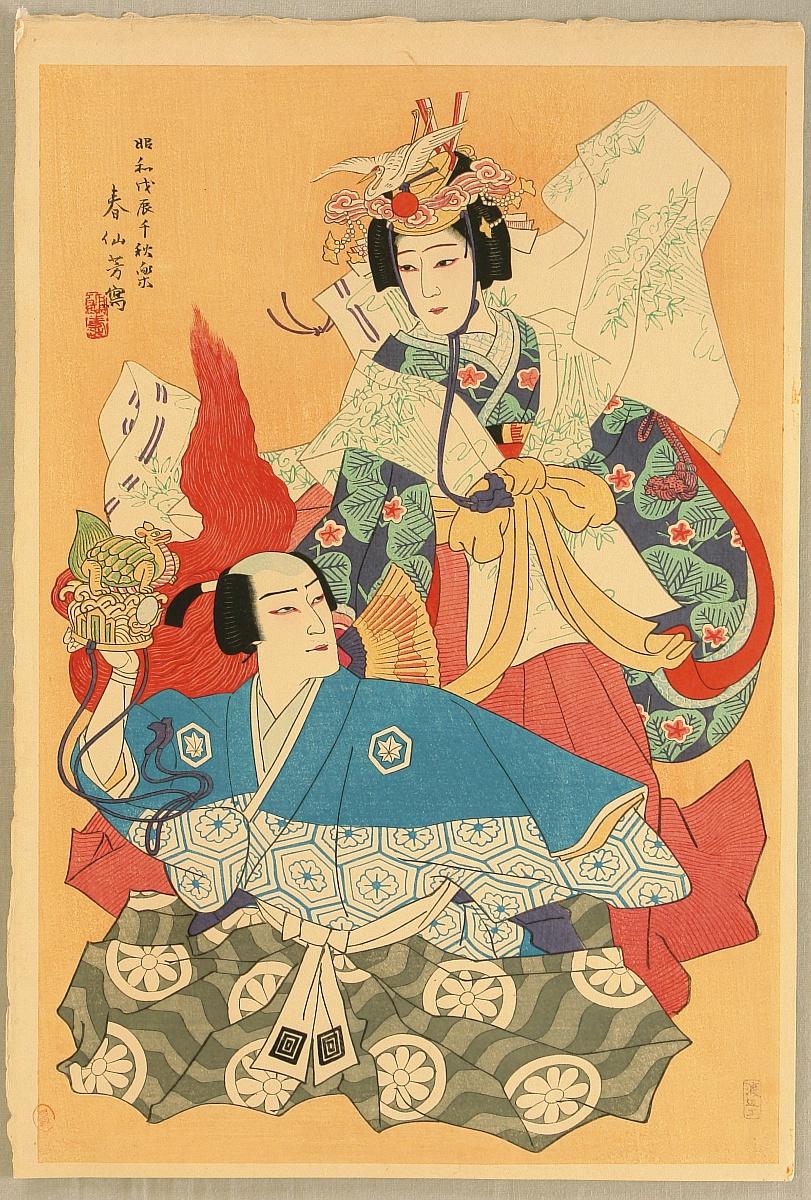
Two Dancers
Woodblock print
