
Biography
Numata Kashū (沼田荷舟, 1838-1901) was a Meiji-period Japanese painter and book illustrator from Nagoya, best known to modern audiences for the Shūchō gafu (聚鳥畫譜, "Picture Album of Various Birds"), a three-volume color woodblock-printed bird book published in Tokyo in 1885 that is widely regarded as one of the most ambitious natural-history print projects of early Meiji Japan. Working in the kachō-e (bird-and-flower) tradition that connected Edo-period Japanese painting with the centuries-old East Asian fascination with the artistic depiction of birds, plants, and seasonal change, Kashū combined the close observation of bird anatomy associated with the Maruyama-Shijō shasei (sketching from life) tradition with the saturated color and elaborate carving made possible by the high-end Tokyo block-printing trade of the 1880s.
Kashū was born in 1838 in Nagoya into a well-born family. The biographical record for him is much thinner than for his Tokyo and Kyoto contemporaries, in part because his career bridged the Bakumatsu-to-Meiji transition without becoming attached to one of the schools that dominated the new Meiji art establishment, and in part because his greatest single project — the Shūchō gafu — was produced in such a short, lavishly capitalized run that it became almost immediately a collector's rarity rather than a textbook reference. What is clear from the surviving record is that he trained in classical Japanese painting, that he made a working career as a painter of birds and nature (with at least one imperial commission to decorate the Imperial Palace in Tokyo cited in later sources), and that by the early 1880s he had moved into the orbit of Tokyo publishers willing to underwrite ambitious illustrated books.
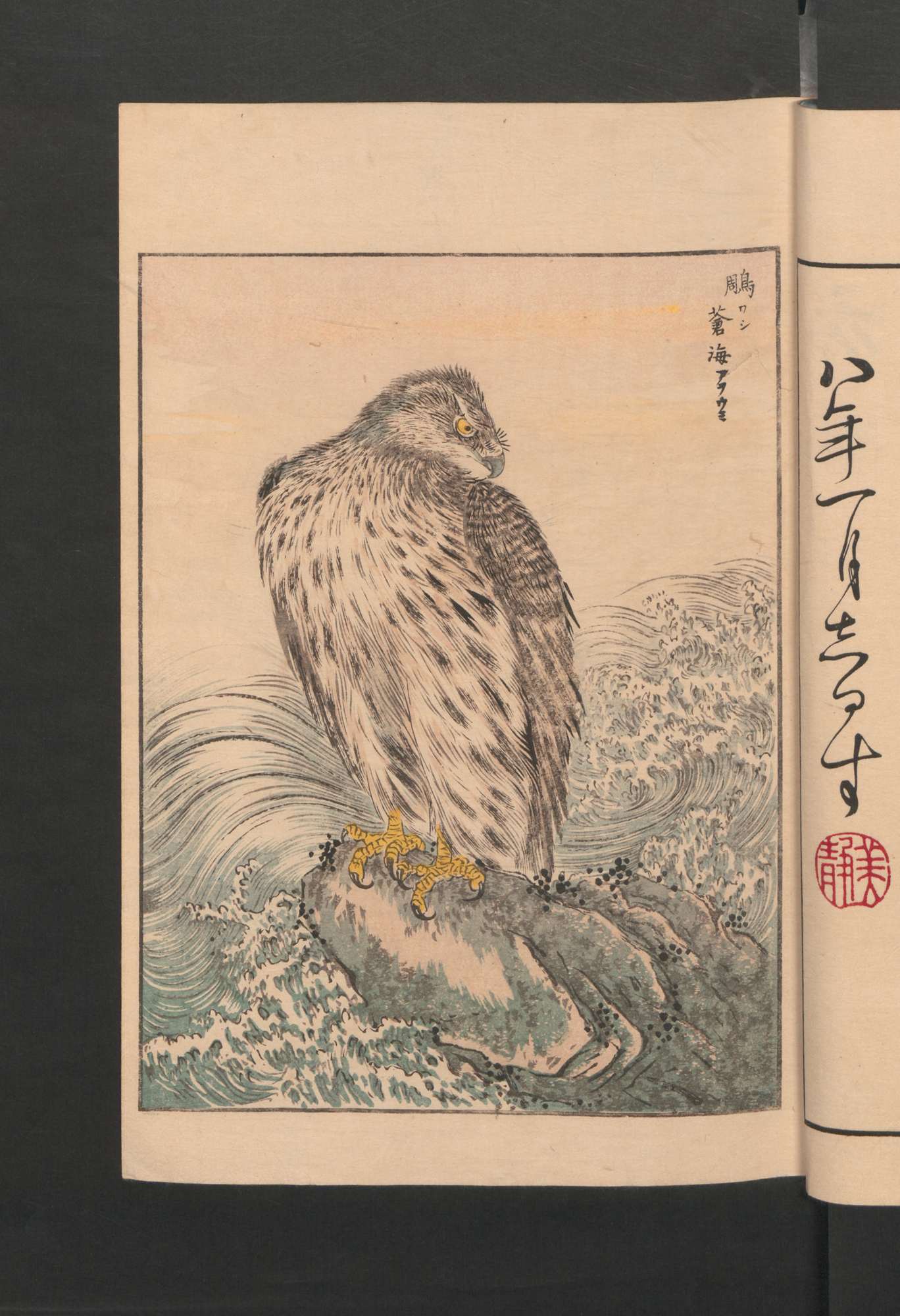
The Shūchō gafu, published in Tokyo in Meiji 18 (1885) by the firm Kinkadō in three bound volumes, was the result of that move. It collected more than 100 plates of Japanese birds shown with their characteristic plants and habitats: the sparrow in the rice fields, the brown-eared bulbul among holly and rosa rugosa, the golden pheasant with quince blossom, the wren on a daffodil stem, the mandarin duck on water plants, the demoiselle crane in marsh reeds, the white-fronted goose, the eastern waxwing, the Japanese golden eagle against a stylized stormy sea, and a much wider census of small songbirds, waterfowl, and birds of prey. Kashū's drawing combined two registers that earlier kachō-e printmakers had usually treated separately: ornithological precision (correct beak shape, leg structure, feather pattern, and posture appropriate to species) and decorative compositional intelligence (long diagonals, asymmetric placement against generous negative space, and the kind of seasonal-poetic motif pairing that the Japanese painting tradition had inherited from waka and haikai poetry). The result was an album that could be read both as a serious natural-history reference and as a deeply traditional kachō-e work for cultivated collectors.
The technical production of the Shūchō gafu was carried out by a Tokyo block-printing workshop operating at the technical edge of Meiji color printing: multi-block registration was precise enough to handle small-scale anatomical detail without misalignment, color gradations (bokashi) on water, sky, and feather plumage were applied with the kind of restraint and subtlety that had been associated with the finest Edo-period nishiki-e, and the paper was of a heavier weight than ordinary commercial print runs allowed. Produced in a small, costly edition, the original three-volume sets were rare almost from the outset, and this first 1885 printing is today considered very scarce: only a small number of complete sets survive in major institutional collections (the Metropolitan Museum of Art holds a copy under accession JIB2), and many of the surviving plates entered Western collections individually, having been removed from disbound albums by dealers responding to early twentieth-century Western demand for Japanese print imagery on a page-by-page basis.
The long afterlife of the Shūchō gafu was secured by a series of twentieth- and twenty-first-century reprints and reproductions. A Dover Publications edition titled Japanese Woodblock Bird Prints (issued under the Dover Fine Art / History of Art line) reproduced a large selection of the plates in a single affordable paperback, making the imagery familiar to a much wider audience than the rare originals could ever reach. More recently, high-resolution public-domain scans of the plates have circulated widely online, putting well over a hundred individual plate images into open circulation. The combined effect is that Kashū's birds — drawn from life in early Meiji Japan and carved and printed in 1885 by craftsmen working at the technical peak of Tokyo color printing — now circulate as one of the most accessible representations of the Meiji kachō-e tradition outside the more famous bird albums of Imao Keinen and Kōno Bairei.
Kashū's other publications include Kachō gasui (花鳥書粹, "Selected Bird-and-Flower Paintings") and Kachō gaen (花鳥画苑, "Garden of Bird-and-Flower Paintings"), both later kachō-e albums issued in similar formats, as well as paintings on commission for private and imperial patrons. He died in 1901 at the age of 63. While he never achieved the institutional prominence of Imao Keinen in Kyoto or Watanabe Seitei in Tokyo, the survival of the Shūchō gafu in a small number of complete sets and the wide circulation of its plates through later reproductions have secured his place as one of the more significant — and most visually rewarding — kachō-e printmakers of early Meiji Japan, working at a moment when the traditional bird-and-flower genre was being asked to absorb both serious natural-history observation and the rising commercial possibilities of multi-volume color woodblock books.
Key Facts
- Active Period
- 1838–1901
- Nationality
- 🇯🇵Japan
- Movement
- Meiji/Taishō Prints
- Subjects
- Birds & Flowers
- Works Indexed
- 18
Frequently Asked Questions
Numata Kashū (沼田荷舟, 1838-1901) was a Meiji-period Japanese painter and book illustrator from Nagoya, best known to modern audiences for the Shūchō gafu (聚鳥畫譜, "Picture Album of Various Birds"), a three-volume color woodblock-printed bird book published in Tokyo in 1885 that is widely regarded as one of the most ambitious natural-history print projects of early Meiji Japan. Working in the kachō-e (bird-and-flower) tradition that connected Edo-period Japanese painting with the centuries-old East Asian fascination with the artistic depiction of birds, plants, and seasonal change, Kashū combined the close observation of bird anatomy associated with the Maruyama-Shijō shasei (sketching from life) tradition with the saturated color and elaborate carving made possible by the high-end Tokyo block-printing trade of the 1880s.
Numata Kashū was active from 1838 to 1901. They were associated with the Meiji/Taishō Prints movement.
Numata Kashū's work was shaped by the Meiji/Taishō Prints tradition in Japanese woodblock printmaking. Meiji/Taishō Prints: Meiji and Taishō era prints (1868–1926) bridge the transition from traditional ukiyo-e to the modern shin-hanga and sosaku-hanga movements.
Numata Kashū's prints frequently feature birds & flowers.
Original prints by Numata Kashū can be found in collections including Wikimedia Commons (rawpixel, after 1885 Numata Kashū original), Metropolitan Museum of Art.
Woodblock Prints by Numata Kashū (18)

Brown-eared Bulbul and Dioecious Holly, from Pictorial Monograph of Birds (Shūchō gafu)
聚鳥畫譜 — 鵯と柊
1885
Color woodblock print from a book; ink and color on paper

Brown-eared Bulbul and Rosa Rugosa, from Pictorial Monograph of Birds (Shūchō gafu)
聚鳥畫譜 — 鵯と浜茄子
1885
Color woodblock print from a book; ink and color on paper

Reed-Bunting and Reed, from Pictorial Monograph of Birds (Shūchō gafu)
聚鳥畫譜 — 蒿雀と葦
1885
Color woodblock print from a book; ink and color on paper

Japanese Golden Eagle and Dark Blue Sea, from Pictorial Monograph of Birds (Shūchō gafu)
聚鳥畫譜 — 鷲と荒海
1885
Color woodblock print from a book; ink and color on paper
Picture Album of Various Birds (Shūchō gafu)
聚鳥畫譜
1885, first month
Polychrome woodblock printed book; ink and color on paper

Golden Pheasant and Flower of Japanese Quince, from Pictorial Monograph of Birds (Shūchō gafu)
聚鳥畫譜 — 錦鶏と木瓜
1885
Color woodblock print from a book; ink and color on paper

Siskin and Euonymus Alata, from Pictorial Monograph of Birds (Shūchō gafu)
聚鳥畫譜 — 真鶸と錦木
1885
Color woodblock print from a book; ink and color on paper

Demoiselle Crane and Reed, from Pictorial Monograph of Birds (Shūchō gafu)
聚鳥畫譜 — 鍋鶴と葦
1885
Color woodblock print from a book; ink and color on paper

Eastern Whimbrel and Wisteria Vine, from Pictorial Monograph of Birds (Shūchō gafu)
聚鳥畫譜 — 中杓鷸と藤
1885
Color woodblock print from a book; ink and color on paper

Grey Starling and Cercidiphyllum Japonicum (Katsura), from Pictorial Monograph of Birds (Shūchō gafu)
聚鳥畫譜 — 椋鳥と桂
1885
Color woodblock print from a book; ink and color on paper

Japanese Wren and Daffodil, from Pictorial Monograph of Birds (Shūchō gafu)
聚鳥畫譜 — 鷦鷯と水仙
1885
Color woodblock print from a book; ink and color on paper

Mandarin Duck and Pearl Barley, from Pictorial Monograph of Birds (Shūchō gafu)
聚鳥畫譜 — 鴛鴦と鳩麦
1885
Color woodblock print from a book; ink and color on paper
Black-eared Kite, from Pictorial Monograph of Birds (Shūchō gafu)
聚鳥畫譜 — 鳶
1885
Color woodblock print from a book; ink and color on paper

Japanese Jungle Nightjar, from Pictorial Monograph of Birds (Shūchō gafu)
聚鳥畫譜 — 夜鷹
1885
Color woodblock print from a book; ink and color on paper

Japanese Bunting and Plum Tree, from Pictorial Monograph of Birds (Shūchō gafu)
聚鳥畫譜 — 野路子と梅
1885
Color woodblock print from a book; ink and color on paper

Sparrow, from Pictorial Monograph of Birds (Shūchō gafu)
聚鳥畫譜 — 雀
1885
Color woodblock print from a book; ink and color on paper

White-Fronted Goose, from Pictorial Monograph of Birds (Shūchō gafu)
聚鳥畫譜 — 真雁
1885
Color woodblock print from a book; ink and color on paper

Eastern Waxwing, from Pictorial Monograph of Birds (Shūchō gafu)
聚鳥畫譜 — 緋連雀
1885
Color woodblock print from a book; ink and color on paper