
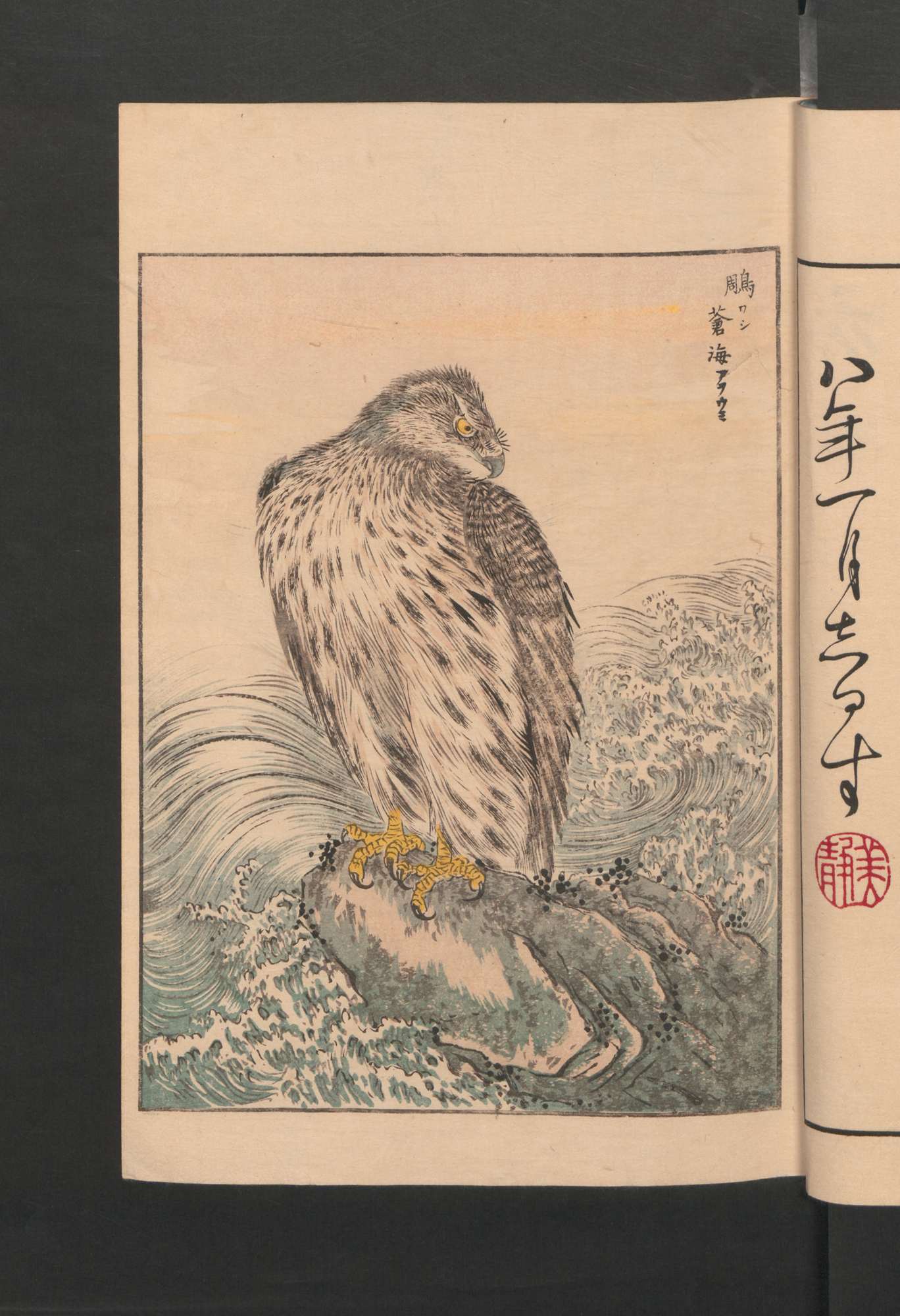
Japanese Golden Eagle and Dark Blue Sea, from Pictorial Monograph of Birds (Shūchō gafu)
聚鳥畫譜 — 鷲と荒海
by Numata Kashū
- Date:
- 1885
- Medium:
- Color woodblock print from a book; ink and color on paper
Description
Japanese Golden Eagle and Dark Blue Sea is one of the most dramatic plates in Numata Kashū's Shūchō gafu (1885), pairing the inu-washi (Japanese golden eagle) with a stylized stormy sea below — a composition that draws on a long East Asian painting tradition of eagles set against coastal cliffs and surging waves as emblems of power, vigilance, and the wilder edges of the natural world. The golden eagle is the apex raptor of mainland Japan, associated in Japanese folklore with high mountains, with the imperial hunt, and with the kind of martial valor that the Edo-period samurai class cultivated as personal iconography; in Kashū's treatment, the bird is rendered with the close anatomical observation that distinguishes the Shūchō gafu from earlier conventional kachō-e — correct beak hook, talons, feathering of the breast and shoulders, and the alert hunting posture of the head — while the sea below is reduced to dark, schematic curls of wave-form that recall the long tradition descended from Hokusai's Great Wave and from Kanō-school screen painting. The plate exemplifies the way Kashū's 1885 album could move between strict natural-history observation and the older decorative kachō-e idiom within the space of a single page.
More Prints by Numata Kashū

Brown-eared Bulbul and Dioecious Holly, from Pictorial Monograph of Birds (Shūchō gafu)
聚鳥畫譜 — 鵯と柊
1885
Color woodblock print from a book; ink and color on paper

Brown-eared Bulbul and Rosa Rugosa, from Pictorial Monograph of Birds (Shūchō gafu)
聚鳥畫譜 — 鵯と浜茄子
1885
Color woodblock print from a book; ink and color on paper

Reed-Bunting and Reed, from Pictorial Monograph of Birds (Shūchō gafu)
聚鳥畫譜 — 蒿雀と葦
1885
Color woodblock print from a book; ink and color on paper
Picture Album of Various Birds (Shūchō gafu)
聚鳥畫譜
1885, first month
Polychrome woodblock printed book; ink and color on paper
More Birds & Flowers Prints
Frequently Asked Questions
Japanese Golden Eagle and Dark Blue Sea, from Pictorial Monograph of Birds (Shūchō gafu) (聚鳥畫譜 — 鷲と荒海) was created by Numata Kashū (沼田荷舟) in 1885.
Japanese Golden Eagle and Dark Blue Sea, from Pictorial Monograph of Birds (Shūchō gafu) depicts birds & flowers.