
Biography
Suzuki Harunobu (鈴木春信, c. 1725-1770) was an Edo ukiyo-e print designer whose technical innovations in 1765 transformed Japanese woodblock printing from a limited two- or three-color craft into the fully polychrome art form known as nishiki-e, or "brocade pictures." Active for barely a decade, Harunobu nevertheless produced an estimated 400 to 1,000 designs, most of them refined chuban-format bijin-ga depicting slender, dreamlike young women in domestic, poetic, and amorous settings. His prints set the technical and aesthetic standard for the next generation of Edo ukiyo-e and made him the central figure of the 1760s print scene in Japan.
Harunobu's early life and training remain poorly documented. His birthplace and exact birthdate are unknown; he was active in Edo, but a number of scholars believe he came from or grew up in Kyoto. He is traditionally said to have trained under the Edo print designer Nishimura Shigenaga — to whom Ishikawa Toyonobu is likewise traditionally linked — though the Kyoto painter and printmaker Nishikawa Sukenobu is also frequently cited as a formative influence and possible teacher. His earliest signed works, from around 1760, are typically benizuri-e (limited red-and-green prints) or narrow hashira-e pillar prints depicting kabuki actors and beauties in a conventional Edo idiom, and nothing in this obscure first phase of his career suggests the technical revolution to come.
The breakthrough arrived in 1765 with the production of egoyomi, or pictorial calendar prints. These were commissioned not by commercial publishers but by amateur poetry circles of samurai and wealthy townsmen who exchanged ingeniously designed calendar prints as New Year tokens. The leading patron was the poet Ōkubo Kyosen (born Ōkubo Tadanobu, 1722-1777), a hatamoto samurai whose circle — the Kyosen-renchū — is largely credited with funding Harunobu's earliest nishiki-e and spared no expense in commissioning prints that hid the long and short months of the lunisolar calendar within elaborate pictorial designs. Because cost was no object and the prints were not intended for commercial sale, the publishers and engravers around Harunobu were able to experiment with multiple separately registered woodblocks, each carrying a different color, and with high-quality hosho paper, embossing (karazuri), metallic pigments, and other luxury techniques. The result was the first true nishiki-e: fully polychrome prints printed from a sequence of carefully registered key and color blocks, with subtle gradations and a far broader chromatic range than anything previously produced commercially.
Within months the technique migrated from private egoyomi exchanges into the commercial Edo print market. Commercial Edo publishers released Harunobu's nishiki-e to enormous demand, and 1765 to 1770 became the decisive moment in which the multi-color woodblock print became the dominant form of Japanese popular printmaking. Harunobu was the central designer of this transformation, and the term nishiki-e — "brocade picture" — explicitly compared the saturated, layered color of the new prints to the polychrome silk textiles for which Kyoto was famous.
Aesthetically, Harunobu used the new technique to invent a distinctive idiom of Edo ukiyo-e bijin-ga. His figures, almost always young women or pre-adult youths, are slender and small-headed, with rounded faces, narrow eyes, and a calm, doll-like stillness. He preferred the intimate chuban format (approximately 28 x 21 cm), which suited his domestic interiors and quiet poetic settings far better than the larger ōban sheets favored by later masters. Where contemporary bijin-ga concentrated on Yoshiwara courtesans in full regalia, Harunobu more often depicted ordinary young townswomen in chaste domestic moments — preparing tea, reading letters, sweeping snow from a veranda, sharing an umbrella with a lover — or shojo and youths in mitate-e parodies of classical Chinese and Japanese subjects.
Mitate-e — "parody pictures" or "analogue pictures" that transposed canonical literary, religious, or historical themes into modern Edo settings — became a Harunobu specialty. His most celebrated series in this mode is Zashiki Hakkei ("Eight Views of the Parlor"), published around 1766, which reimagined the classical Chinese landscape theme of the Eight Views of the Xiao and Xiang Rivers as eight interior vignettes featuring young women in a domestic Edo room. "Autumn Moon at the Mirror Stand" transposes the classical autumn-moon view onto the polished surface of a lady's mirror stand; "Evening Bell of the Clock" replaces the temple's evening bell with the chime of a domestic timepiece. The series is one of the supreme achievements of 1760s nishiki-e and a defining example of the witty, allusive sensibility of mid-Edo print culture.
Harunobu also pioneered the celebration of identifiable everyday teahouse and shop beauties as print subjects. The two most famous are Osen, the daughter of the proprietor of the Kagiya teahouse beside the Kasamori Inari Shrine in Yanaka, and Ofuji, who served at the Motoyanagiya toothpick shop near the Asakusa Kannon temple (Sensōji). Both became celebrities in their own right through Harunobu's repeated prints of them, anticipating by a generation the named-beauty prints of Kitagawa Utamaro and providing some of the earliest documented examples of ukiyo-e as a form of celebrity portraiture.
A substantial portion of Harunobu's output consisted of amorous prints (shunga and lightly erotic genre scenes), produced both as single sheets and as small-format albums. These pieces share the same refined chuban figures and poetic restraint as his public bijin-ga and form a major part of his surviving oeuvre.
Harunobu died in the sixth month of 1770, at roughly forty-five years of age. His sudden death cut short a career that had lasted only five years at full strength, but his impact on Edo ukiyo-e was immediate and enduring. Isoda Koryūsai, formerly a samurai painter, took over much of Harunobu's clientele and continued the chuban nishiki-e tradition, gradually expanding it into the ōban format and the early hashira-e pillar print. Shiba Kōkan, the Western-style painter and copperplate engraver who early in his career signed himself Suzuki Harushige, openly boasted of his ability to forge Harunobu prints under the master's name in the years just after Harunobu's death — an episode that complicates the attribution of late-1770 designs but also testifies to Harunobu's commercial dominance. Through Koryūsai and his pupils, the Harunobu manner shaped the work of Kitao Shigemasa, Torii Kiyonaga, and ultimately Utamaro, and it established the chuban-format domestic bijin-ga as a permanent strain of Edo print design.
Today Suzuki Harunobu is represented in virtually every major public collection of Japanese prints, including the Museum of Fine Arts, Boston (which holds one of the largest Harunobu groups outside Japan, much of it from the William Sturgis Bigelow collection), the Art Institute of Chicago (the Clarence Buckingham collection), the Metropolitan Museum of Art (the H. O. Havemeyer and Howard Mansfield collections), the Honolulu Museum of Art (the James A. Michener collection), the British Museum, the Tokyo National Museum, and the Chiba City Museum of Art. Major monographic exhibitions have been mounted in Tokyo, Chiba, Boston, and Chicago, and Harunobu remains a touchstone figure in the historical narrative of Edo ukiyo-e, the inventor of the nishiki-e "brocade picture" and the lyric poet of mid-eighteenth-century Japanese print design.
Key Facts
- Active Period
- 1725–1770
- Nationality
- 🇯🇵Japan
- Movement
- Ukiyo-e
- Works Indexed
- 288
Frequently Asked Questions
Suzuki Harunobu (鈴木春信, c. 1725-1770) was an Edo ukiyo-e print designer whose technical innovations in 1765 transformed Japanese woodblock printing from a limited two- or three-color craft into the fully polychrome art form known as nishiki-e, or "brocade pictures." Active for barely a decade, Harunobu nevertheless produced an estimated 400 to 1,000 designs, most of them refined chuban-format bijin-ga depicting slender, dreamlike young women in domestic, poetic, and amorous settings. His prints set the technical and aesthetic standard for the next generation of Edo ukiyo-e and made him the central figure of the 1760s print scene in Japan.
Suzuki Harunobu was active from 1725 to 1770. They were associated with the Ukiyo-e movement.
Suzuki Harunobu's work was shaped by the Ukiyo-e tradition in Japanese woodblock printmaking. Ukiyo-e: ## What is ukiyo-e? Ukiyo-e ([浮世絵](/glossary/ukiyo-e)) — literally "pictures of the floating world" — is the Edo-period Japanese print and painting tradition that flourished from roughly 1660 to 1868, depicting the pleasures of urban life in Edo (modern Tokyo): courtesans, kabuki actors, sumo wrestlers, famous landscapes, and seasonal beauties.
Suzuki Harunobu's prints frequently feature birds & flowers, winter, children, autumn foliage, rain, moonlight.
Original prints by Suzuki Harunobu can be found in collections including Art Institute of Chicago, Cleveland Museum of Art, ukiyo-e.org.
Woodblock Prints by Suzuki Harunobu (288)
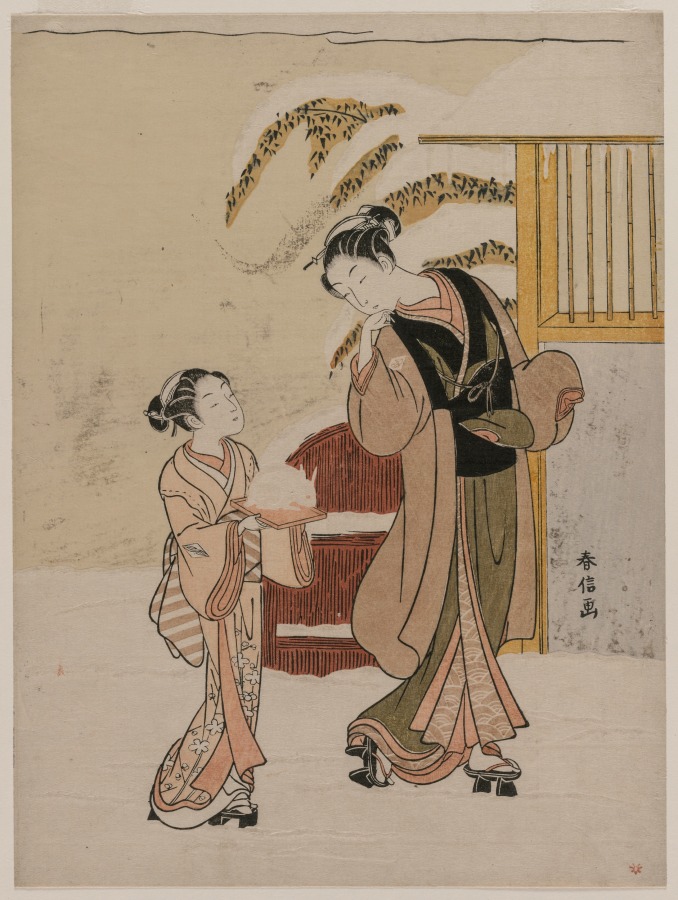
Young Woman Admiring a Snow Rabbit
late 1760s
Woodblock print; ink, color, and embossing on paper

Fidelity (Shin), from the series Five Cardinal Virtues
Edo period (1615–1868), 1767
Color woodblock print; chuban

Catching Fireflies
About 1767
Color woodblock print; chūban

Benevolence (Jin), from the series "Five Cardinal Virtues"
1767
Color woodblock print; chuban

Knowledge (Chi), from the series "Five Cardinal Virtues"
1767
Color woodblock print; chuban
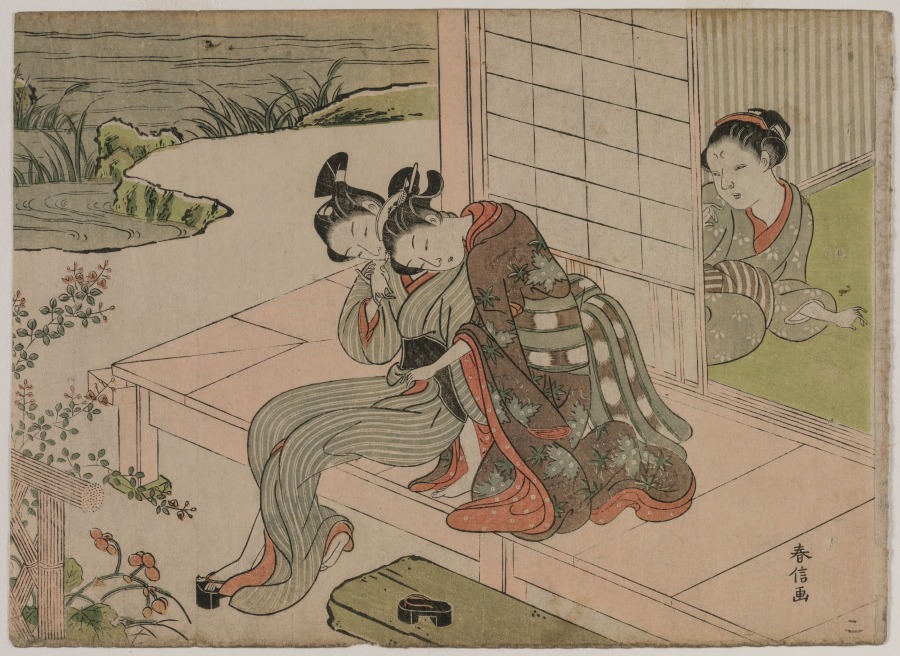
Woman Watching Young Couple Embrace on a Veranda
late 1760s
color woodblock print

Righteousness (Gi), from the series "Five Cardinal Virtues"
1767
Color woodblock print; chuban
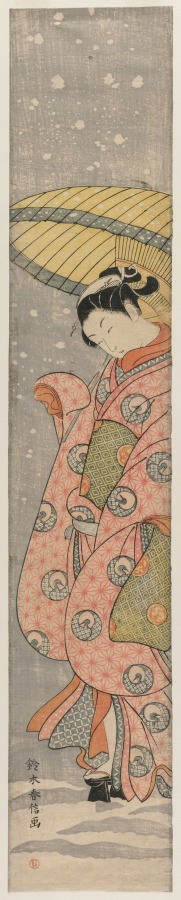
Young Woman Standing Under an Umbrella in the Snow
1767–68
Woodblock print; ink and color on paper

'Lovers reading a letter'
ca. 1768
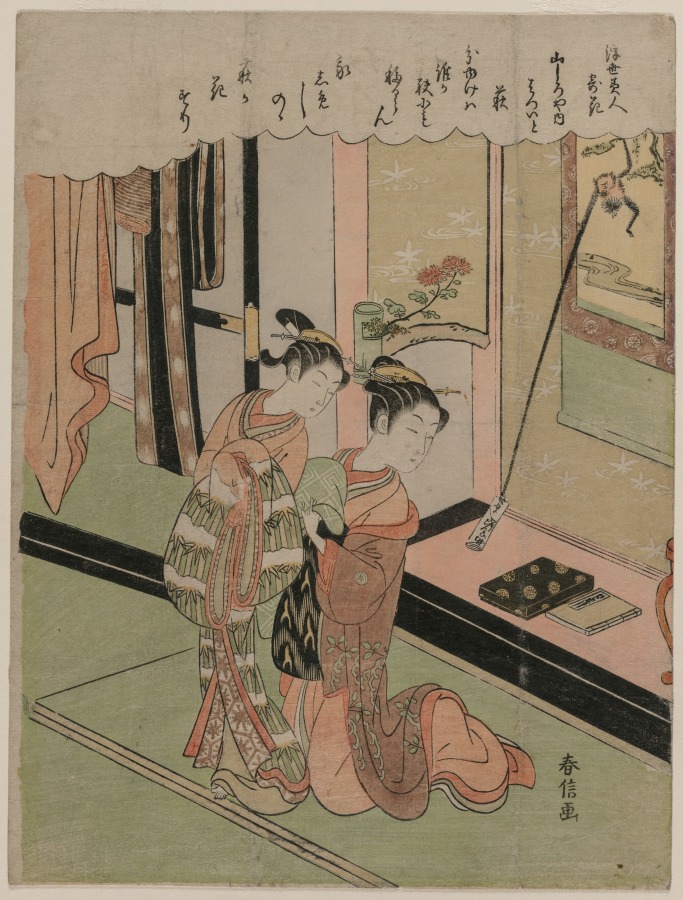
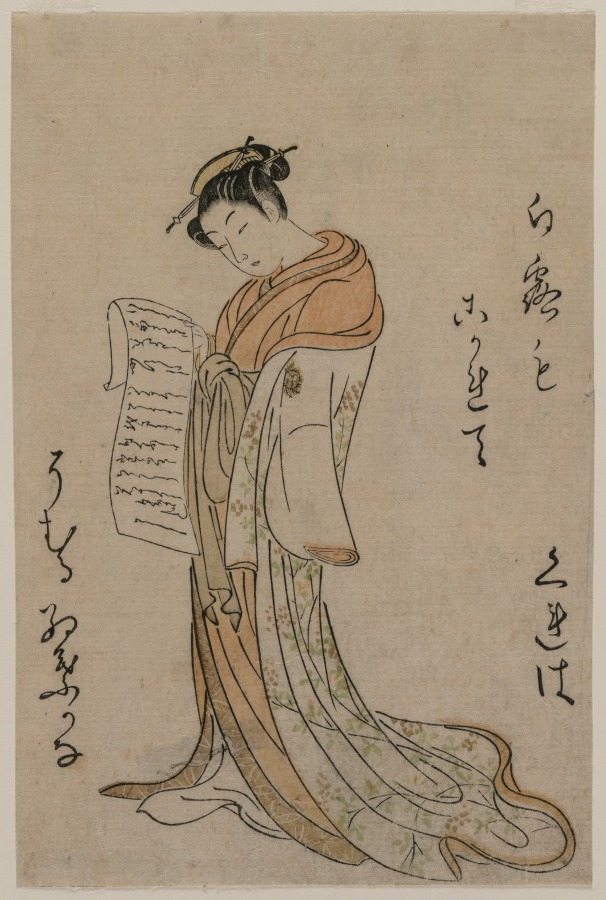
Hatsuito of the Yamashiroya Likened to Bush Clover, from Beauties of the Floating World Compared to Flowers
1769–70
color woodblock print
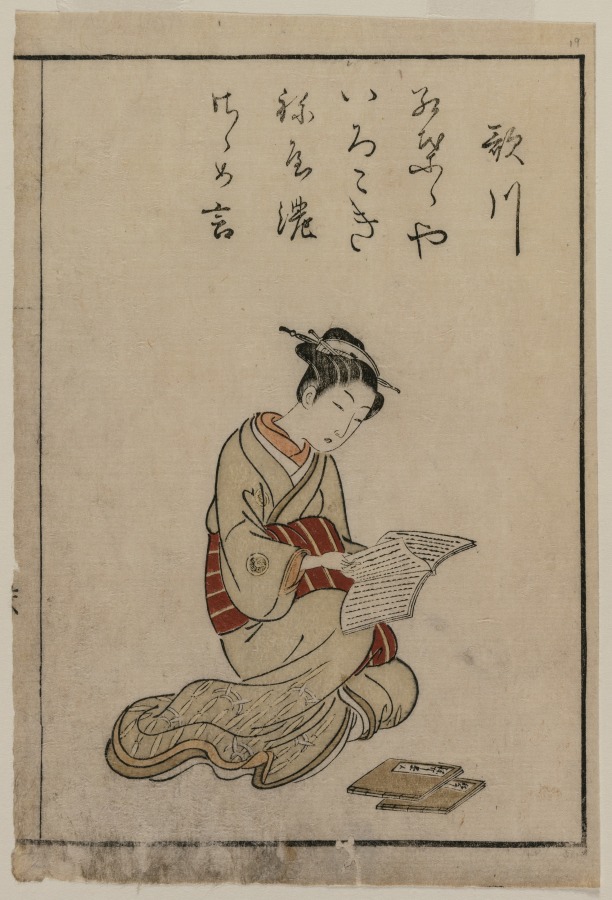
Kureha of Gakuiseya, from Selection of Beauties from the Pleasure Quarters
1770
color woodblock print
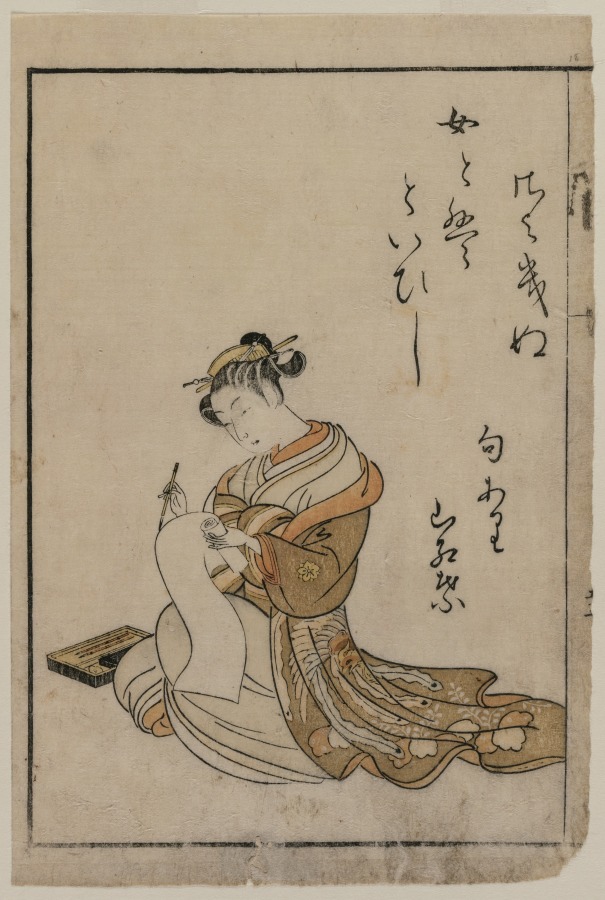
The Courtesan (From A Collection of Beautiful Women of the Yoshiwara)
1770
color woodblock print
The Courtesan Writing from a Book from the series A Collection of Beautiful Women of the Yoshiwara
1770
color woodblock print

Double-page Illustration from Vol. 2 of "Picture Book of Spring Brocades (Ehon haru no nishiki)"
1771
Color woodblock print; double-page illustration from book

Spring Brocades, A Picture Book (Ehon haru no nishiki)
1771

Young Woman Walking in Snow with Umbrella
c. 1868–1912
Woodblock print; ink and color on paper
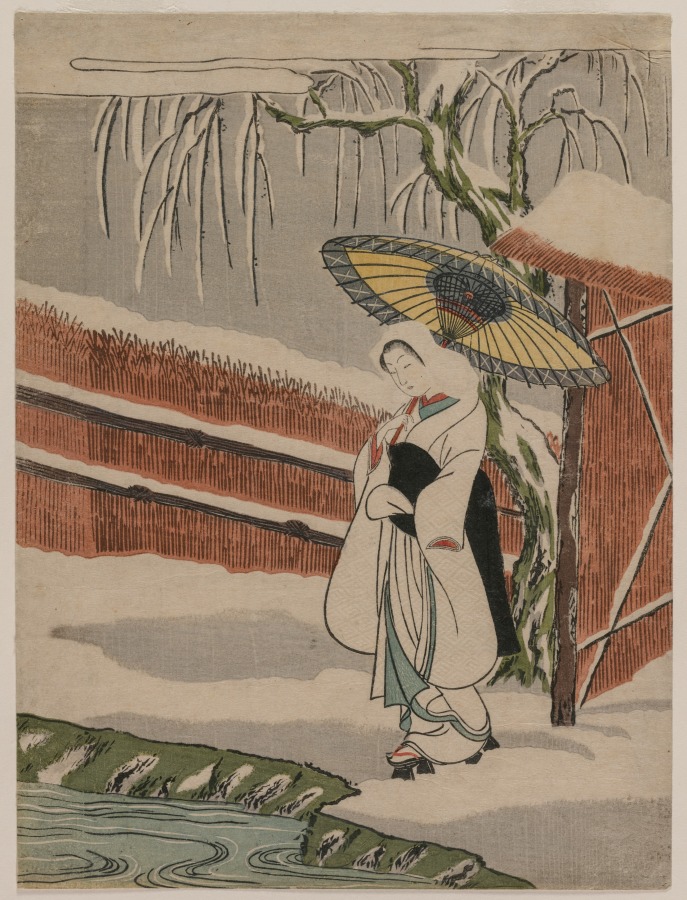
The Heron Maiden Standing Beneath a Willow Tree
1868–1912
color woodblock print

Shakkyô

The Wrestling Bout

Ehon haru no nishiki
1771
Woodblock- printed book; 2 vols (bound as one).

The Courtesan Agemaki

The Archery Ground

Segawa Kikunojo as Mumegae
