
Biography
Tachibana Minkō (橘岷江, active c. 1764-1772) was a mid-Edo ukiyo-e artist and book illustrator whose principal surviving achievement, the two-volume Saiga shokunin burui (彩画職人部類, Various Classes of Artisans in Colored Pictures) first published in 1770, stands as one of the most technically distinctive and ethnographically valuable color-printed books of the eighteenth century. Working at the precise historical moment when Suzuki Harunobu was perfecting the multi-block polychrome nishiki-e in Edo, Minkō pursued a parallel chromatic path through kappa-zuri (stencil printing), a technique in which color was applied to a sumi-printed base sheet through cut paper stencils rather than from carved color blocks. The Saiga shokunin burui represents the highest sustained application of kappa-zuri ever achieved in Japanese book illustration, and its scenes of twenty-eight artisans at their workbenches preserve an unmatched visual record of the urban craft economy of the late Hōreki and early Meiwa eras.
Biographical specifics about Minkō are sparse. Surviving sources record that he was originally an Osaka embroiderer who specialized in metal-foil work before turning to print design and relocating to Edo, where his major project found its publisher. His active career as a print and book designer falls within the narrow window of approximately 1764 through 1772, with his earliest dated production being the 1765 series Kitsune no yomeiri (狐の嫁入り, The Fox's Wedding), a charming sequence of small chuban yoko-e prints depicting the folk-belief procession of a fox bride and her vulpine retinue traveling through rain and mist. The Fox's Wedding series was reportedly executed in collaboration with five other artists, probably his pupils, indicating that by the mid-1760s Minkō already operated a small studio capable of coordinated production. His birth and death dates remain unrecorded in the standard sources, though his stylistic placement within the Harunobu-era nishiki-e revolution puts his probable working maturity in the 1760s and 1770s.
The Saiga shokunin burui defines Minkō's reputation. Issued in two volumes in 1770 and 1771 (with a second printing in 1784), the book presents twenty-eight craftsmen and artisans each at work in his distinctive trade: a hatmaker, a mirror polisher, a carpenter, a swordsmith forging a blade, an armorer, a cord maker, a weaver, a papermaker, a mask maker, and many others, with each plate organized around the figure of the artisan in his shop, surrounded by the specific tools, raw materials, and finished products of his profession. The compositions follow a consistent format that gives each artisan dignified central placement, while accompanying text identifies the craft and frequently includes verses or descriptive passages. As social documentation, the Saiga shokunin burui belongs to the shokunin-zukushi (gathering of artisans) tradition that stretched back to medieval Japan, but Minkō's version is distinguished by the precision of its observed tool-and-workshop detail and by the chromatic richness of its kappa-zuri color application.
Kappa-zuri, the stencil-printing technique through which Minkō achieved the polychrome effect of the Saiga shokunin burui, had a long but specialized history in Japanese printing. Stencils of waxed paper were cut by hand to allow color to be brushed or pounced through openings onto specific zones of an underlying sumi-printed sheet, producing flat, even color areas that could be registered separately for each pigment. Unlike the multi-block nishiki-e of Harunobu and his successors, in which each color was printed from a separately carved woodblock and combined through precise kentō registration, kappa-zuri was labor-intensive but allowed for subtle color modulation and was particularly well suited to book illustration, where individual sheets were bound and viewed in handheld intimacy. Minkō's deployment of the technique across the twenty-eight plates of the Saiga shokunin burui represents what most specialists consider the pinnacle of the kappa-zuri printed book.
Minkō's reputation today rests almost entirely on the Saiga shokunin burui and the Fox's Wedding series, but these two productions establish him as a distinctive voice in the broader eighteenth-century print landscape. While Harunobu, Koryūsai, and Shiba Kōkan in Edo and Tsukioka Settei in Osaka were extending the nishiki-e revolution into new pictorial subjects, Minkō chose a different path through stencil color and ethnographic observation, producing a body of work whose technical and documentary value has been recognized continuously since the late eighteenth century. Major examples of his work survive in the Art Institute of Chicago, the Victoria and Albert Museum, the British Museum, and other significant collections of Japanese illustrated books and prints.
Key Facts
Frequently Asked Questions
Tachibana Minkō (橘岷江, active c. 1764-1772) was a mid-Edo ukiyo-e artist and book illustrator whose principal surviving achievement, the two-volume Saiga shokunin burui (彩画職人部類, Various Classes of Artisans in Colored Pictures) first published in 1770, stands as one of the most technically distinctive and ethnographically valuable color-printed books of the eighteenth century. Working at the precise historical moment when Suzuki Harunobu was perfecting the multi-block polychrome nishiki-e in Edo, Minkō pursued a parallel chromatic path through kappa-zuri (stencil printing), a technique in which color was applied to a sumi-printed base sheet through cut paper stencils rather than from carved color blocks. The Saiga shokunin burui represents the highest sustained application of kappa-zuri ever achieved in Japanese book illustration, and its scenes of twenty-eight artisans at their workbenches preserve an unmatched visual record of the urban craft economy of the late Hōreki and early Meiwa eras.
Tachibana Minkō's work was shaped by the Ukiyo-e tradition in Japanese woodblock printmaking. Ukiyo-e: ## What is ukiyo-e? Ukiyo-e ([浮世絵](/glossary/ukiyo-e)) — literally "pictures of the floating world" — is the Edo-period Japanese print and painting tradition that flourished from roughly 1660 to 1868, depicting the pleasures of urban life in Edo (modern Tokyo): courtesans, kabuki actors, sumo wrestlers, famous landscapes, and seasonal beauties.
Tachibana Minkō's prints frequently feature rain.
Original prints by Tachibana Minkō can be found in collections including Art Institute of Chicago, Victoria and Albert Museum.
Woodblock Prints by Tachibana Minkō (3)
The Bride Traveling in the Rain, from the series "The Foxes' Wedding"
狐の嫁入り
1765
Color woodblock print; chuban yoko-e

Saiga Shokunin Burui (Various Classes of Artisans in Colored Pictures)
彩画職人部類
1770
Woodblock-printed book; 2 vols.; kappa-zuri (stencil printing)
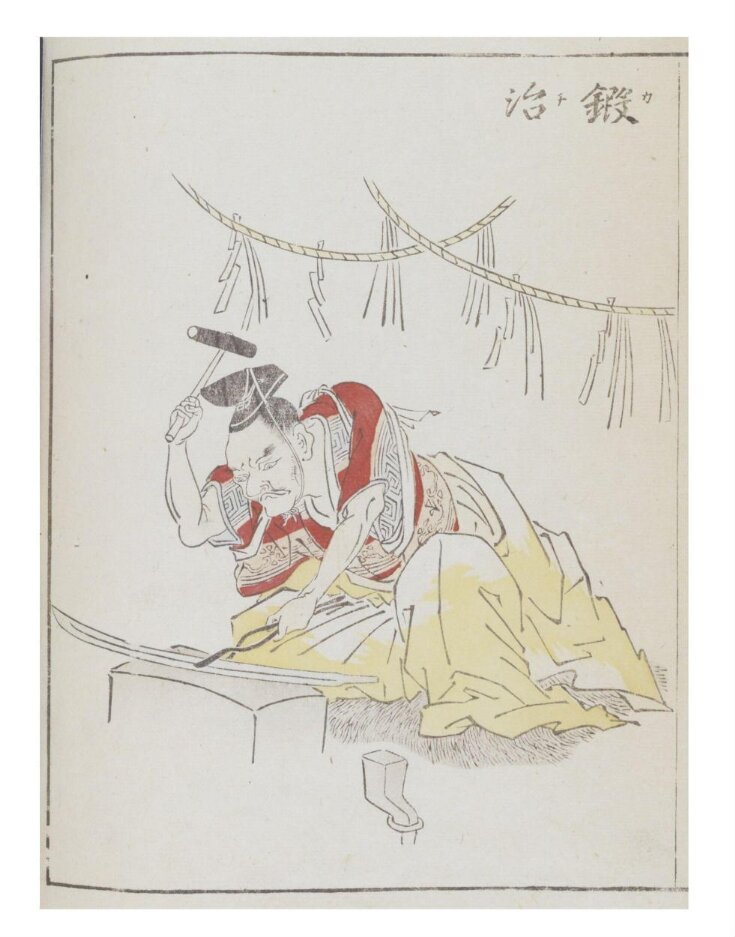
Saiga Shokunin Burui: A Swordsmith Forging a Blade
彩画職人部類
1784 (reprint of 1770 original)
Woodblock and stencil print (kappa-zuri) on paper