
Saiga Shokunin Burui (Various Classes of Artisans in Colored Pictures)
彩画職人部類
- Date:
- 1770
- Medium:
- Woodblock-printed book; 2 vols.; kappa-zuri (stencil printing)
- Source:
- Art Institute of Chicago
Description
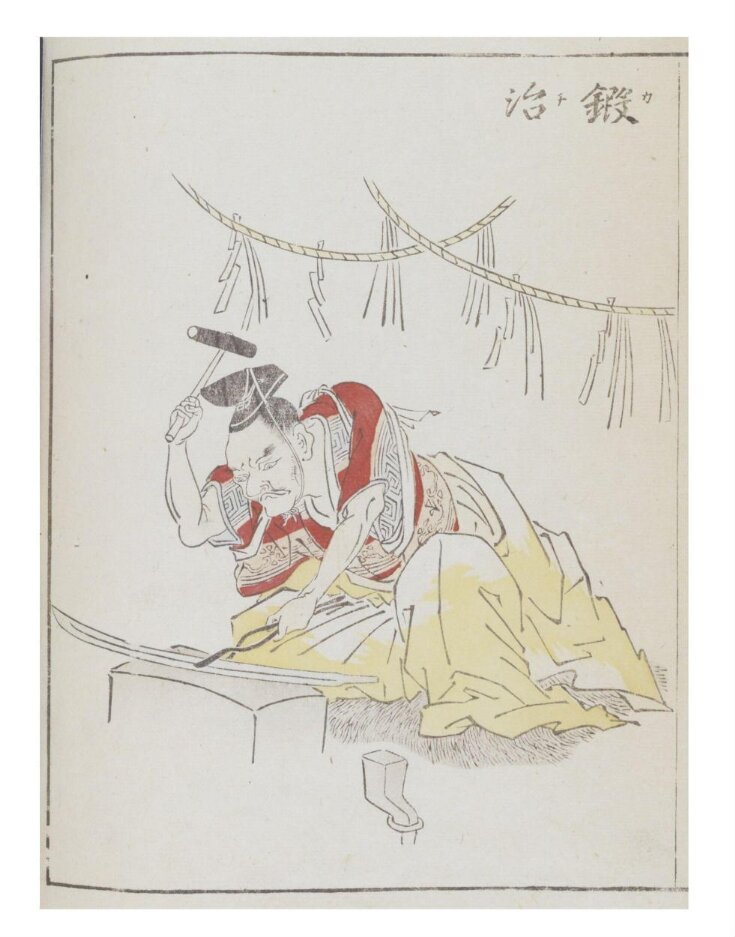
Held in the Art Institute of Chicago and dated 1770, Saiga shokunin burui (彩画職人部類, Various Classes of Artisans in Colored Pictures) is Tachibana Minkō's principal achievement and one of the most technically distinctive color-printed books of the eighteenth century. Issued in two volumes through the publisher Tōrindō Suwaraya Sahē, the work presents twenty-eight craftsmen and artisans of Edo, each depicted at his workbench surrounded by the specific tools, raw materials, and finished products of his trade. The portrayed artisans range across the urban craft economy of the late Hōreki and early Meiwa eras: a hatmaker, a mirror polisher, a carpenter, a swordsmith forging a blade in his smithy, an armorer, a bow maker, a cord maker, a weaver, a papermaker, a lacquerer, and many others, with each composition organized to give the artisan dignified central placement amid the precisely observed paraphernalia of his profession. Accompanying texts identify each craft and frequently include verses or descriptive passages. As social documentation, the Saiga shokunin burui belongs to the shokunin-zukushi (gathering of artisans) tradition stretching back to medieval handscrolls, but Minkō's version is distinguished both by the ethnographic precision of its tool-and-workshop observation and by its chromatic execution through kappa-zuri stencil printing. Unlike the contemporary multi-block nishiki-e being perfected by Suzuki Harunobu in Edo, kappa-zuri achieved its polychrome effects by brushing or pouncing colors through hand-cut paper stencils onto a sumi-printed base sheet, producing flat, even color areas of remarkable subtlety. The Saiga shokunin burui represents what specialists generally consider the technical pinnacle of the kappa-zuri printed book. The Art Institute of Chicago example, from the Frederick W. Gookin Collection, preserves the first 1770 edition.
More Prints by Tachibana Minkō

Frequently Asked Questions
Saiga Shokunin Burui (Various Classes of Artisans in Colored Pictures) (彩画職人部類) was created by Tachibana Minkō (橘岷江) in 1770.