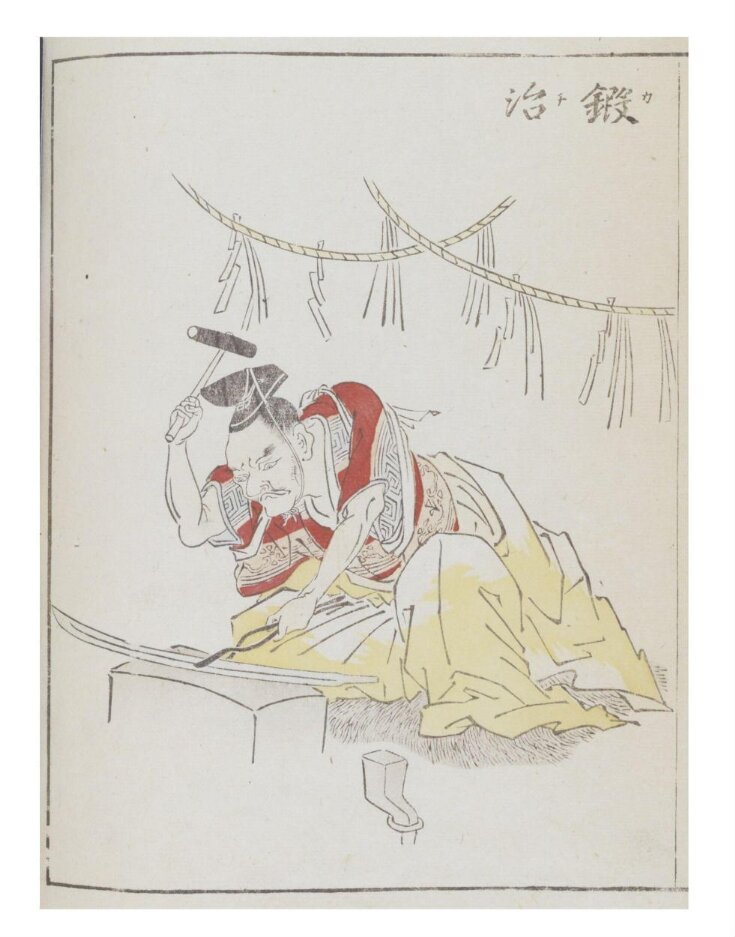
Saiga Shokunin Burui: A Swordsmith Forging a Blade
彩画職人部類
- Date:
- 1784 (reprint of 1770 original)
- Medium:
- Woodblock and stencil print (kappa-zuri) on paper
- Source:
- Victoria and Albert Museum
Description
Held in the Victoria and Albert Museum and dated 1784, this page from the second printing of Saiga shokunin burui depicts a swordsmith forging a blade in his smithy, one of the most arresting plates in Minkō's twenty-eight-artisan series. The swordsmith (katanakaji) was among the most prestigious artisans of Edo Japan, his craft tied to the warrior identity of the samurai class and the ritual purity demanded of blade-making. Minkō's composition shows the smith and his assistants at the forge, hammering the glowing heated steel on the anvil through the repeated folding and forging that distinguished Japanese sword construction, with the smithy's tools, the bellows, the water trough, and the racked finished blades all carefully delineated around the central act. The 1784 (Tenmei 4) edition was issued from newly cut blocks after the original 1770 plates had presumably worn from earlier impressions, and it preserves the kappa-zuri color application that defines the Saiga shokunin burui as a technical achievement. The polychrome effect, in which mineral colors are pounced or brushed through hand-cut paper stencils onto a sumi-printed base sheet, produces the characteristically flat, even color areas of stencil printing, with subtle gradations that give the smithy's heated metal and quenching steam a vivid presence. The V&A example, accessioned in 1925 (E.2670-1925), provides one of the strongest extant impressions of the second-state Saiga shokunin burui and helps document the continued circulation of Minkō's masterwork through the late eighteenth century, when its scenes of urban craft labor remained a model for subsequent shokunin-zukushi illustrated books.
More Prints by Tachibana Minkō


Frequently Asked Questions
Saiga Shokunin Burui: A Swordsmith Forging a Blade (彩画職人部類) was created by Tachibana Minkō (橘岷江) in 1784 (reprint of 1770 original).