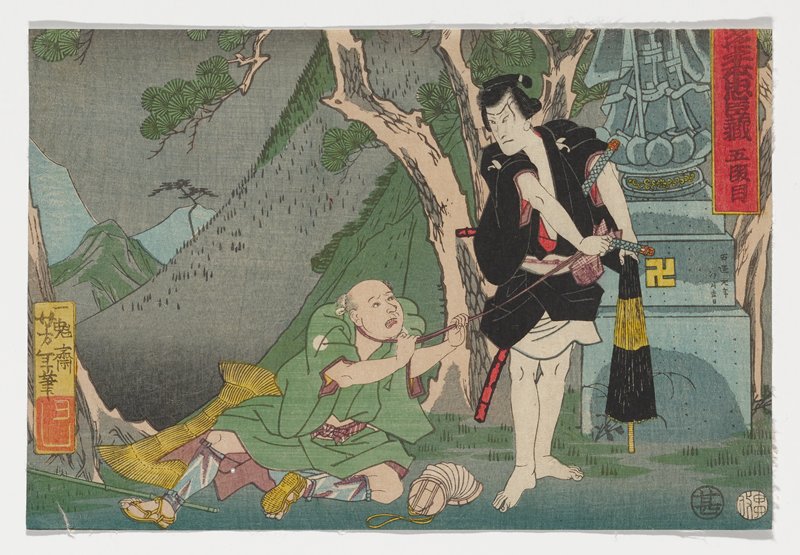
Tsukioka Yoshitoshi (月岡芳年, 1839–1892) was the last great master of traditional Japanese ukiyo-e woodblock printing, an artist whose dramatic narrative compositions bridged the twilight of the Edo-period print tradition and the dawn of modern Japanese art. Working during one of the most turbulent periods in Japanese history — the collapse of the Tokugawa shogunate, the Meiji Restoration, and the wrenching modernization that followed — Yoshitoshi transformed the declining ukiyo-e medium into a vehicle for powerful, psychologically complex imagery that continues to captivate collectors and scholars more than a century after his death. He is also recognized as a pivotal figure in the genealogy of manga and anime, his dramatic compositions and supernatural imagery having profoundly influenced the visual language of Japanese popular culture.
Born Owariya Yonejiro in Shimbashi, Edo (modern Tokyo), on April 30, 1839, Yoshitoshi came from a prosperous merchant family. His father was a well-off tradesman, and his grandfather had purchased samurai status, after which the family adopted the name Yoshioka. The young Yoshitoshi left home while fairly young to live with his uncle, Kyoya Orizaburo, a childless pharmacist who was fond of his nephew and provided a stable household during the boy's formative years. This early displacement from his birth family may have contributed to the sense of emotional turbulence that would mark both his life and his art.
In 1850, at the age of eleven, Yoshitoshi was apprenticed to the renowned ukiyo-e master Utagawa Kuniyoshi, entering one of the most vibrant and productive studios in Edo. Kuniyoshi was famous for his dynamic warrior prints, his imaginative supernatural compositions, and his love of cats, and the young Yoshitoshi absorbed his teacher's bold approach to narrative illustration with remarkable aptitude. Kuniyoshi's training methods were unusual for the time — he emphasized drawing from real life, encouraging his students to observe the world directly rather than simply copying established artistic models. He also exposed his pupils to his personal collection of Western engravings and prints, giving Yoshitoshi an early familiarity with European drawing techniques, perspective, and chiaroscuro that would later inform his own innovations. Kuniyoshi gave his apprentice the art name "Yoshitoshi" — combining the "yoshi" from his master's name with "toshi" meaning year — and the young artist published his first print at the age of just fourteen, a triptych depicting a naval battle from the Genpei wars. This precocious debut marked the beginning of a career that would span nearly four decades.
The 1860s were a period of intense creative development for Yoshitoshi, though they also coincided with the violent upheaval of the Bakumatsu era — the chaotic final years of the Tokugawa shogunate. The Boshin War of 1868–69, which pitted imperial loyalists against shogunal forces, brought armed conflict to the streets of Edo itself. The political turmoil and social chaos of this period profoundly shaped Yoshitoshi's artistic sensibility. He reportedly witnessed the aftermath of the Battle of Ueno in 1868, where imperial troops stormed the Shogitai forces at Kan'ei-ji temple, and the carnage left a lasting impression. During these years he produced the controversial "Twenty-Eight Famous Murders with Verse" (Eimei Nijuhasshuku), a collaboration with his fellow Kuniyoshi student Utagawa Yoshiiku. This series of shockingly graphic depictions of violence and bloodshed — showing decapitations, dismemberments, and murders rendered in visceral, almost hallucinatory detail — earned Yoshitoshi the nickname "Bloody Yoshitoshi" (Chi Yoshitoshi). While these prints are sometimes dismissed as sensationalist, they represented an unflinching engagement with the brutality of the era and a willingness to push the ukiyo-e tradition into emotional territory that previous artists had avoided.
Tsukioka Yoshitoshi (月岡芳年, 1839–1892) was the last great master of traditional Japanese ukiyo-e woodblock printing, an artist whose dramatic narrative compositions bridged the twilight of the Edo-period print tradition and the dawn of modern Japanese art. Working during one of the most turbulent periods in Japanese history — the collapse of the Tokugawa shogunate, the Meiji Restoration, and the wrenching modernization that followed — Yoshitoshi transformed the declining ukiyo-e medium into a vehicle for powerful, psychologically complex imagery that continues to captivate collectors and scholars more than a century after his death. He is also recognized as a pivotal figure in the genealogy of manga and anime, his dramatic compositions and supernatural imagery having profoundly influenced the visual language of Japanese popular culture.
Tsukioka Yoshitoshi was active from 1839 to 1892. They were associated with the Meiji/Taishō Prints and Ukiyo-e movements.
Tsukioka Yoshitoshi's work was shaped by the Meiji/Taishō Prints and Ukiyo-e traditions in Japanese woodblock printmaking. Meiji/Taishō Prints: Meiji and Taishō era prints (1868–1926) bridge the transition from traditional ukiyo-e to the modern shin-hanga and sosaku-hanga movements. Ukiyo-e: ## What is ukiyo-e?
Ukiyo-e ([浮世絵](/glossary/ukiyo-e)) — literally "pictures of the floating world" — is the Edo-period Japanese print and painting tradition that flourished from roughly 1660 to 1868, depicting the pleasures of urban life in Edo (modern Tokyo): courtesans, kabuki actors, sumo wrestlers, famous landscapes, and seasonal beauties.
Tsukioka Yoshitoshi's prints frequently feature figures, warriors, mythology, night scenes, portraits, kabuki.
Original prints by Tsukioka Yoshitoshi can be found in collections including Art Institute of Chicago, Harvard Art Museums, Victoria and Albert Museum, Minneapolis Institute of Art.
Last great ukiyo-e master. Moon series prints are highly sought.
The early Meiji period brought severe hardship to Yoshitoshi and the ukiyo-e world more broadly. Western printing technologies — lithography, photography, and mechanized color printing — threatened to render the traditional woodblock medium obsolete. The government actively promoted Western art and technology as part of its modernization program, and public taste shifted away from the old forms. Many ukiyo-e artists abandoned the craft or descended into poverty. Yoshitoshi himself suffered a devastating mental breakdown around 1872–73, entering a period of severe depression during which he was barely able to work. His personal circumstances were dire: he lived with his devoted mistress, Okoto, in conditions of appalling poverty. Okoto sold her own clothes and possessions to buy food and art supplies, and at one point they were reduced to burning floorboards from the house for warmth. The crisis was both personal and professional, as the art form to which he had devoted his life seemed to be dying around him.
Yoshitoshi's recovery in the late 1870s marked one of the great comebacks in art history. Changing his name to Taiso Yoshitoshi to signal a fresh start, he began rebuilding his career with renewed purpose. Rather than imitating Western techniques or retreating into nostalgia, he forged a distinctive new approach that combined the narrative power of traditional ukiyo-e with a modern psychological intensity. His compositions became more sophisticated, his palette more refined, and his treatment of human expression and emotion more nuanced than anything previously achieved in the woodblock medium. He also benefited from the rise of the newspaper industry in Meiji Japan, producing illustrations for publications including the Yubin Hochi Shimbun and the Tokyo Nichinichi Shimbun. These commissions provided both income and a new audience for woodblock imagery, and Yoshitoshi's news illustrations — depicting sensational crimes, military events, and human-interest stories — helped him reconnect with the popular market.
The masterpiece of Yoshitoshi's career is "One Hundred Aspects of the Moon" (Tsuki Hyakushi), a series of one hundred prints published between 1885 and 1892. Each print takes the moon as its thematic anchor, depicting scenes drawn from Japanese and Chinese history, mythology, literature, and folklore. The series is remarkable for its range and ambition, encompassing subjects from the mythological — the moon goddess, fox spirits, and ghosts — to the historical — famous samurai, poets, and courtesans — to the intimate — a lonely woman gazing at the moon, a farmer resting after the harvest, a fox priest performing rites beneath a lunar glow. The prints are unified by their luminous depictions of moonlight, which Yoshitoshi rendered with extraordinary sensitivity, using subtle gradations of color achieved through meticulous bokashi printing to evoke the moon's presence even when it is not directly shown. The series is widely considered the finest sustained achievement of the Meiji print tradition and one of the greatest series in the entire history of ukiyo-e.
Another major series from this final period is "New Forms of Thirty-Six Ghosts" (Shinkei Sanjurokkaisen), published between 1889 and 1892. This series, Yoshitoshi's last major work, depicts supernatural subjects drawn from Japanese folklore, kabuki theater, and historical legend. The prints combine eerie atmosphere with dramatic narrative power, depicting encounters between humans and the spirit world with a psychological intensity that transcends mere illustration. "The Ghost of Okiku at Sarayashiki" shows the spectral maid rising from the well where she drowned, her face a mask of grief and rage. "The Fox Woman Kuzunoha Leaving Her Child" captures the heartbreaking moment when a shape-shifting fox wife, her true nature revealed, bids farewell to her human son, her shadow on the shoji screen showing her vulpine form. The series was technically demanding, employing advanced techniques including burnishing, embossing, and elaborate bokashi gradations, and several of Yoshitoshi's students assisted in its preparation. The final prints were not issued until shortly after the artist's death.
Yoshitoshi also produced notable series of warriors, beauties, and contemporary subjects. His "Mirror of Beauties Past and Present" (Fuzoku Sanjuniso), published between 1888 and 1890, presents thirty-two types of women from different historical eras and social classes, each individualized through costume, pose, and expression — from Heian-era court ladies to Meiji-era women in Western dress. The series demonstrates his remarkable ability to differentiate character and period through subtle variations in posture, facial expression, and the handling of textiles. His warrior prints, drawing on the tradition of his master Kuniyoshi, depict famous samurai and historical battles with dynamic energy and meticulous attention to armor, weaponry, and the physical dynamics of combat. His kabuki triptychs from the late 1880s are among the most visually spectacular theatrical prints of the Meiji era, capturing the drama and spectacle of the kabuki stage with a vividness that made them popular as both art objects and theatrical souvenirs.
Another significant series was "Postal Newspaper Illustrations" (Yubin Hochi Shimbun), produced in the mid-1870s, which depicted sensational news stories — murders, natural disasters, acts of heroism, and supernatural occurrences — in the vivid, narrative style that Yoshitoshi had developed through his warrior and ghost prints. These newspaper illustrations played an important role in his recovery from mental illness, providing a steady income and reconnecting him with the commercial print market. They also represented an innovative adaptation of the ukiyo-e tradition to the new medium of mass journalism, demonstrating that traditional woodblock techniques could serve modern informational purposes.
Yoshitoshi's technical command of the woodblock medium was extraordinary, and he was known for his demanding standards of production quality. He insisted on supervising the carving and printing process closely, often returning proofs to the carver for correction and specifying precise color formulations for the printer. His prints from the 1880s and early 1890s represent the technical apogee of the traditional woodblock medium, employing the full range of printing techniques — multiple color blocks, metallic pigments, embossing, burnishing, and elaborate bokashi gradations — with a sophistication that no subsequent artist would match, because the traditional woodblock industry itself was dying. In this sense, Yoshitoshi's late masterpieces represent not just personal artistic achievement but the final flowering of a centuries-old craft tradition.
Yoshitoshi's relationship with his contemporaries illuminates the complex landscape of late nineteenth-century Japanese art. His closest rival in the Meiji print world was Kobayashi Kiyochika (1847–1915), who adopted Western-influenced light-and-shadow techniques (kosen-ga) to create atmospheric cityscapes and war prints. The two artists represented fundamentally different responses to the crisis facing ukiyo-e in the Meiji era. Where Kiyochika observed and documented Meiji modernization with a cool, almost journalistic eye — his night scenes of Tokyo lit by gaslight and his images of trains and steamships embraced the new Japan — Yoshitoshi looked backward to the mythological and historical traditions, infusing them with modern emotional intensity. Together, they are often described as the twin pillars of Meiji-era printmaking, each finding a way to keep the woodblock medium relevant in an age of mechanical reproduction. Ogata Gekko (1859–1920), another significant contemporary, blended ukiyo-e traditions with nihonga painting aesthetics and produced refined prints of considerable beauty, but lacked Yoshitoshi's narrative power and psychological intensity. Toyohara Kunichika (1835–1900) dominated Meiji-era actor prints and was one of the few artists who matched Yoshitoshi in productivity, but operated primarily in the kabuki genre. Yoshitoshi's unique position — as an artist who honored tradition while pushing the medium forward into psychological and compositional territory it had never explored — set him apart from all of these figures.
Yoshitoshi's personal life was marked by intense relationships and periodic instability. His devoted mistress Okoto, who had supported him through his years of poverty, eventually became his common-law wife, but the relationship was strained by his mental health episodes and financial difficulties. He also maintained close bonds with his students, several of whom went on to significant careers. Tsukinoka Kogyo, who specialized in prints of Noh theater, and Migita Toshihide, who became known for historical subjects, were among his most distinguished followers. The loyalty of his students during his periods of illness and hardship suggests that Yoshitoshi, like his master Kuniyoshi before him, inspired deep personal devotion as well as artistic admiration.
Throughout his career, Yoshitoshi worked with several publishers, most notably Akiyama Buemon, who published the "One Hundred Aspects of the Moon" series, and Sasaki Toyokichi. The artist was known for his exacting standards and his insistence on high-quality printing, often supervising the carving and printing process closely to ensure that his designs were faithfully reproduced. This attention to production quality is one of the reasons why fine impressions of his prints remain among the most visually stunning works in the ukiyo-e canon.
Yoshitoshi's mental health remained fragile throughout his later years, and he experienced periodic episodes of depression and instability. In early 1891, he invited friends to a gathering of artists that turned out to be a delusion — no such event existed. His physical condition deteriorated, and his misfortune was compounded when all of his money was stolen in a robbery. After further symptoms, he was admitted to a mental hospital. He eventually left in May 1892 but did not return home, instead renting rooms elsewhere. He died three weeks later, on June 9, 1892, from a cerebral hemorrhage, at the age of fifty-three.
In the art market, Yoshitoshi's prints have seen steadily growing collector interest over the past several decades, rising from relative obscurity in the mid-twentieth century to become among the most sought-after works in the ukiyo-e field. Individual prints from the "One Hundred Aspects of the Moon" series regularly sell for between $5,000 and $50,000 depending on subject and condition, with exceptional impressions of the most desirable subjects commanding even higher prices. His "Thirty-Six Ghosts" prints and large-format warrior triptychs are similarly sought after. A triptych sold at Christie's New York for $47,880 in 2023. The growing appreciation for Yoshitoshi's work has been driven in part by major museum exhibitions, including retrospectives at the Los Angeles County Museum of Art, the Museum of Fine Arts Boston, and the Art Gallery of New South Wales in Sydney, which have introduced his dramatic imagery to new audiences. The publication of John Stevenson's comprehensive catalogue "Yoshitoshi's One Hundred Aspects of the Moon" (1992) and subsequent scholarly studies have also elevated his critical standing.
Yoshitoshi's works are held in major collections worldwide, including the Los Angeles County Museum of Art, the Museum of Fine Arts Boston, the Metropolitan Museum of Art, the British Museum, the Art Gallery of New South Wales, the Machida City Museum of Graphic Arts in Tokyo, and the Hagi Uragami Museum in Yamaguchi Prefecture. Major exhibitions have been devoted to his work at institutions on multiple continents.
The legacy of Tsukioka Yoshitoshi is that of an artist who refused to let a great tradition die without a final, magnificent flowering. At a time when ukiyo-e was dismissed as a commercial relic, Yoshitoshi demonstrated that the woodblock print could be a medium for serious artistic expression — psychologically complex, technically innovative, and emotionally powerful. His influence extends far beyond the print world into the mainstream of Japanese popular culture. Manga artists and anime creators frequently cite his dramatic compositions and supernatural imagery as foundational inspirations. Kazuo Koike and Goseki Kojima's influential manga "Lone Wolf and Cub" draws directly on his visual language, and the bloody intensity of his muzan-e prints has influenced artists including Suehiro Maruo and Shintaro Kago. His combination of traditional Japanese narrative subjects with modern psychological depth and technical virtuosity created a bridge between the old world of ukiyo-e and the new world of modern Japanese visual storytelling — making him not merely the last great master of one tradition but a founding figure of the next.