
Biography
Utagawa Hirokage (歌川広景), also known as Ichiyūsai Hirokage, was a late-Edo ukiyo-e print designer active in Edo (Tokyo) roughly from 1855 to 1865. He is best known for a single sustained series: the Edo meisho dōke zukushi (江戸名所道化尽, 'Comical Views of Famous Places in Edo'), a set of vertical ōban prints published by Tsujiokaya Bunsuke from 1859 to 1861. Working at the very end of the Tokugawa period, against the backdrop of the Bakumatsu years that culminated in the Meiji Restoration of 1868, Hirokage left one of the more sharply concentrated bodies of work in late ukiyo-e. He is documented as a pupil of Utagawa Hiroshige I (1797-1858), but no firm dates of birth or death survive, and almost everything known about him is reconstructed from the prints themselves.
Hirokage entered the Utagawa school late, joining Hiroshige I in the final years of the older master's life. His art name follows Utagawa-school custom in combining a character from the master's name — the 'hiro' (広) of Hiroshige — with 'kage' (景, 'view' or 'scene'), a fitting choice for a designer whose principal subject was the landscape and city-view tradition that Hiroshige had brought to its highest point. The publisher Tsujiokaya Bunsuke issued the Edo meisho dōke zukushi into an established commercial niche aimed at Edo townsmen with an appetite for views of their own city, and Hirokage's career fits squarely within it.
The Edo meisho dōke zukushi is the work for which Hirokage is overwhelmingly remembered. The series gathers some fifty vertical ōban sheets, each depicting a famous Edo location — Asakusa, Ryōgoku Bridge, Shinobazu Pond, Mannen Bridge at Fukagawa, and many more — but with the conventions of meisho-e ('famous-place pictures') systematically subverted by comic incident. Where Hiroshige's One Hundred Famous Views of Edo (Meisho Edo hyakkei, 1856-58) had presented its sites as dignified, contemplative tableaux, Hirokage stages the same kinds of locations as the settings for pratfalls, weather mishaps, and everyday mischief: a stray dog snatching a fisherman's catch, a bowl of soba upended over a passer-by's head, travelers tricked by foxes or tanuki, and gusts of wind scattering pedestrians across a bridge. The compositional vocabulary remains recognizably Hiroshige's — the vertical ōban format, the diagonal sweeps of bridge or hillside, the weather effects of rain, wind, and snow, the famous-place legend set in a cartouche — but overlaid on this template is a sustained comic humor closer to the caricature (giga) vein of the Utagawa school and the kibyōshi (comic picture-book) tradition than to Hiroshige's reserved landscapes.
The series was published over roughly three years, from 1859 to 1861, each sheet carrying its series-title cartouche, an individual title naming the Edo location, and Hirokage's signature. The prints were aimed at Edo townsmen who knew the depicted sites intimately; the comic incident on each sheet relies on the viewer's understanding of how the place ordinarily looked and how visitors ordinarily behaved there. This combination of meisho-e familiarity and comic disruption gives the series an ethnographic texture absent from more straightforward landscape sets, and it explains the appeal Hirokage's work has continued to hold for collectors interested in the social history of late-Tokugawa Edo. Sheets from the series are held by the Museum of Fine Arts, Boston, the Victoria and Albert Museum, the Ōta Memorial Museum of Art, and other major public collections.
Outside the dōke zukushi, Hirokage's surviving output is small but suggestive. He produced at least one notable triptych — the Aomono sakana gunzei daikassen no zu (青物魚軍勢大合戦之図, 'The Great Battle of the Vegetables and Fruits and the Fish'), of 1859 — a parody of a warrior battle in which an army of caricatured vegetables wages war against an army of fish, squarely in the caricature (giga) tradition that Utagawa Kuniyoshi had popularized. His Tiger of Ryōgoku of 1860, from the series True Scenes (Hirokage shinkei no uchi), reflects an interest in topical Edo entertainments such as the misemono ('sideshow') spectacles staged at Ryōgoku. Together with the dōke zukushi, these works show a designer comfortable across late-ukiyo-e modes — landscape parody, caricature, and topical reportage — with a consistent comic-vernacular voice.
Hirokage seems to have stopped designing prints by about 1865, three years before the formal end of the Tokugawa period, and his fate after that date is unknown. He left behind a tightly concentrated body of work — produced over roughly a decade and centered on a single comic series — that nevertheless occupies a distinctive position in the history of ukiyo-e. The Edo meisho dōke zukushi is one of the most sustained pieces of comic city-view printmaking in the Japanese tradition, and modern audiences have come to appreciate his sheets as a slapstick counter-history of the Edo capital just before its transformation into Meiji Tokyo; the Ōta Memorial Museum of Art devoted a 2025 exhibition to the series, showing all fifty prints together for the first time in eight years.
Key Facts
- Nationality
- 🇯🇵Japan
- Movement
- Ukiyo-e
- Works Indexed
- 11
Frequently Asked Questions
Utagawa Hirokage (歌川広景), also known as Ichiyūsai Hirokage, was a late-Edo ukiyo-e print designer active in Edo (Tokyo) roughly from 1855 to 1865. He is best known for a single sustained series: the Edo meisho dōke zukushi (江戸名所道化尽, 'Comical Views of Famous Places in Edo'), a set of vertical ōban prints published by Tsujiokaya Bunsuke from 1859 to 1861. Working at the very end of the Tokugawa period, against the backdrop of the Bakumatsu years that culminated in the Meiji Restoration of 1868, Hirokage left one of the more sharply concentrated bodies of work in late ukiyo-e. He is documented as a pupil of Utagawa Hiroshige I (1797-1858), but no firm dates of birth or death survive, and almost everything known about him is reconstructed from the prints themselves.
Utagawa Hirokage's work was shaped by the Ukiyo-e tradition in Japanese woodblock printmaking. Ukiyo-e: ## What is ukiyo-e? Ukiyo-e ([浮世絵](/glossary/ukiyo-e)) — literally "pictures of the floating world" — is the Edo-period Japanese print and painting tradition that flourished from roughly 1660 to 1868, depicting the pleasures of urban life in Edo (modern Tokyo): courtesans, kabuki actors, sumo wrestlers, famous landscapes, and seasonal beauties.
Utagawa Hirokage's prints frequently feature bridges, winter.
Original prints by Utagawa Hirokage can be found in collections including Museum of Fine Arts, Boston (via Wikimedia Commons), Ōta Memorial Museum of Art (via Wikimedia Commons), Metropolitan Museum of Art, Library of Congress (via Wikimedia Commons).
Woodblock Prints by Utagawa Hirokage (11)

Snow at Okuramae (Okuramae no yuki), from the series Edo meisho dōke zukushi (Comical Views of Famous Places in Edo)
御蔵前の雪 — 江戸名所道化尽
1859
Color woodblock print (nishiki-e)

No. 2, Shower at Ryōgoku Bridge (Ryōgoku no yūdachi), from the series Comical Views of Famous Places in Edo
江戸名所道化尽 二 両国の夕立
1859
Color woodblock print (nishiki-e)
Asakusa Onmayagashi, from the series Edo meisho dōke zukushi (Comical Views of Famous Places in Edo)
浅草 御厩河岸 — 江戸名所道化尽
1859
Color woodblock print (nishiki-e)

No. 34, Inside Sujikai Gate (Sujikai gomon uchi), from the series Comical Views of Famous Places in Edo
江戸名所道化尽 三十四 筋違御門内
1859
Color woodblock print (nishiki-e)

No. 28, View of Gomizaka in Tsumagoi (Tsumagoi Gomizaka no kei), from the series Comical Views of Famous Places in Edo
江戸名所道化尽 二十八 妻恋ごみ坂之景
1859
Color woodblock print (nishiki-e)

Shinobazu Pond (Shinobazu no ike), from the series Edo meisho dōke zukushi (Comical Views of Famous Places in Edo)
不忍の池 — 江戸名所道化尽
1859
Color woodblock print (nishiki-e)
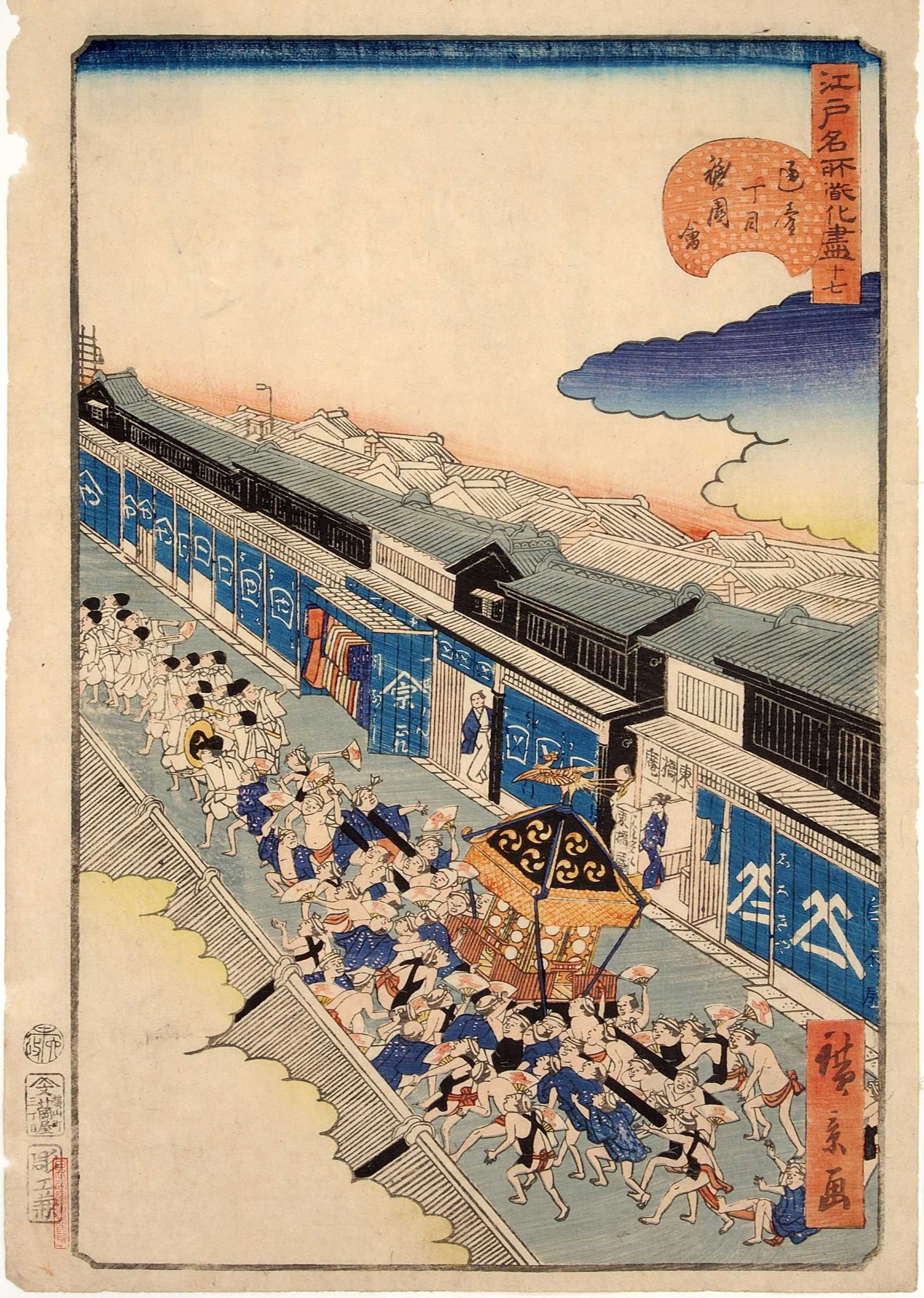
No. 17, Gion Festival at Tōri-itchōme (Tōri-itchōme Gion-e), from the series Comical Views of Famous Places in Edo
江戸名所道化尽 十七 通一丁目祇園会
1859
Color woodblock print (nishiki-e)

Dōkanyama mushi kiki (Listening to Insects at Dōkan Hill), from the series Edo meisho dōke zukushi (Comical Views of Famous Places in Edo)
道灌山虫聞 — 江戸名所道化尽
1859
Color woodblock print (nishiki-e)
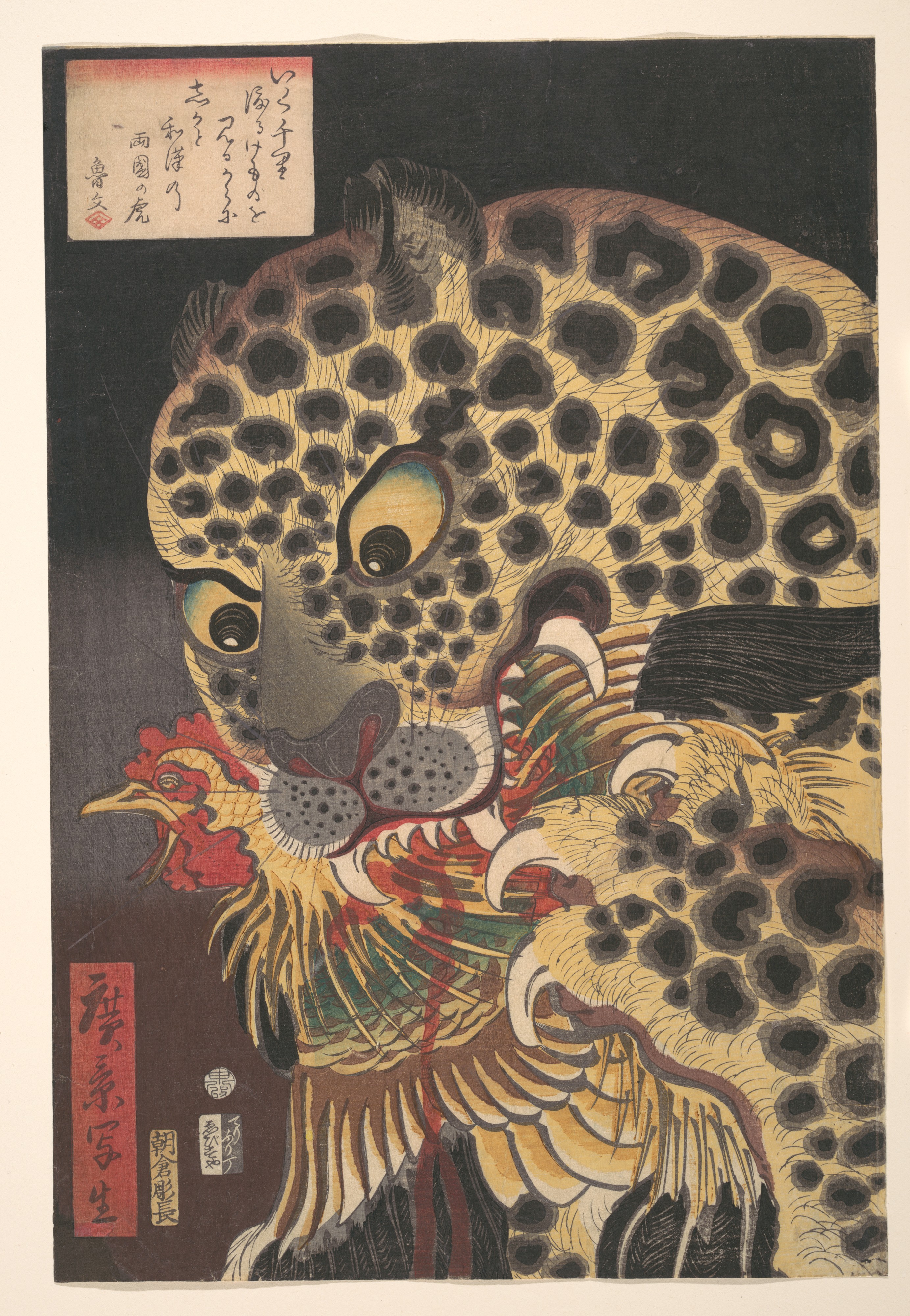
The Tiger of Ryōgoku, from the series True Scenes by Hirokage
両国の虎 — 廣景眞景之内
8th month, 1860
Color woodblock print (nishiki-e)

No. 39, Mannen Bridge at Fukagawa (Fukagawa Mannen-bashi), from the series Comical Views of Famous Places in Edo
江戸名所道化尽 三十九 深川万年橋
1860
Color woodblock print (nishiki-e)
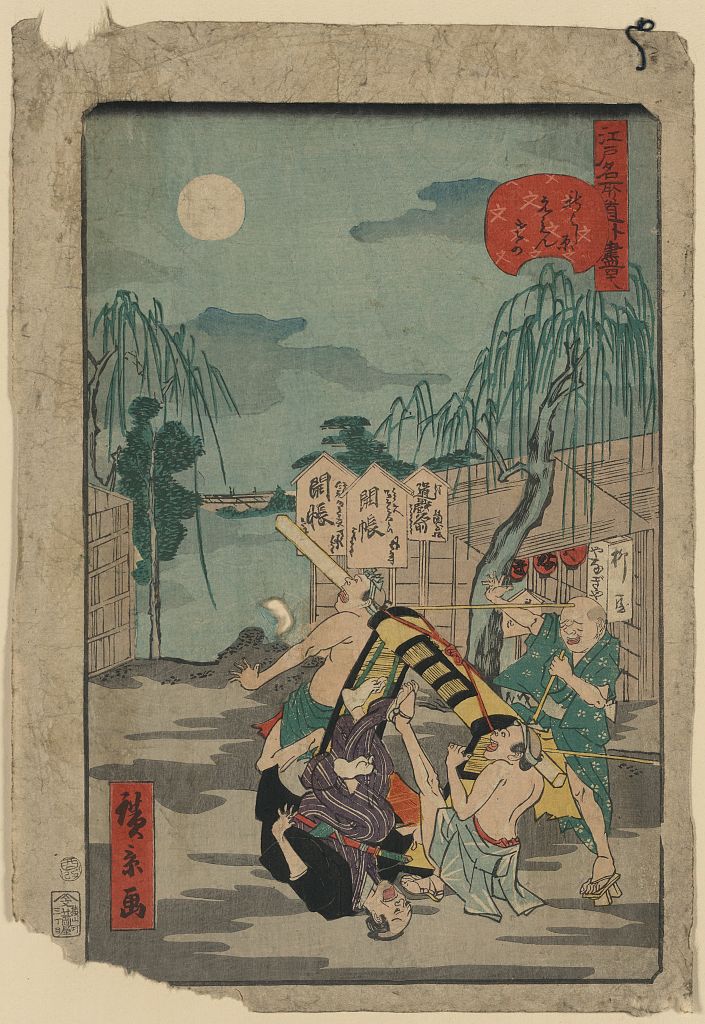
Emonzaka at Shin-Yoshiwara (Shin-Yoshiwara Emonzaka), No. 48 from the series Edo meisho dōke zukushi (Comical Views of Famous Places in Edo)
四十八 新吉原衣紋坂 — 江戸名所道化尽
1861
Color woodblock print (nishiki-e)