Biography
Utagawa Kuninao (歌川国直, 1795-1854) was a late-Edo ukiyo-e designer trained in the Utagawa school under Toyokuni I, whose career bridged the bijin-ga and yakusha-e traditions of his master with the landscape and figural ideas he absorbed during a later association with Katsushika Hokusai. Born in Shinano province (present-day Nagano), he moved to Edo in his youth and entered Toyokuni's studio, taking the gō Kuninao from the 'kuni' character that Toyokuni customarily distributed to his pupils. His earliest surviving signed surimono date to the mid-1810s, when he was still young, and they identify him as a designer working confidently in the Utagawa house manner of richly costumed female figures and theatrically posed half-length compositions.
Kuninao's career took an unusual turn when he became a follower of Katsushika Hokusai, then at the height of his renown. The exact terms of the relationship are not securely documented - Hokusai accepted pupils freely and many of his nominal students continued to work in their original house styles - but Kuninao is one of the relatively few Utagawa-school designers whose surviving work registers Hokusai's influence in identifiable ways. His landscape backgrounds gained the lower horizon line, the meticulous architectural drawing, and the calligraphic line economy of the Hokusai school, while his figure compositions retained the Utagawa preference for tall, full-bodied women in elaborate textiles. This hybrid Utagawa-Hokusai manner is most visible in his surimono, where the small format and demanding metallic and embossed printing techniques rewarded the careful drawing both schools cultivated.
Surimono in fact constitute one of the most distinctive parts of Kuninao's output, and his work is well represented in the surimono collections of the Metropolitan Museum of Art and the Art Institute of Chicago. He designed both single-sheet surimono and longer surimono series organised around literary themes, often with kyōka (witty thirty-one-syllable verse) inscriptions composed by the poets who commissioned the prints. The Harusame shū (Spring Rain Collection) album at the Met includes a Kuninao print depicting a Genroku-style courtesan - a deliberately archaising subject that displays his ability to evoke an earlier era's costume conventions through carefully studied detail. The Contest of Beauties (Bijin awase) series of about 1820 at the Art Institute applied the same exacting surimono technique to comparative beauty studies. Such prints were not produced for the open market: they were privately funded by literary circles and circulated within those networks.
Beyond surimono, Kuninao was a prolific book illustrator - a side of late-Edo print culture that has historically attracted less collector attention than single-sheet prints but which constituted, by sheer volume, the bulk of many Utagawa designers' incomes. He produced illustrations for illustrated popular fiction, poetry anthologies, and pattern books for textile designers, including the Oatsurae Kujiraobi (1826), a colour-printed pattern book of kimono sash (obi) designs held at the Art Institute of Chicago. The Ukiyo edehon (1848) and Bijin imayō nishiki, both at the Art Institute, document his continuing book-illustration activity into the later years of his career. The volume of his book output reflects the structural realities of nineteenth-century Edo print publishing, where book commissions provided more stable income than the often speculative single-sheet print trade.
Kuninao's open-market single-sheet prints include actor portraits, bijin-ga, and occasional landscapes inflected by the Hokusai-derived attention to architectural detail. The Street Scene in the New Year Season surimono of 1814 at the Met combines calendrical-festival subject matter with a multi-figure street composition.
Kuninao died in 1854. His prints are held today in the surimono and Japanese print collections of the Metropolitan Museum of Art, the Art Institute of Chicago, the Spencer Museum of Art at the University of Kansas, and other institutions with substantial holdings of late-Edo ukiyo-e. Although he never achieved the popular fame of Kunisada or Kuniyoshi - whose actor and warrior prints dominated the Edo market of the 1830s and 1840s - his hybrid Utagawa-Hokusai manner and sustained productivity in surimono and book illustration give his work a distinctive position in the history of nineteenth-century Japanese printmaking.
Key Facts
- Active Period
- 1795–1854
- Nationality
- 🇯🇵Japan
- Movement
- Ukiyo-e
- Works Indexed
- 3
Frequently Asked Questions
Utagawa Kuninao (歌川国直, 1795-1854) was a late-Edo ukiyo-e designer trained in the Utagawa school under Toyokuni I, whose career bridged the bijin-ga and yakusha-e traditions of his master with the landscape and figural ideas he absorbed during a later association with Katsushika Hokusai. Born in Shinano province (present-day Nagano), he moved to Edo in his youth and entered Toyokuni's studio, taking the gō Kuninao from the 'kuni' character that Toyokuni customarily distributed to his pupils. His earliest surviving signed surimono date to the mid-1810s, when he was still young, and they identify him as a designer working confidently in the Utagawa house manner of richly costumed female figures and theatrically posed half-length compositions.
Utagawa Kuninao was active from 1795 to 1854. They were associated with the Ukiyo-e movement.
Utagawa Kuninao's work was shaped by the Ukiyo-e tradition in Japanese woodblock printmaking. Ukiyo-e: ## What is ukiyo-e? Ukiyo-e ([浮世絵](/glossary/ukiyo-e)) — literally "pictures of the floating world" — is the Edo-period Japanese print and painting tradition that flourished from roughly 1660 to 1868, depicting the pleasures of urban life in Edo (modern Tokyo): courtesans, kabuki actors, sumo wrestlers, famous landscapes, and seasonal beauties.
Utagawa Kuninao's prints frequently feature spring, rain.
Original prints by Utagawa Kuninao can be found in collections including Metropolitan Museum of Art.
Woodblock Prints by Utagawa Kuninao (3)
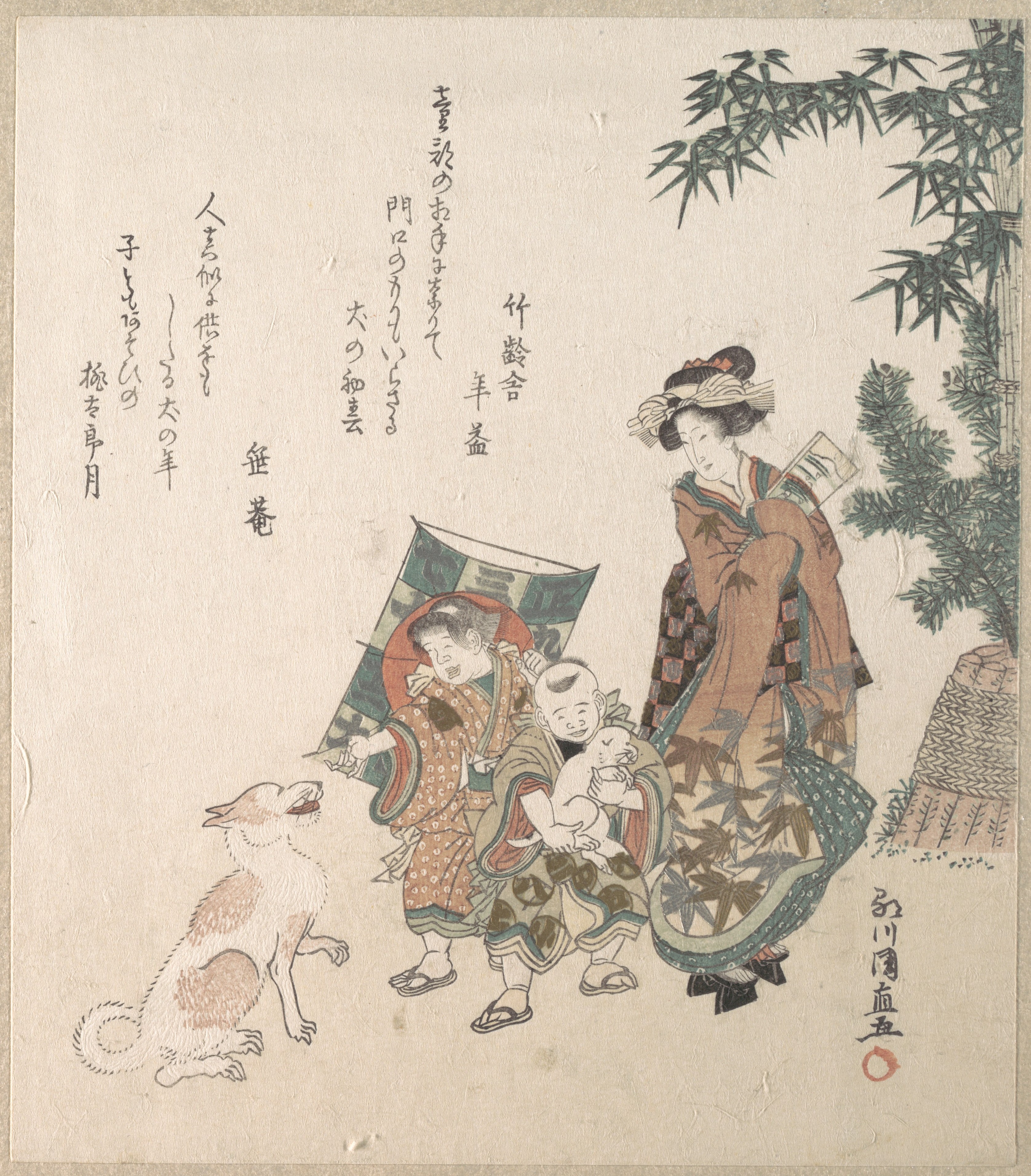
Street Scene in the New Year Season
1814
Woodblock print (surimono); ink and color on paper
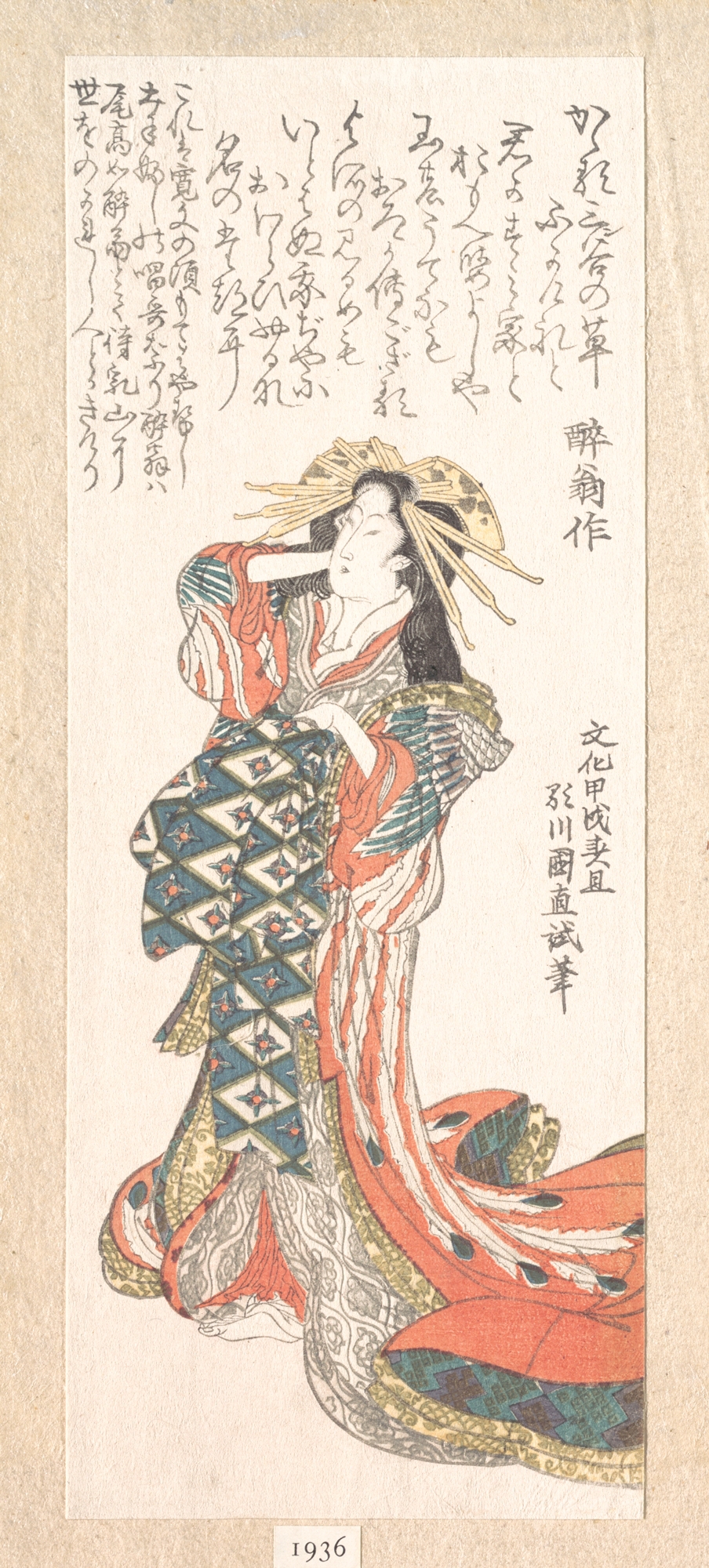
Courtesan
1814
Woodblock print (surimono); ink and color on paper
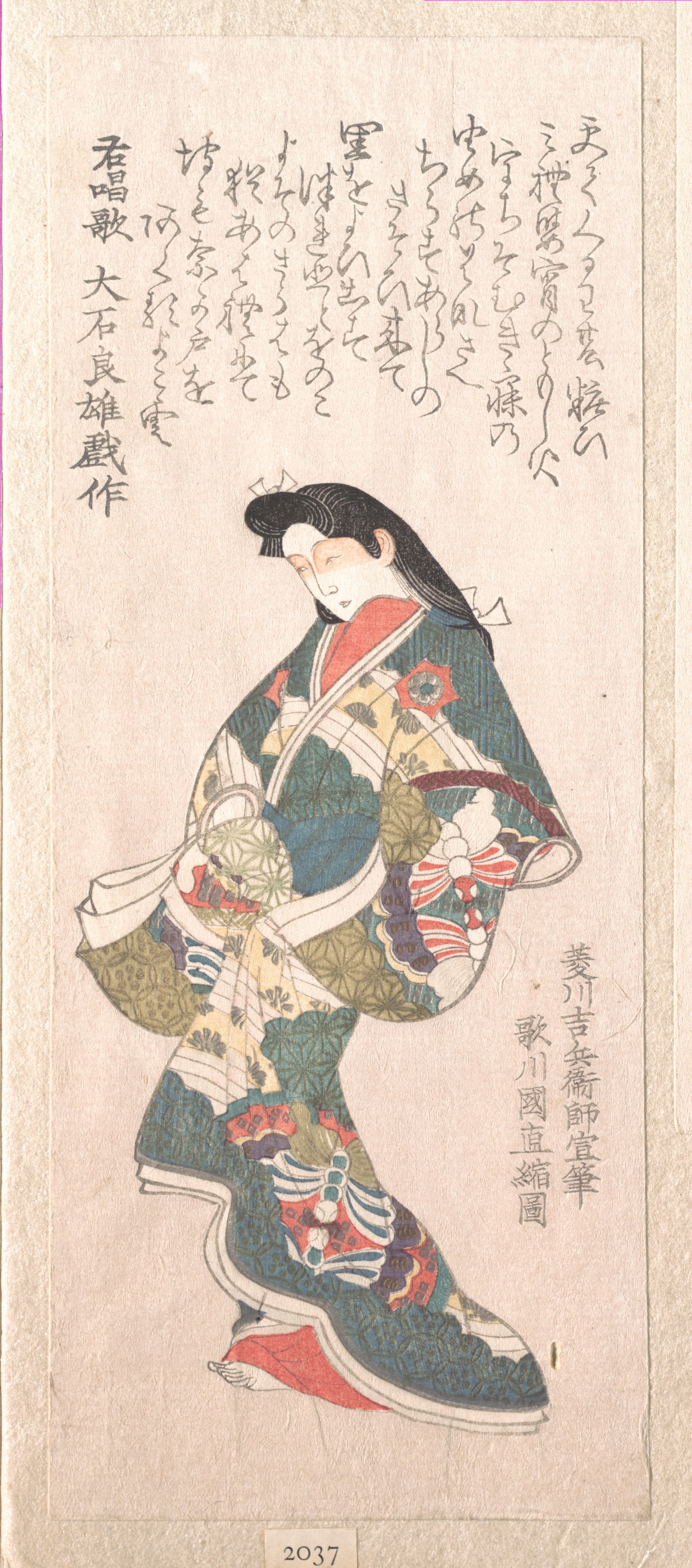
Spring Rain Collection (Harusame shū), vol. 1: Genroku-style Courtesan
probably 1810s
Privately published woodblock prints (surimono) mounted in an album; ink and color on paper