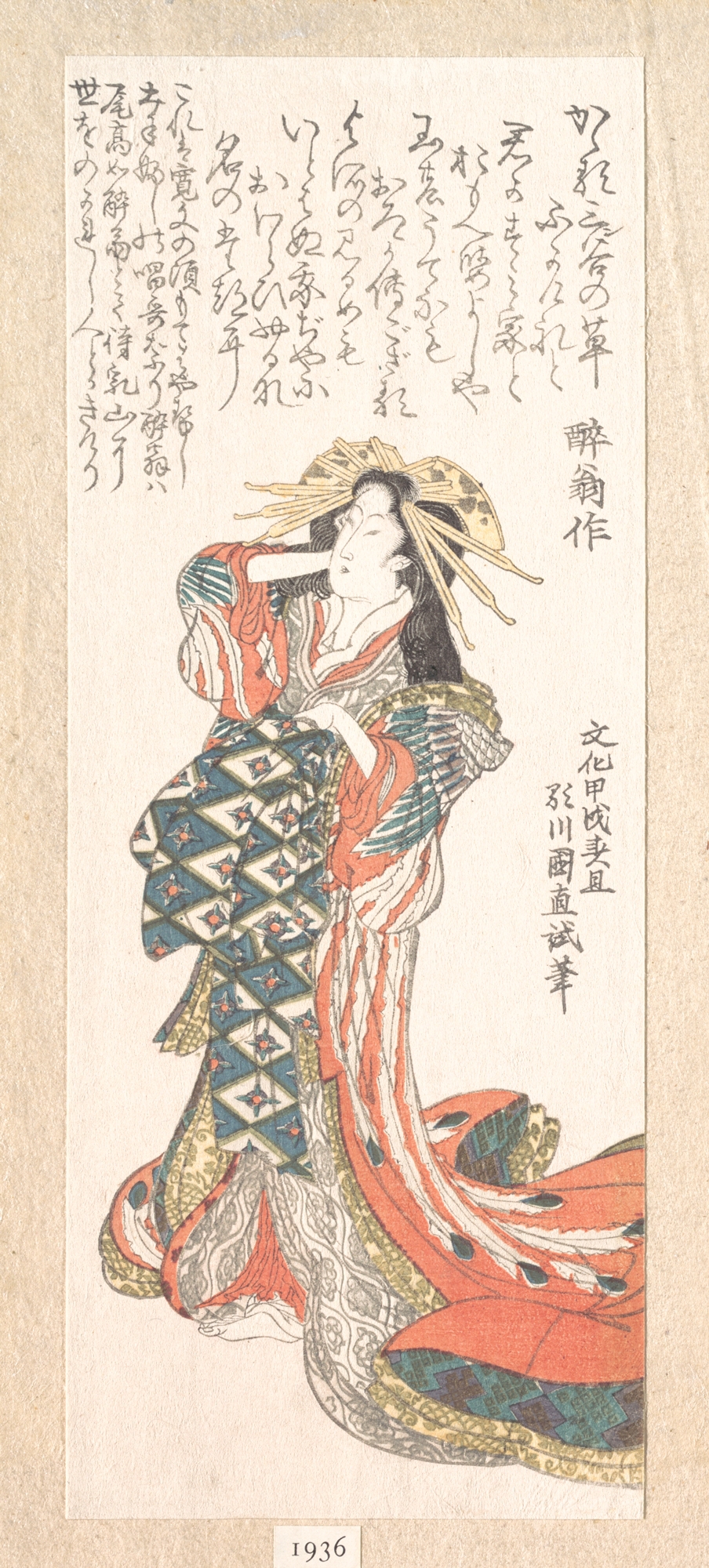
Courtesan
- Date:
- 1814
- Medium:
- Woodblock print (surimono); ink and color on paper
- Source:
- Metropolitan Museum of Art
Description
A surimono by Utagawa Kuninao of a courtesan, dated 1814 and held at the Metropolitan Museum of Art. The single-figure composition - a standing courtesan in elaborate kimono on the narrow surimono sheet - belongs to the period of Kuninao's early career, when he was still in his late teens or very early twenties and working in the bijin-ga manner he had absorbed during his Utagawa workshop training under Toyokuni I. The print's small dimensions (approximately 21 by 8.3 cm) and the inscribed kyōka verses that surimono of this kind typically carry identify it as a privately commissioned poetry-club deluxe print rather than a commercial bijin-ga. Surimono - the term means 'printed thing' but in practice designated the luxury private-commission category - employed metallic pigments, blind embossing, and densely printed colour to produce sheets whose visual richness considerably exceeded that of standard commercial single-sheet prints. The format suited educated patrons who valued the carefully drawn detail of textile pattern, hair ornament, and pose more than the bold visual signals of commercial bijin-ga. The Met's surimono holdings are among the most extensive in any Western collection. Kuninao's 1814 work places him as an active surimono designer at the start of his career, and the print typifies the Utagawa-school bijin-ga manner that would be the foundation of his later, more hybrid work after his association with Hokusai.
More Prints by Utagawa Kuninao
Frequently Asked Questions
Courtesan was created by Utagawa Kuninao (歌川国直) in 1814.