Biography
Utagawa Kunisada III (三代目歌川国貞, 1848–1920), born Takenōchi Hidehisa, was the last designer to carry the Kunisada name through the senior succession of the Utagawa school. His working life spanned the entire Meiji period (1868–1912) and the opening years of Taishō, and his prints document the long contraction of the woodblock industry as Japan modernized and photography displaced the kabuki-print market. Less celebrated than his namesakes, he remained a recognized producer of yakusha-e (actor prints), sensō-e (war prints), and Meiji genre prints into the 1900s; his work is held today at the Art Institute of Chicago, the Metropolitan Museum of Art, the Library of Congress, the British Museum, and the Museum of Fine Arts, Boston.
He entered the Utagawa studio as a young child — Western sources record that he began studying under Kunisada I around the age of ten — and trained alongside the older pupils who would carry the school's signatures forward after the master's death in the twelfth month of 1864. When Kunisada I died, the senior succession passed to Kunisada II (1823–1880); the young pupil continued under Kunisada II's instruction through the late Bakumatsu and early Meiji years. His earliest signed prints, issued from the late 1860s into the 1880s, carry the names Baidō Kunimasa (梅堂国政) and Kōchōrō Kunimasa (香蝶楼国政) — the Kunimasa line being the junior signature used by promising pupils before promotion to the senior names. The 'Kunimasa IV' designation in Western catalogues counts him as the fourth holder of that name within the Utagawa lineage.
When Kunisada II died in 1880, no immediate successor took the Kunisada name; the studio's hierarchy had loosened, and the print market itself was contracting as Meiji-era newspapers, lithography, and imported chromolithographic illustration began to displace the woodblock as the popular medium of choice. After roughly a decade of continued work under his Kunimasa name, he formally adopted the Kunisada signature around 1889, signing variously as Kunisada (国貞), Baidō Kunisada, and Kōchōrō Kunisada from that year onward. By about 1892 he had added further gō to his repertoire — Hōsai (豊斎), Kōchōrō Hōsai, Baidō Hōsai, and Utagawa Hōsai — under which much of his late actor and theater work appears. Some Japanese sources record that he eventually held the Toyokuni name as Toyokuni V (五代豊国), continuing the convention by which the senior Utagawa designer also carried the Toyokuni signature, though the Toyokuni V claim is less consistently used in Western cataloguing than for his Bakumatsu predecessors.
His output through the 1890s and 1900s sustained the school's traditional repertoire while absorbing the new subjects of the Meiji era. He continued to issue actor prints for the major Tokyo kabuki houses — Ichimura-za, Kabuki-za, Meiji-za — picturing stars such as Ichikawa Danjūrō IX, Onoe Kikugorō V, Suketakaya Kodenji, and Ichikawa Sadanji in their celebrated roles. The death of the leading Meiji kabuki actors at the turn of the twentieth century — Danjūrō IX and Kikugorō V both died in 1903 — drew from him a series of formal memorial portraits (shini-e), several of which are now held at the Art Institute of Chicago; with their funerary cartouches and posthumous Buddhist names, these prints mark the end of the great Meiji generation of the kabuki stage.
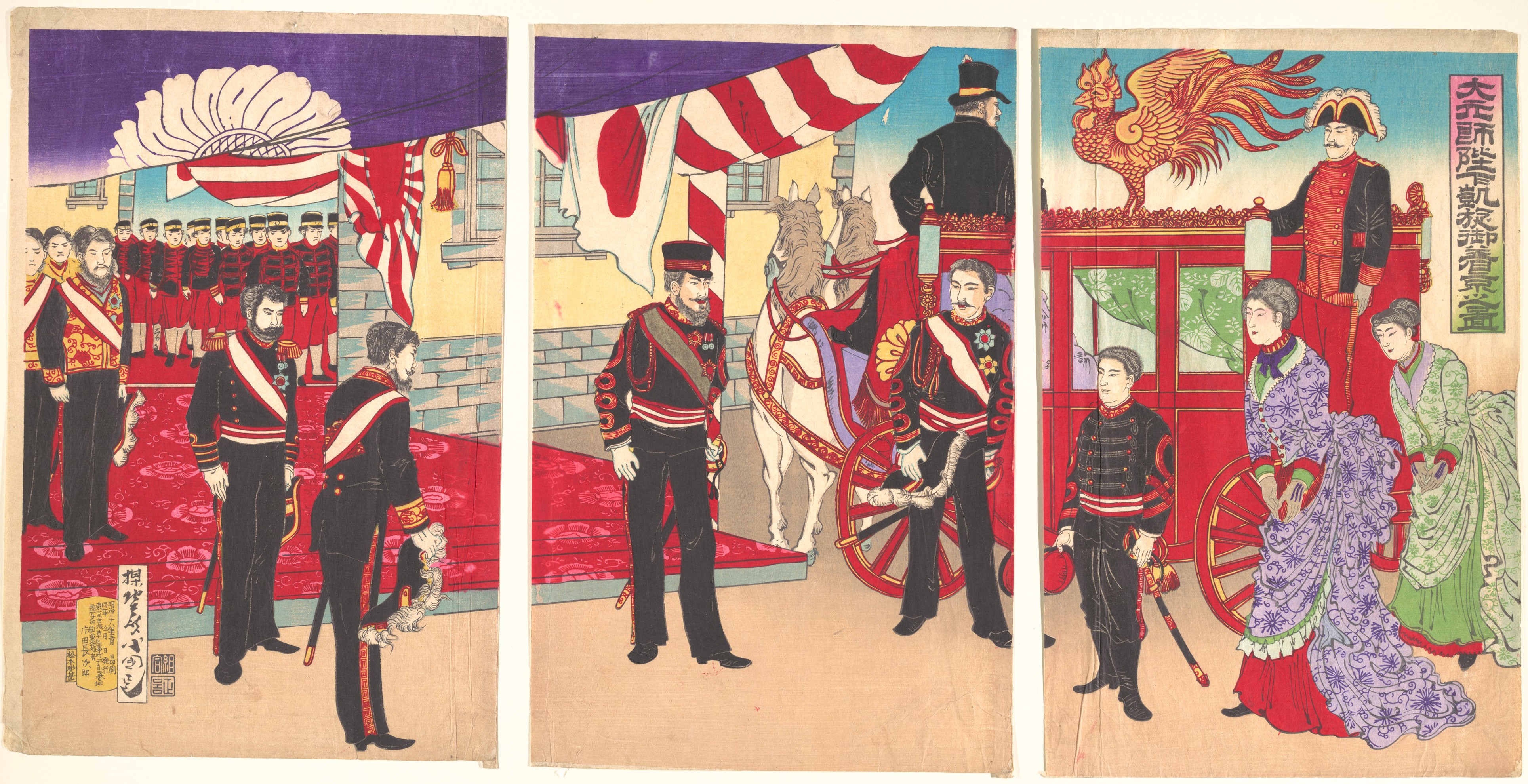
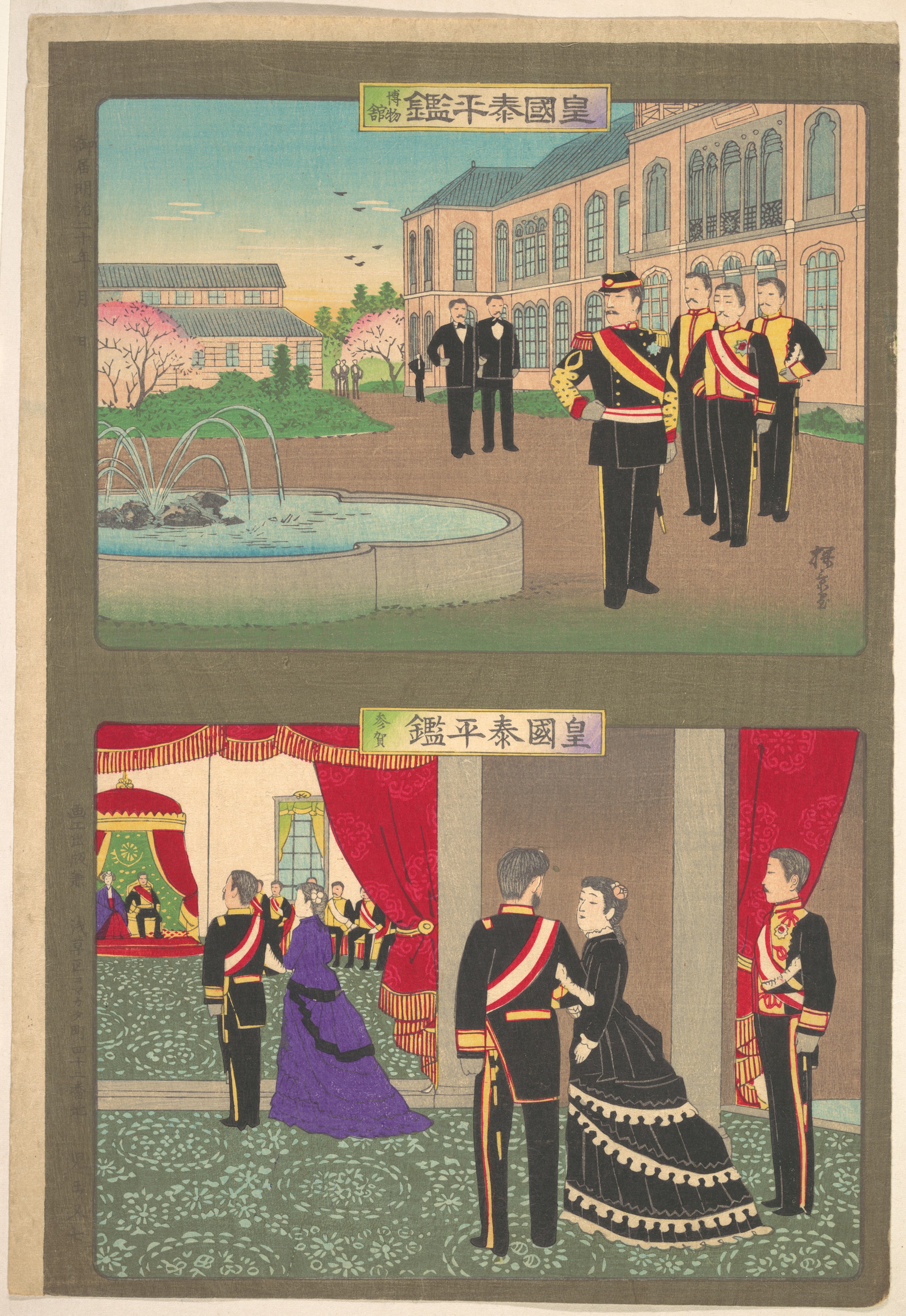
Alongside the theater work he produced sensō-e during the Sino-Japanese War of 1894–95, the first modern conflict documented across the Japanese popular print market. His triptychs of battle scenes, troop movements, and naval engagements fed an enormous public appetite for visual news, and prints of this genre by him are held at the Library of Congress and the Metropolitan Museum of Art. His 1895 print Arrival of the Emperor at Tokyo after the Victory, in the Met's collection, depicts the Meiji emperor's triumphal return to Tokyo following the war. He also worked on Meiji genre subjects — court ceremonies, the new Western-style museum buildings, the imperial family at leisure — as in the 1887 print Example of Peaceful Empire: Museum, Congratulatory Palace Visit (also Met), part of a kaika-e series celebrating Meiji-era 'civilization and enlightenment.'
He died in Tokyo in 1920, the last designer to carry the Kunisada name in the senior Utagawa line. By then the commercial woodblock industry had contracted to a small specialist market, displaced by photography and offset lithography for popular illustration and by the emerging shin-hanga movement for collector prints. His work survives across major Western collections as a documentary record of the long Meiji decline of the Utagawa school, and as a body of late actor prints, sensō-e, and Meiji genre subjects bridging the floating-world tradition of his teachers and the illustrated culture of twentieth-century Japan.
Key Facts
- Active Period
- 1848–1920
- Nationality
- 🇯🇵Japan
- Movements
- Meiji/Taishō PrintsUkiyo-e
- Works Indexed
- 2
Frequently Asked Questions
Utagawa Kunisada III (三代目歌川国貞, 1848–1920), born Takenōchi Hidehisa, was the last designer to carry the Kunisada name through the senior succession of the Utagawa school. His working life spanned the entire Meiji period (1868–1912) and the opening years of Taishō, and his prints document the long contraction of the woodblock industry as Japan modernized and photography displaced the kabuki-print market. Less celebrated than his namesakes, he remained a recognized producer of yakusha-e (actor prints), sensō-e (war prints), and Meiji genre prints into the 1900s; his work is held today at the Art Institute of Chicago, the Metropolitan Museum of Art, the Library of Congress, the British Museum, and the Museum of Fine Arts, Boston.
Utagawa Kunisada III was active from 1848 to 1920. They were associated with the Meiji/Taishō Prints and Ukiyo-e movements.
Utagawa Kunisada III's work was shaped by the Meiji/Taishō Prints and Ukiyo-e traditions in Japanese woodblock printmaking. Meiji/Taishō Prints: Meiji and Taishō era prints (1868–1926) bridge the transition from traditional ukiyo-e to the modern shin-hanga and sosaku-hanga movements. Ukiyo-e: ## What is ukiyo-e? Ukiyo-e ([浮世絵](/glossary/ukiyo-e)) — literally "pictures of the floating world" — is the Edo-period Japanese print and painting tradition that flourished from roughly 1660 to 1868, depicting the pleasures of urban life in Edo (modern Tokyo): courtesans, kabuki actors, sumo wrestlers, famous landscapes, and seasonal beauties.
Original prints by Utagawa Kunisada III can be found in collections including Metropolitan Museum of Art, Art Institute of Chicago.