
Biography
Utagawa Kuniyasu (歌川国安, 1794-1832) was a Japanese ukiyo-e print designer of the Utagawa school who worked in Edo during the Bunka (1804-1818) and Bunsei (1818-1830) eras, a generation that produced some of the most refined and decoratively elaborate prints in the history of the genre. He was a direct pupil of Utagawa Toyokuni I (1769-1825), the dominant teacher of the early-nineteenth-century Edo print world, and a fellow student of Kunisada (later Toyokuni III) and Kuniyoshi. Within that famous workshop Kuniyasu specialized chiefly in bijin-ga (pictures of beautiful women), yakusha-e (actor prints), and privately commissioned surimono, working in the lavish polychrome nishiki-e idiom that defined late-Edo print culture.
Kuniyasu was born in 1794 and given the name Yasugorō. He entered Toyokuni I's studio sometime in the 1810s and adopted the Utagawa surname together with the personal name Kuniyasu, a name constructed on the standard Utagawa-school pattern in which pupils took the first character of their teacher's name (Kuni, from Toyokuni) followed by a distinguishing second character. He also used the art names (gō) Ipposai (一鳳齋), under which many of his finest bijin-ga and surimono are signed, and occasionally Nishikawa Yasunobu. Like his Utagawa peers, Kuniyasu worked across the full range of commercial print genres while developing a personal style that became increasingly distinctive in the Bunsei decade.
His bijin-ga of the late 1810s and 1820s are among the most accomplished depictions of Edo women produced in their generation. Kuniyasu favoured the tall oban format and built his compositions around willowy, elegantly elongated female figures dressed in densely patterned robes whose surface complexity rivals anything in late-Edo printmaking. A characteristic series, the so-called untitled four-seasons set held by the Art Institute of Chicago, presents a single beauty for each season; the women stand or recline against minimal grounds, their kimono and obi rendered with the dense small-scale patterning, deep mineral pigments, and selective use of metallic and embossed surfaces that distinguish Bunsei-era nishiki-e. Such series catered to the urban Edo market for refined images of women — geisha, courtesans, and ordinary townswomen — and reflected the dominant aesthetic of Kuniyasu's mature decade.
Alongside this bijin-ga production, Kuniyasu was a busy designer of yakusha-e and kabuki-related prints. He worked in the standard Edo formats — single-sheet oban portraits and large multi-sheet horizontal compositions — and developed an unusual specialty in prints showing women holding hand-puppets dressed and made up as celebrated actors in current kabuki roles. Two such sheets from a multi-panel composition of the 1820s are preserved in the Art Institute of Chicago, depicting a woman with a puppet of Ichikawa Danjuro VII as Karigane Bunshichi and a companion sheet with a puppet of Onoe Kikugoro III as Gokuin Sen'emon. These mitate (visual parody) prints sit at a witty intersection of bijin-ga and yakusha-e, combining the beauty's elegant figure with a miniature theatrical portrait of one of the great kabuki stars of the Bunsei stage.
Kuniyasu was also a notable designer of surimono, the privately commissioned, lavishly printed greeting and commemorative cards produced for poetry circles and other Edo cultural clubs. Surimono allowed printmakers and their publishers to deploy the full range of technical effects — embossing (karazuri), metallic pigments, mica grounds (kira-zuri), and exceptionally fine block-cutting — in editions intended for connoisseurs rather than the mass market. The Metropolitan Museum of Art holds a Kuniyasu surimono, "Three Kabuki Actors Playing Hanetsuki," which depicts performers playing the traditional New Year's battledore-and-shuttlecock game and exemplifies the genre's fusion of theatrical portraiture with seasonal celebration. Long, horizontal surimono and "ladies playing instruments" compositions belong to the same world of poetry-club commissions and high-end private printing.
Kuniyasu's career was brief; he died in 1832, at the age of thirty-nine, before the great mid-century flowering of his Utagawa-school peers Kunisada, Kuniyoshi, and Hiroshige. Despite that abbreviated career he produced a substantial body of work whose technical refinement and stylistic personality have ensured his lasting reputation. His prints are held by major institutions including the Art Institute of Chicago, the Metropolitan Museum of Art, the Museum of Fine Arts Boston, the British Museum, and the Victoria and Albert Museum. For students of Bunsei-era bijin-ga and surimono, Kuniyasu stands as a representative figure of the Utagawa workshop's middle generation — the cohort that translated Toyokuni I's late style into the dense decorative idiom of the 1820s.
Key Facts
- Active Period
- 1794–1832
- Nationality
- 🇯🇵Japan
- Movement
- Ukiyo-e
- Subjects
- Autumn FoliageMount FujiSpring
- Works Indexed
- 8
Frequently Asked Questions
Utagawa Kuniyasu (歌川国安, 1794-1832) was a Japanese ukiyo-e print designer of the Utagawa school who worked in Edo during the Bunka (1804-1818) and Bunsei (1818-1830) eras, a generation that produced some of the most refined and decoratively elaborate prints in the history of the genre. He was a direct pupil of Utagawa Toyokuni I (1769-1825), the dominant teacher of the early-nineteenth-century Edo print world, and a fellow student of Kunisada (later Toyokuni III) and Kuniyoshi. Within that famous workshop Kuniyasu specialized chiefly in bijin-ga (pictures of beautiful women), yakusha-e (actor prints), and privately commissioned surimono, working in the lavish polychrome nishiki-e idiom that defined late-Edo print culture.
Utagawa Kuniyasu was active from 1794 to 1832. They were associated with the Ukiyo-e movement.
Utagawa Kuniyasu's work was shaped by the Ukiyo-e tradition in Japanese woodblock printmaking. Ukiyo-e: ## What is ukiyo-e? Ukiyo-e ([浮世絵](/glossary/ukiyo-e)) — literally "pictures of the floating world" — is the Edo-period Japanese print and painting tradition that flourished from roughly 1660 to 1868, depicting the pleasures of urban life in Edo (modern Tokyo): courtesans, kabuki actors, sumo wrestlers, famous landscapes, and seasonal beauties.
Utagawa Kuniyasu's prints frequently feature autumn foliage, mount fuji, spring.
Original prints by Utagawa Kuniyasu can be found in collections including Art Institute of Chicago, The Metropolitan Museum of Art.
Woodblock Prints by Utagawa Kuniyasu (8)

Beauty representing autumn, from an untitled series of beauties representing the four seasons
c. 1818/30
Color woodblock print; oban

Beauty representing spring, from an untitled series of beauties representing the four seasons
c. 1818/30
Color woodblock print; oban

Ladies Playing Instruments
early 19th century
Color woodblock print; long surimono
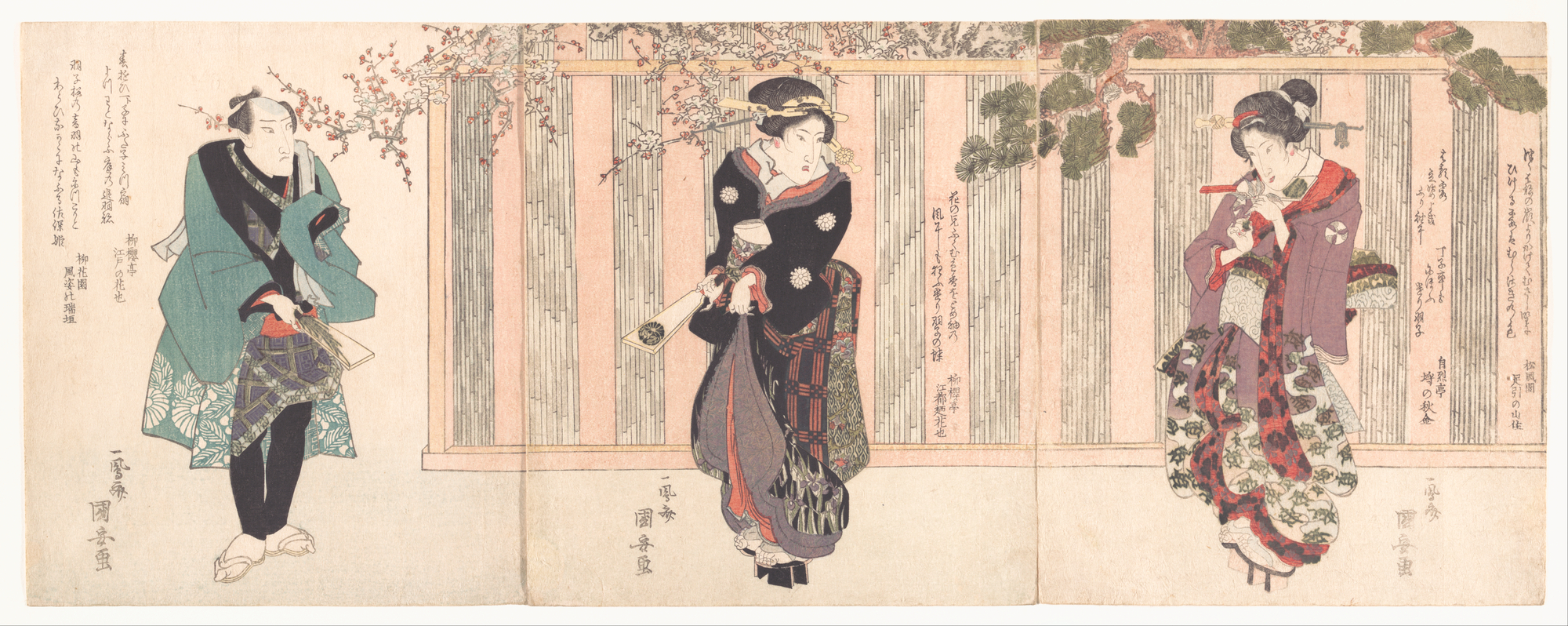
Three Kabuki Actors Playing Hanetsuki
ca. 1823
Triptych of woodblock prints (surimono); ink and color on paper

Woman holding puppet of actor Onoe Kikugoro III as Gokuin Sen'emon
c. 1820s
Color woodblock print; sheet from oban pentaptych

Segawa Roko as a courtesan
early 19th century
Color woodblock print

The actor Fujikawa Tomokichi II as Okaru, wife of Kanpei
early 19th century
Color woodblock print; oban
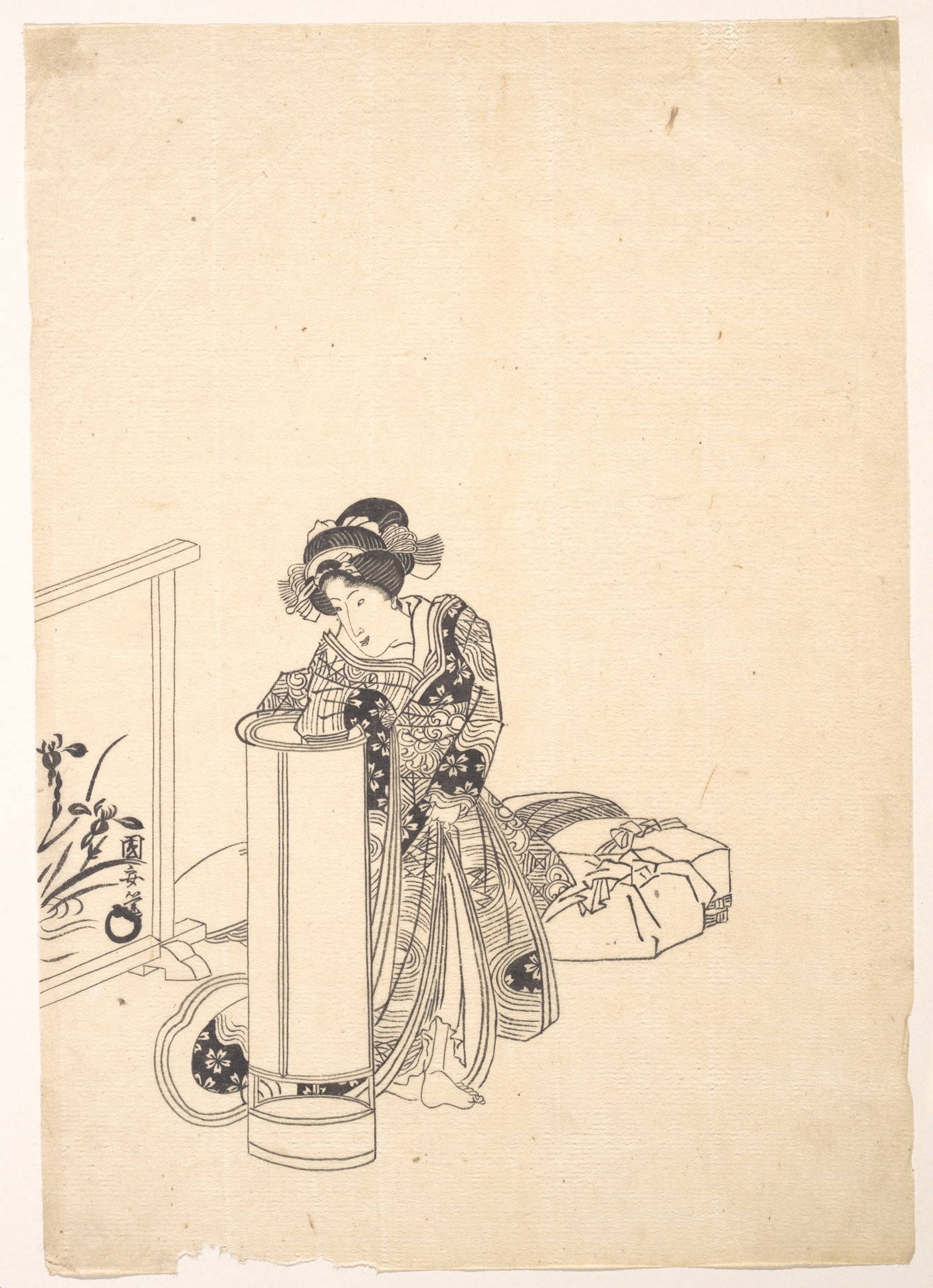
Young Woman Leaning over a Tall Lamp
early 19th century
Monochrome woodblock print; ink on paper