Biography
Yamada Keichū (山田敬中, 1868–1934) was a Meiji-Taishō nihonga painter whose career bridged the ukiyo-e and Maruyama-Shijō studio traditions of the late Edo period and the institutional reorganization of Japanese painting that defined the modern era. Born in the Asakusa district of Edo (Tokyo) in 1868 — the year of the Meiji Restoration — under the personal name Chūzō, he first trained in ukiyo-e under Tsukioka Yoshitoshi before entering the studio of the Kyoto-trained naturalist Kawabata Gyokushō (1842–1913). He went on to become an early member of the Nihon Bijutsuin (Japan Art Institute), the reformist body founded by Okakura Tenshin in 1898, and worked across the principal nihonga genres of his time — kachō-e (bird-and-flower), landscape, and figural subjects — while also designing kuchi-e woodblock frontispieces for novels and literary magazines. His name remains less familiar in the West than those of his more celebrated contemporaries such as Yokoyama Taikan, Hishida Shunsō, and Shimomura Kanzan, but within the densely populated world of Meiji nihonga he was a respected professional whose works survive in Japanese and Western collections.
Keichū came of age in a Japan undergoing radical political, economic, and cultural transformation. The traditional system of artistic patronage that had supported Edo-period painters — bakufu commissions, daimyō households, urban merchant clientele — was collapsing, and a new system of state-sponsored exhibitions, government-chartered art schools, and private painting societies was rapidly taking its place. After early study with the ukiyo-e master Yoshitoshi, Keichū entered the studio of Kawabata Gyokushō, one of the most prominent transitional figures in Meiji painting. Gyokushō had trained in the Maruyama-Shijō tradition under Nakajima Raishō in Kyoto before settling in Tokyo, where he became a professor at the Tokyo School of Fine Arts and helped consolidate nihonga as a coherent national tradition. Under Gyokushō, Keichū absorbed the sketching-from-life (shasei) discipline of Maruyama-Shijō naturalism — its careful attention to birds, plants, and atmospheric landscape — while encountering the broader debates about how Japanese painting should respond to Western art that animated his teacher's generation.
Keichū was closely tied to Okakura Tenshin's circle of nihonga reformers. From the Kawabata studio he joined Okakura's Japan Youth Painting Association (Nihon Seinen Kaiga Kyōkai) in 1891, and when the Japan Painting Association (Nihon Kaiga Kyōkai) was organized in 1896 he served as one of its councilors. In 1898, when Okakura resigned from the Tokyo School of Fine Arts amid the upheaval known as the Tokyo art school incident and founded the Nihon Bijutsuin as an independent center for nihonga reform, Keichū followed him and was among the institute's founding regular members (seiin). The Nihon Bijutsuin gathered around Okakura's intellectual leadership a roster of painters — including Yokoyama Taikan, Hishida Shunsō, and Shimomura Kanzan — who would become central to twentieth-century Japanese painting, and it was in this circle that the new 'hazy style' (mōrōtai) of dissolved outlines and atmospheric color was developed in dialogue with Western naturalism.
That same year, however, Keichū's path diverged from the Tokyo avant-garde. In 1898 he took up a teaching post in the design and painting department of the Ishikawa Prefectural Industrial School and moved to Kanazawa, where he became a central figure in the founding of the Hokuriku Painting Association and remained until his return to Tokyo in 1907. Back in the capital, he exhibited at the government salons — the Bunten and later the Teiten — and after the death of his teacher Kawabata Gyokushō in 1913 he became a professor at the Kawabata Painting School.
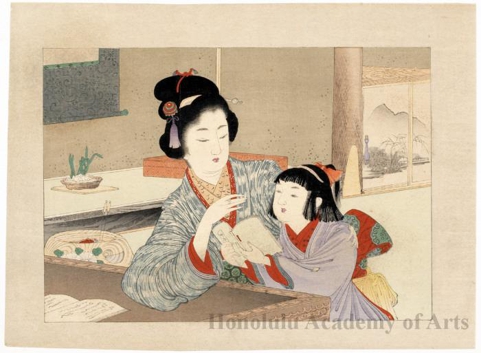
Keichū's surviving works span the principal nihonga subjects of his generation. He is known for kachō-e — birds, flowers, and small-scale natural subjects rendered in the careful observational manner of the Shijō tradition — and for landscapes, particularly mountain views and snow scenes that reflect the Meiji-Taishō nihonga fascination with the Japanese countryside. A smaller body of figural work survives, including bijin-ga (pictures of beautiful women) and genre subjects. Among the most widely circulated of his designs are the kuchi-e frontispieces he produced for late-Meiji fiction, examples of which entered Western print collections, including that of the Honolulu Museum of Art.
Keichū died in 1934, his career spanning the entire arc of Meiji and Taishō nihonga and the first years of Shōwa. By the time of his death the painting world he had entered as a young man had been transformed several times over. Today he is a minor but documented figure in the history of modern Japanese painting, his works preserved in Japanese and Western collections, and for collectors and students of the period his work offers a window into the densely populated middle stratum of Meiji-Taishō nihonga — the careful, professional painters who sustained the tradition between its more celebrated innovators.
Key Facts
- Active Period
- 1868–1934
- Nationality
- 🇯🇵Japan
- Movement
- Meiji/Taishō Prints
- Subjects
- Birds & FlowersWinter
- Works Indexed
- 8
Frequently Asked Questions
Yamada Keichū (山田敬中, 1868–1934) was a Meiji-Taishō nihonga painter whose career bridged the ukiyo-e and Maruyama-Shijō studio traditions of the late Edo period and the institutional reorganization of Japanese painting that defined the modern era. Born in the Asakusa district of Edo (Tokyo) in 1868 — the year of the Meiji Restoration — under the personal name Chūzō, he first trained in ukiyo-e under Tsukioka Yoshitoshi before entering the studio of the Kyoto-trained naturalist Kawabata Gyokushō (1842–1913). He went on to become an early member of the Nihon Bijutsuin (Japan Art Institute), the reformist body founded by Okakura Tenshin in 1898, and worked across the principal nihonga genres of his time — kachō-e (bird-and-flower), landscape, and figural subjects — while also designing kuchi-e woodblock frontispieces for novels and literary magazines. His name remains less familiar in the West than those of his more celebrated contemporaries such as Yokoyama Taikan, Hishida Shunsō, and Shimomura Kanzan, but within the densely populated world of Meiji nihonga he was a respected professional whose works survive in Japanese and Western collections.
Yamada Keichū was active from 1868 to 1934. They were associated with the Meiji/Taishō Prints movement.
Yamada Keichū's work was shaped by the Meiji/Taishō Prints tradition in Japanese woodblock printmaking. Meiji/Taishō Prints: Meiji and Taishō era prints (1868–1926) bridge the transition from traditional ukiyo-e to the modern shin-hanga and sosaku-hanga movements.
Yamada Keichū's prints frequently feature birds & flowers, winter.
Original prints by Yamada Keichū can be found in collections including Wikimedia Commons (catalog reproduction).
Woodblock Prints by Yamada Keichū (8)

Landscape III
風景 三
before 1935
Painting reproduction; ink and color on silk or paper

Flower Seller
花売り
before 1935
Painting reproduction; ink and color on silk or paper
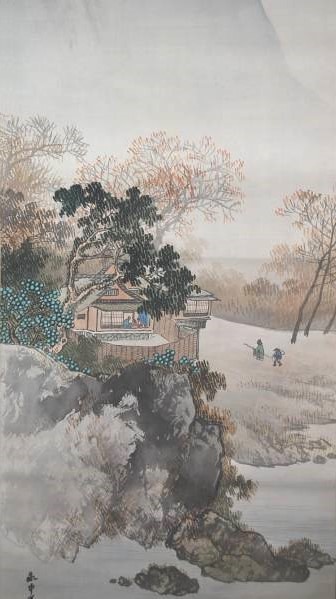
Snowy Landscape
雪景色
before 1935
Painting reproduction; ink and color on silk or paper

Mountain Landscape
山岳風景
before 1935
Painting reproduction; ink and color on silk or paper

Mountain Landscape II
山岳風景 二
before 1935
Painting reproduction; ink and color on silk or paper

Landscape IV
風景 四
before 1935
Painting reproduction; ink and color on silk or paper

Landscape
風景
before 1935
Painting reproduction; ink and color on silk or paper

Landscape II
風景 二
before 1935
Painting reproduction; ink and color on silk or paper