
Mountain Landscape
山岳風景
- Date:
- before 1935
- Medium:
- Painting reproduction; ink and color on silk or paper
Description
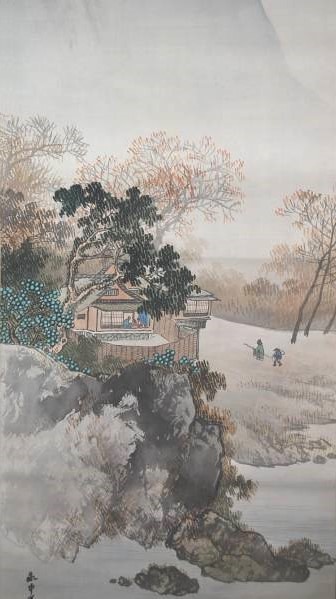
This mountain landscape (山岳風景, sangaku fūkei), preserved through an early twentieth-century catalog photograph archived on Wikimedia Commons, is one of several mountain scenes by Yamada Keichū that survive in dealer and museum documentation from the early decades of the twentieth century. The vertical composition, suited to hanging-scroll format, organizes peaks, mid-ground slopes, and foreground detail in the layered recession characteristic of classical Japanese landscape painting, while applying the shasei (sketching-from-life) discipline that defined Keichū's Shijō-school training under Kawabata Gyokushō. Mountain subjects had become a central preoccupation of late Meiji and Taishō nihonga, partly as a response to the new Meiji project of imaging the Japanese landscape as a national heritage, partly as a continuation of the older East Asian tradition of landscape as a vehicle for philosophical and aesthetic reflection. Keichū's treatment, working in the conservative naturalism of mainstream late Meiji landscape rather than the more radical atmospheric experiments of his Nihon Bijutsuin contemporaries Yokoyama Taikan and Hishida Shunsō, exemplifies the kind of carefully observed mountain scene that filled the salons of the Bunten and other exhibition venues during the Taishō period. The image survives only in catalog reproduction, but the composition and the artist's signature remain clearly legible.
More Prints by Yamada Keichū

Landscape III
風景 三
before 1935
Painting reproduction; ink and color on silk or paper

Flower Seller
花売り
before 1935
Painting reproduction; ink and color on silk or paper
Snowy Landscape
雪景色
before 1935
Painting reproduction; ink and color on silk or paper

Mountain Landscape II
山岳風景 二
before 1935
Painting reproduction; ink and color on silk or paper
Frequently Asked Questions
Mountain Landscape (山岳風景) was created by Yamada Keichū (山田敬中) in before 1935.