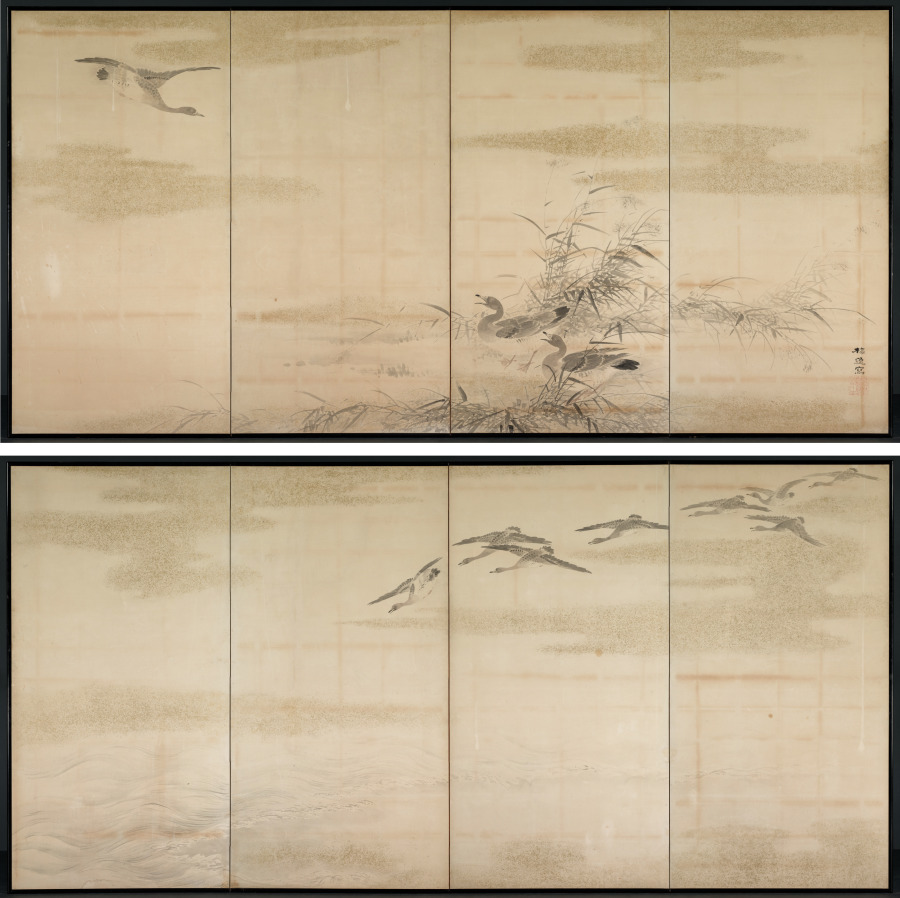
Geese, Reeds, and Water
葦雁図
- Date:
- 1800s
- Medium:
- Pair of four-panel folding screens; ink, color, and cut gold foil on paper
- Source:
- Cleveland Museum of Art
Description
Geese, Reeds, and Water is a pair of four-panel folding screens (byōbu) by Yamamoto Baiitsu in ink, color, and cut gold foil on paper, dated to the nineteenth century and held by the Cleveland Museum of Art (accession 1997.109.1 and 1997.109.2, as the pair 1997.109). The screen format, used in Japanese painting for room dividers and ceremonial occasions, allowed Baiitsu to develop the goose-and-reed subject at architectural scale: the eight panels combined extend across some four meters of wall, with wild geese in flight, on the water, and resting in reeds along the shore, set against a ground of cut gold foil (kirikane) that gives the composition the auspicious shimmer characteristic of the Japanese decorative-painting tradition. The goose-among-reeds motif (rogan), like much of Baiitsu's bird-and-flower repertoire, comes from the Chinese painting tradition, where it carries autumnal and migratory associations — the goose was the literary emblem of the seasonal traveller, the messenger of distant letters — but the gold-foil treatment situates the work within a specifically Japanese decorative idiom that Baiitsu had absorbed in Kyoto from the broader nihonga environment. The pair entered the Cleveland Museum of Art in 1997 and is one of the most important Baiitsu screens outside Japan.
More Prints by Yamamoto Baiitsu
Frequently Asked Questions
Geese, Reeds, and Water (葦雁図) was created by Yamamoto Baiitsu (山本梅逸) in 1800s.