Biography
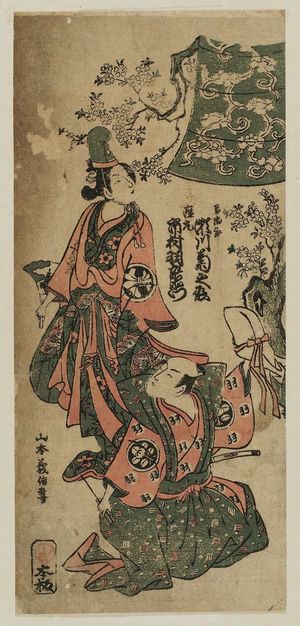
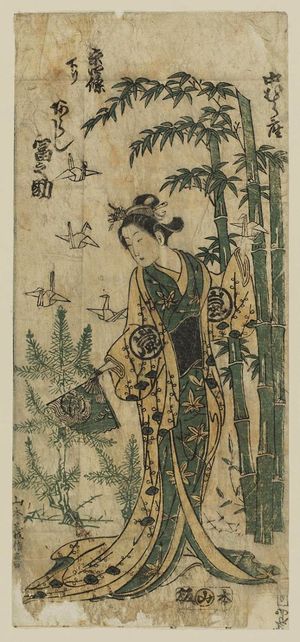
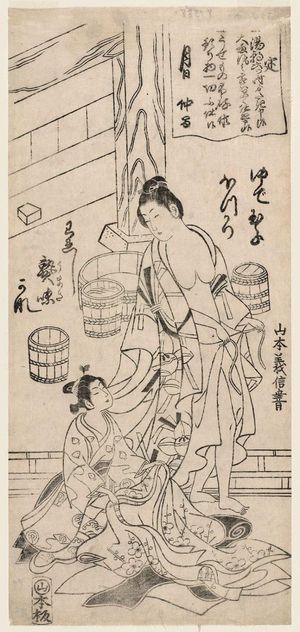
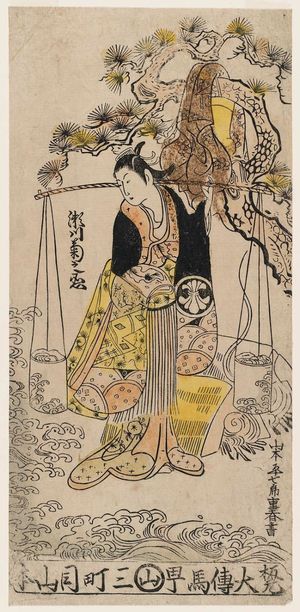
Yamamoto Yoshinobu (山本義信, active c. 1745–1758) was a mid-eighteenth-century Edo ukiyo-e designer who worked within the pictorial lineage of Nishimura Shigenaga (1697–1756). He was active during the crucial transitional decades between the hand-colored urushi-e and beni-e of the early eighteenth century and the multi-block benizuri-e of the 1740s and 1750s that immediately preceded Suzuki Harunobu's full-color nishiki-e revolution of 1765. Biographical details for Yoshinobu are sparse — neither his birth nor his death date is recorded — but his surviving prints in the Metropolitan Museum of Art, the Museum of Fine Arts, Boston, and the British Museum document an artist of refined draftsmanship with a clear specialty in the actor portrait (yakusha-e) genre that was the commercial heart of Edo's mid-century print trade.
The Nishimura affiliation places Yoshinobu within the network of artists that descended from Nishimura Shigenaga, who had been a key figure in the development of the urushi-e technique and an influential designer and teacher; among his pupils was Ishikawa Toyonobu. Within this milieu Yoshinobu appears to have specialized in single-sheet actor prints depicting the leading Kabuki performers of his active years, a period when the actor portrait was being transformed from the bold Torii-school posters of the early eighteenth century into the more intimate, naturalistic mode that would dominate the Harunobu generation. His Metropolitan Museum portrait of Onoe Kikugorō I, one of the most prominent Kabuki actors of the mid-Edo period, dates to circa 1750 and exemplifies this evolving sensibility: Yoshinobu shows the actor seated before an alcove (tokonoma) hung with a painting of him in a contrasting role, a sophisticated picture-within-a-picture device that sets the actor's two stage guises in implicit dialogue.
Yoshinobu worked at a moment when the female-role specialists (onnagata) of the Kabuki stage were among its greatest stars; the celebrated onnagata of these decades included Segawa Kikunojō I (1693–1749) and Segawa Kikunojō II (1741–1773). Actor prints of the period documented the visual conventions of mid-Edo female-role performance — the elegant draping of the long-sleeved kimono, the gestural restraint that signaled feminine grace, and the specific role iconography that allowed Edo audiences to identify a character at a glance.
Working as the print trade was technically experimenting — moving from monochrome black-line prints with hand-applied color toward the limited two- and three-block benizuri-e that dominated the 1740s and 1750s — Yoshinobu operated as a competent specialist whose surviving prints represent a small but consistent contribution to the mid-eighteenth-century actor portrait. His work has not received the scholarly attention of the major Nishimura-school figures, but the survival of his prints in major museum collections testifies to their quality and to the durability of the actor portrait market within which he worked.
Key Facts
- Nationality
- 🇯🇵Japan
- Movement
- Ukiyo-e
- Works Indexed
- 4
Frequently Asked Questions
Yamamoto Yoshinobu (山本義信, active c. 1745–1758) was a mid-eighteenth-century Edo ukiyo-e designer who worked within the pictorial lineage of Nishimura Shigenaga (1697–1756). He was active during the crucial transitional decades between the hand-colored urushi-e and beni-e of the early eighteenth century and the multi-block benizuri-e of the 1740s and 1750s that immediately preceded Suzuki Harunobu's full-color nishiki-e revolution of 1765. Biographical details for Yoshinobu are sparse — neither his birth nor his death date is recorded — but his surviving prints in the Metropolitan Museum of Art, the Museum of Fine Arts, Boston, and the British Museum document an artist of refined draftsmanship with a clear specialty in the actor portrait (yakusha-e) genre that was the commercial heart of Edo's mid-century print trade.
Yamamoto Yoshinobu's work was shaped by the Ukiyo-e tradition in Japanese woodblock printmaking. Ukiyo-e: ## What is ukiyo-e? Ukiyo-e ([浮世絵](/glossary/ukiyo-e)) — literally "pictures of the floating world" — is the Edo-period Japanese print and painting tradition that flourished from roughly 1660 to 1868, depicting the pleasures of urban life in Edo (modern Tokyo): courtesans, kabuki actors, sumo wrestlers, famous landscapes, and seasonal beauties.
Original prints by Yamamoto Yoshinobu can be found in collections including Museum of Fine Arts, Boston.