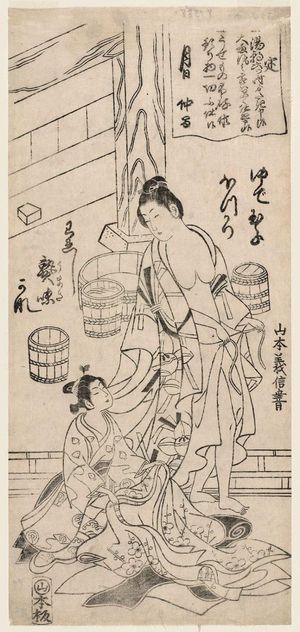
In a Public Bath House
- Date:
- 1758
- Medium:
- Hand-colored woodblock print
- Source:
- Museum of Fine Arts, Boston
Description
Held in the Museum of Fine Arts, Boston and dated to 1758, In a Public Bath House represents an unusual departure from Yamamoto Yoshinobu's typical actor-portrait subjects into the genre of the bathhouse interior, a thematic territory that had been pioneered by earlier ukiyo-e artists including Nishikawa Sukenobu and Okumura Masanobu. The Edo public bathhouse (sentō) was a central institution of urban life, serving as both a sanitary necessity in a city where private bathing facilities were rare and as a key social gathering space where neighbors met, conducted business, and exchanged news. Print designers had long recognized the bathhouse as a rich source of intimate genre subject matter, offering opportunities to depict figures in informal undress and to capture the unscripted social interactions that the public bath uniquely facilitated. Yoshinobu's composition, working within the hand-colored print mode of the mid-eighteenth century, organizes a bathhouse interior with its bathers, attendants, and architectural details into the kind of horizontally distributed grouping that mid-Edo genre prints favored. The 1758 dating places the print near the end of Yoshinobu's known active period, suggesting a late-career expansion of his subject range beyond the actor portrait that had constituted his principal commercial work. The MFA Boston example contributes both to the documentary record of Yoshinobu's mature output and to the broader iconographic tradition of the Edo bathhouse scene in mid-eighteenth-century ukiyo-e.
More Prints by Yamamoto Yoshinobu
Frequently Asked Questions
In a Public Bath House was created by Yamamoto Yoshinobu (山本義信) in 1758.