
Biography
Yuichi Hasegawa was a Japanese woodblock printmaker whose luminous, layered prints drew on Zen spirituality and the vast patterns of the natural cosmos. Born in 1945 in Aizu Wakamatsu, Fukushima Prefecture, Hasegawa came from a family of lacquer artisans, a heritage that would profoundly influence his artistic technique and aesthetic sensibility.
Hasegawa began printmaking in 1970 under the guidance of Kiyoshi Saito (1907–1997), the renowned woodblock master who was also a native of Aizu. Under Saito's mentorship, Hasegawa developed a distinctive approach to the medium that set him apart from most contemporary printmakers. Rather than carving separate blocks for each color in the traditional manner, he worked with a single block that he carved, printed, and progressively effaced through successive stages until he achieved his ideal image. This reduction technique meant that each edition was necessarily small, as the block was largely destroyed in the printing process.
Hasegawa's family background in lacquerwork gave him an intuitive understanding of surface quality and luminosity. He incorporated lacquer resin into his printing process to add a distinctive gleam to his works, and used oil-based inks that produced a rich, tactile surface with beautifully defined color and metallic effects. He printed on soft handmade paper, which he often reinforced with additional papers or by applying persimmon juice to the reverse — a technique borrowed from the stencil makers of the fabric-dyeing trade.
Drawing on the deep spirituality of Zen Buddhism, Hasegawa described his artistic vision in terms of the immense time and space of the universe arranged like a Buddhist mandala, a theme he explored alongside the many forms of creation observed in nature. He established his studio in a converted abandoned schoolhouse in rural Aizu, surrounded by the landscapes that inspired his contemplative imagery of moons, flowers, and cosmic forms.
Saito brought Hasegawa to the attention of the Tolman Collection gallery in the late 1980s, launching a long collaboration that included numerous solo exhibitions in the decades that followed. He exhibited widely in Japan and internationally, including shows in Cairo, Egypt, and Retretti, Finland, and participated in the CWAJ Print Show in Tokyo annually from 1990.
His works are held in the permanent collections of the Art Gallery of New South Wales, the Singapore National Museum, the Cincinnati Art Museum, the Museum of Arts and Crafts in Hamburg, and the Rockefeller Foundation collection, among others. Hasegawa died in 2025 at the age of eighty.
Key Facts
- Active Period
- 1945–2025
- Nationality
- 🇯🇵Japan
- Movement
- Contemporary Mokuhanga
- Works Indexed
- 16
Frequently Asked Questions
Yuichi Hasegawa was a Japanese woodblock printmaker whose luminous, layered prints drew on Zen spirituality and the vast patterns of the natural cosmos. Born in 1945 in Aizu Wakamatsu, Fukushima Prefecture, Hasegawa came from a family of lacquer artisans, a heritage that would profoundly influence his artistic technique and aesthetic sensibility.
Yuichi Hasegawa was active from 1945 to 2025. They were associated with the Contemporary Mokuhanga movement.
Yuichi Hasegawa's work was shaped by the Contemporary Mokuhanga tradition in Japanese woodblock printmaking. Contemporary Mokuhanga: Contemporary mokuhanga (literally "wood-block print") encompasses artists working from approximately 1970 to the present who continue or reinvent traditional Japanese woodblock printing techniques.
Yuichi Hasegawa's prints frequently feature abstract, religious, night scenes, landscapes, moonlight, nature.
Woodblock Prints by Yuichi Hasegawa (16)

Chamber Music 1
Woodblock print

Mirage
Woodblock print

Beautiful Early Evening
Woodblock print

Earth (in Arles)
Woodblock print

Moon Flower
Woodblock print

In the Dream
Woodblock print

Paradise
Woodblock print

Good Omen
Woodblock print

Moon at Riverside
Woodblock print
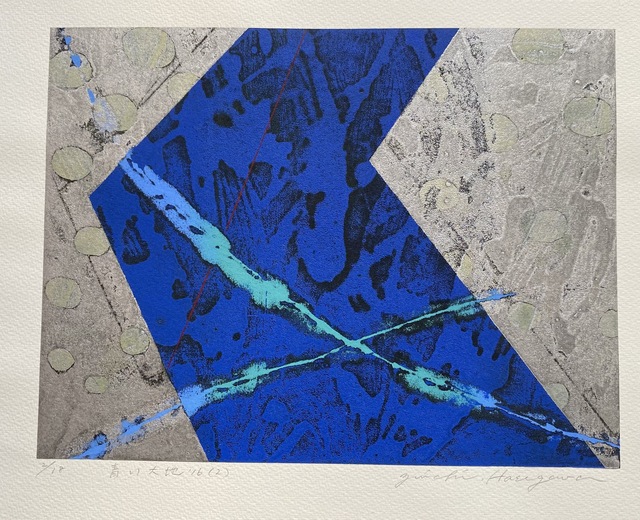
The Great Blue Earth
2016
Woodblock
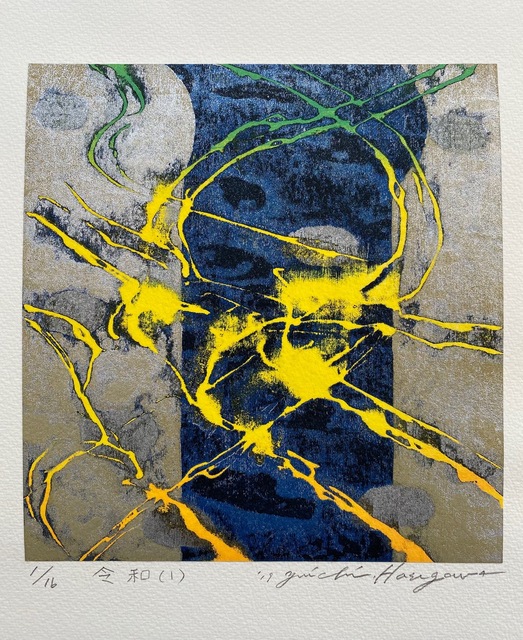
Reiwa 2
2019
Woodblock
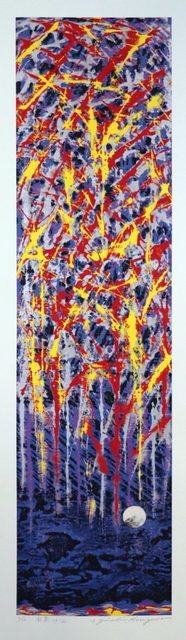
Scenery 19-2
2019
Woodblock
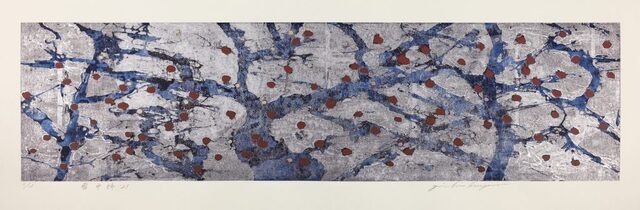
Persimmons In The Snow
2021
Woodblock

Moon Coloring 2
Woodblock print

Moon Coloring 1
Woodblock print

Close to Earth
Woodblock print