
Paradise
- Medium:
- Woodblock print
- Dimensions:
- 19 × 14 cm
- Image courtesy of
- Scriptum Inc.
Description
Paradise engages one of the central concepts of Buddhist cosmology — the Pure Land, or jōdo — through Hasegawa's abstract visual language. Rather than depicting the jeweled trees, lotus ponds, and golden light described in Pure Land sutras, Hasegawa's print would translate this ideal realm into a field of color and light: luminous passages that suggest transcendence without illustrating it literally. The choice to approach paradise abstractly reflects both his Zen training, with its skepticism toward fixed doctrinal images, and his understanding that woodblock printing's essential qualities — light passing through translucent ink, color built through layered impression — are inherently suited to evoking states of heightened awareness. The washi paper ground, with its soft luminosity, participates in the image's meaning rather than simply bearing it. The print likely employs Hasegawa's most refined gradation techniques to achieve its quality of radiant stillness.
More Prints by Yuichi Hasegawa


More Religious Prints

The Great Buddha, Kamakura (Kamakura Daibutsu)
Kamakura Daibutsu
1930
Color woodblock print

Hall of the Great Buddha (Nara Daibutsuden)
1950
Color woodblock print
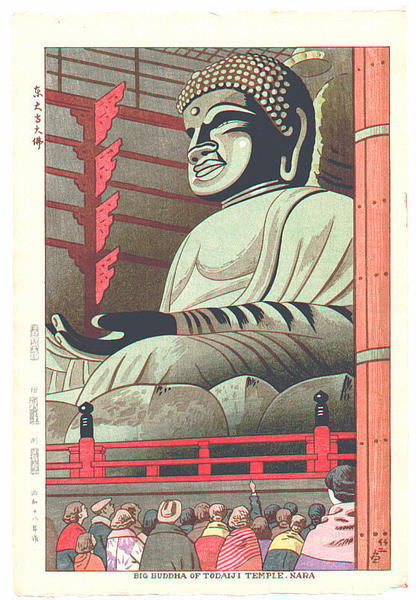
Great Buddha
大仏
Woodblock print

Clearing after a Snowfall at the Kannon Temple in Asakusa (Asakusa Kannon no yukibare), from the series "Twenty Views of Tokyo (Tokyo nijukkei)"
1926
Color woodblock print; oban
Frequently Asked Questions
Paradise was created by Yuichi Hasegawa (長谷川雄一).
Paradise depicts religious and abstract.
Paradise measures 19 × 14 cm.