
Moon at Riverside
- Medium:
- Woodblock print
- Dimensions:
- 39 × 30 cm
- Image courtesy of
- Scriptum Inc.
Description
Moon at Riverside places the recurring lunar subject of Hasegawa's practice in direct relationship with water, a pairing that has structured Japanese landscape imagery from the Heian period through the shin-hanga movement. The riverside setting grounds the celestial object in a specific terrestrial context, with the river's surface offering both reflection and contrast — the moon doubled in still water, or fragmented in current. Hasegawa's approach to moonlight differs from the descriptive rendering of Kawase Hasui or Yoshida Hiroshi in that the natural elements serve as vehicles for spiritual inquiry rather than as ends in themselves. The composition likely uses the river as a strong horizontal element against which the moon's circular form provides counterpoint. Bokashi gradations would build the tonal transitions between water, bank, and night sky characteristic of Hasegawa's atmospheric landscapes.
More Prints by Yuichi Hasegawa


More Landscapes Prints

Lake Kugushi in Wakasa Province (Wakasa Kugushiko), from the series Souvenirs of Travel I (Tabi miyage dai isshu)"
Wakasa Kugushiko
1920
Color woodblock print; oban
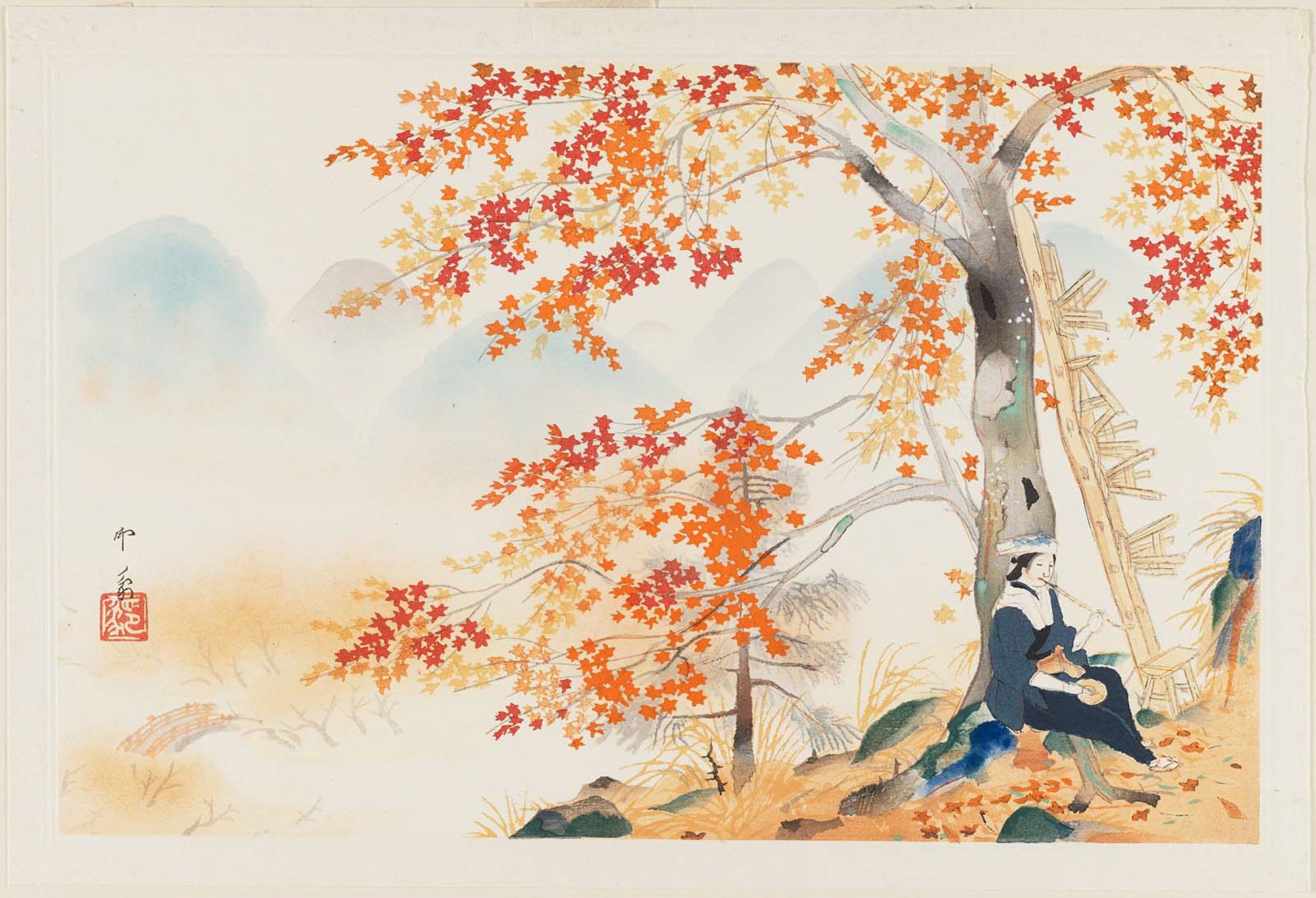
Autumn Maple Leaves at Takao, from the album Eight Views of Kyoto (Kyôto hakkei)
Woodblock print

The Beach at Kaiganji in Sanuki Province (Sanuki Kaiganji no hama), from the series "Collection of Views of Japan II, Kansai Edition (Nihon fukei shu II Kansai hen)"
1934
Color woodblock print; oban

Tea Kettle, section of a sheet from the series "Mirror of Stone Rubbings of Views of the Provinces" (Kohon meihitsu ishizuri kagami)
n.d.
Woodblock print; ishizuri-e, section of harimaze sheet
Featured in Collections
Curated cross-cuts that include this print.
Frequently Asked Questions
Moon at Riverside was created by Yuichi Hasegawa (長谷川雄一).
Moon at Riverside depicts landscapes, moonlight, and night scenes.
Moon at Riverside measures 39 × 30 cm.