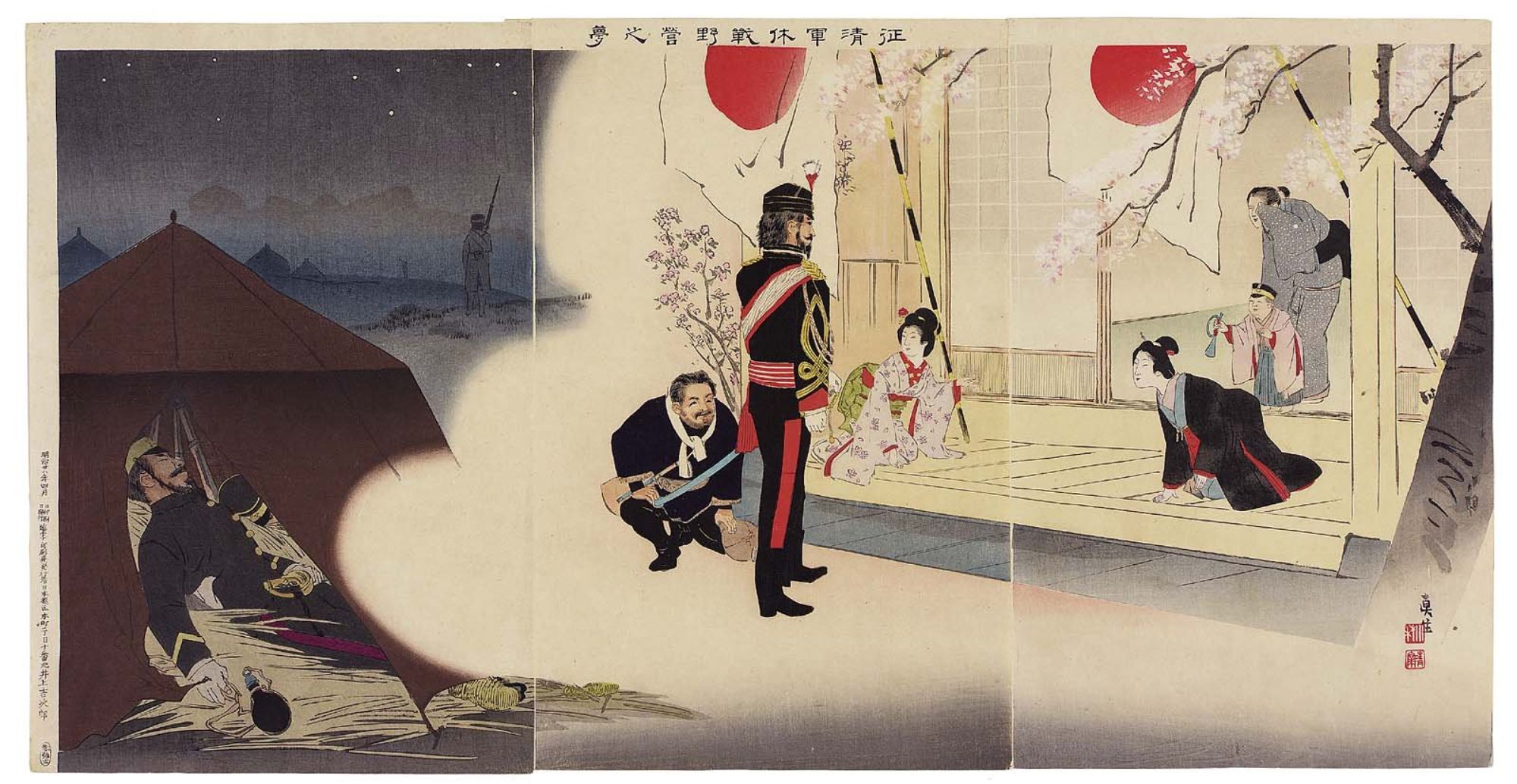
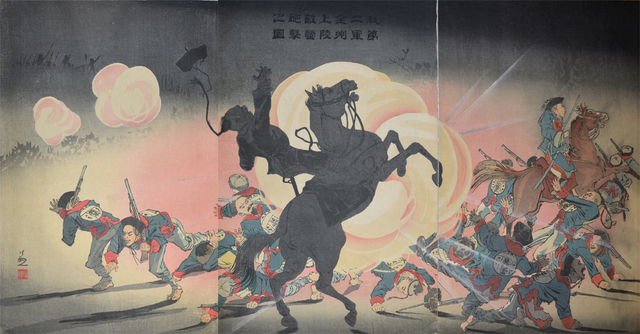
"A Soldier's Dream at Camp during a Truce in the Sino-Japanese War (Seiseigun taisen yaei no yume)"
- Medium:
- Woodblock print
- Source:
- Museum of Fine Arts Boston
- Image courtesy of
- Museum of Fine Arts Boston
Description
The full Japanese title—清征軍対戦野営の夢—translates as a soldier's dream during a camp truce in the punitive war against China, placing this print within the First Sino-Japanese War (1894–1895). The dream-sequence format has deep roots in Japanese visual culture, and Kiyochika uses it to layer a fantastical vision over the mundane reality of a military encampment. A sleeping figure at center would be surrounded by floating dream imagery—perhaps visions of home, of battle glory, or of supernatural figures—rendered in a visual register distinct from the grounded camp setting. This compositional strategy enabled war-print artists to represent the emotional and psychological interiority of soldiers, including homesickness and anxiety, while maintaining the heroic framing required of commercially distributed war imagery. Tonal differentiation between the realistic camp scene and the ethereal dream apparitions—softer outlines, lighter pigment application—would distinguish the two registers within the single composition.
More Prints by Kobayashi Kiyochika
Frequently Asked Questions
"A Soldier's Dream at Camp during a Truce in the Sino-Japanese War (Seiseigun taisen yaei no yume)" was created by Kobayashi Kiyochika (小林清親).