
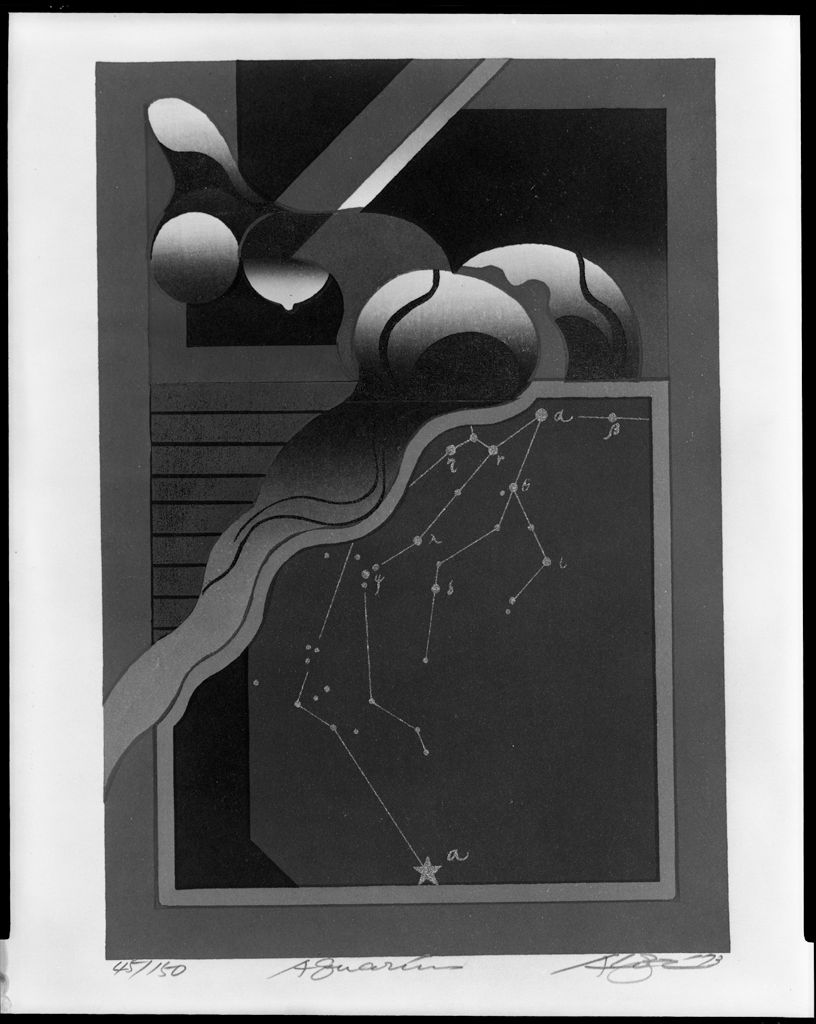
Aquarius, from the Zodiac Series, Shôwa period, circa 1973
- Source:
- ukiyo-e.org
Description
Aquarius belongs to Akira Kurosaki's Zodiac Series, a sequence of twelve mokuhanga prints produced around 1973 in which the postwar master applied the traditional Japanese woodblock medium to the cosmological motifs of the Western astrological calendar. Held in the Harvard Art Museums and cataloged via ukiyo-e.org, the print exemplifies the conceptual reach that distinguished Kurosaki from his sosaku-hanga predecessors: he was less interested in the picturesque scenery of an earlier generation than in pattern, symbol, and the visual logic of a print as a constructed object. The Aquarius composition translates the water-bearer archetype into the spare geometric vocabulary that defines Kurosaki's mature contemporary Japanese woodblock practice, with poured and rippling forms suggested through carefully registered flat planes and the soft, absorbent ink saturation that only handmade washi can hold. As with the rest of the Zodiac Series, the artist worked entirely within the self-printed mokuhanga tradition, carving his own blocks and pulling impressions by hand with a baren, so that every passage of color carries the slight tonal variation and atmospheric grain that distinguish water-based Japanese woodblock from mechanical reproduction. The print sits at an important moment in Kurosaki's career: by the early 1970s he was already exhibiting internationally and would soon help found organizations devoted to teaching mokuhanga abroad, and the Zodiac Series demonstrates the cross-cultural ambition that animated that work. Aquarius reads at once as a planetary emblem and as a study in pure printed surface, a small monumental object that argues for the contemporary relevance of one of Japan's oldest graphic arts.
More Prints by Akira Kurosaki
Featured in Collections
Curated cross-cuts that include this print.
Frequently Asked Questions
Aquarius, from the Zodiac Series, Shôwa period, circa 1973 was created by Akira Kurosaki (黒崎彰).