
Waning Moon
- Date:
- 1960
- Medium:
- Edition:
- Self-printed
- Source:
- Victoria and Albert Museum
Description
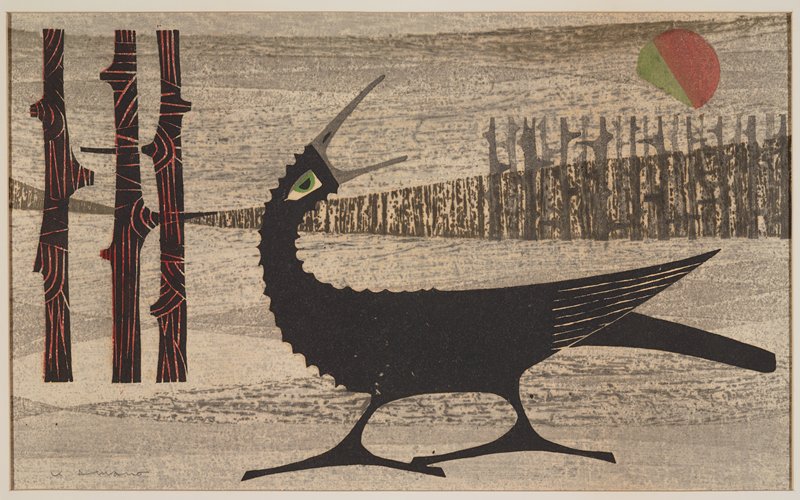
Waning Moon (1960) is an early work that shows Amano already exploring the relationship between celestial bodies and the geometric forms that would increasingly define his practice. The waning moon — tsuki no kage ni naru — occupies a liminal position in Japanese poetic tradition, associated with endings, with the decline that precedes renewal, and with the particular beauty of incompleteness. Amano renders it with the formal clarity of his developing abstract vocabulary, the crescent or gibbous shape becoming a strong compositional element within a simplified nocturnal landscape.
More Prints by Amano Kunihiro


More Moonlight Prints
![Mount Fuji on a Moonlit Night, Kawai Bridge (Tsukiyo no Fuji [Kawaibashi]), from the series "Selection of Views of the Tokaido (Tokaido fukei senshu)" by Kawase Hasui](https://www.artic.edu/iiif/2/d0960668-1e73-339a-b182-fb995a54bff0/full/843,/0/default.jpg)
Mount Fuji on a Moonlit Night, Kawai Bridge (Tsukiyo no Fuji [Kawaibashi]), from the series "Selection of Views of the Tokaido (Tokaido fukei senshu)"
1947
Color woodblock print; oban

Evening Moon at Nakanoshima, Sapporo (Sapporo Nakanoshima no yuzuki), from the series "Collection of Views of Japan, Eastern Japan Edition (Nihon fukei shu higashi Nihon hen)"
March 1933
Color woodblock print; oban

Matsushima in Moonlight (Tsuki no Matsushima)
1919
Color woodblock print

Kiyozumi Garden in Moonlight
January 1938
Woodblock print, ink and color on paper
Frequently Asked Questions
Waning Moon was created by Amano Kunihiro (天野邦弘) in 1960.
Waning Moon depicts moonlight.