
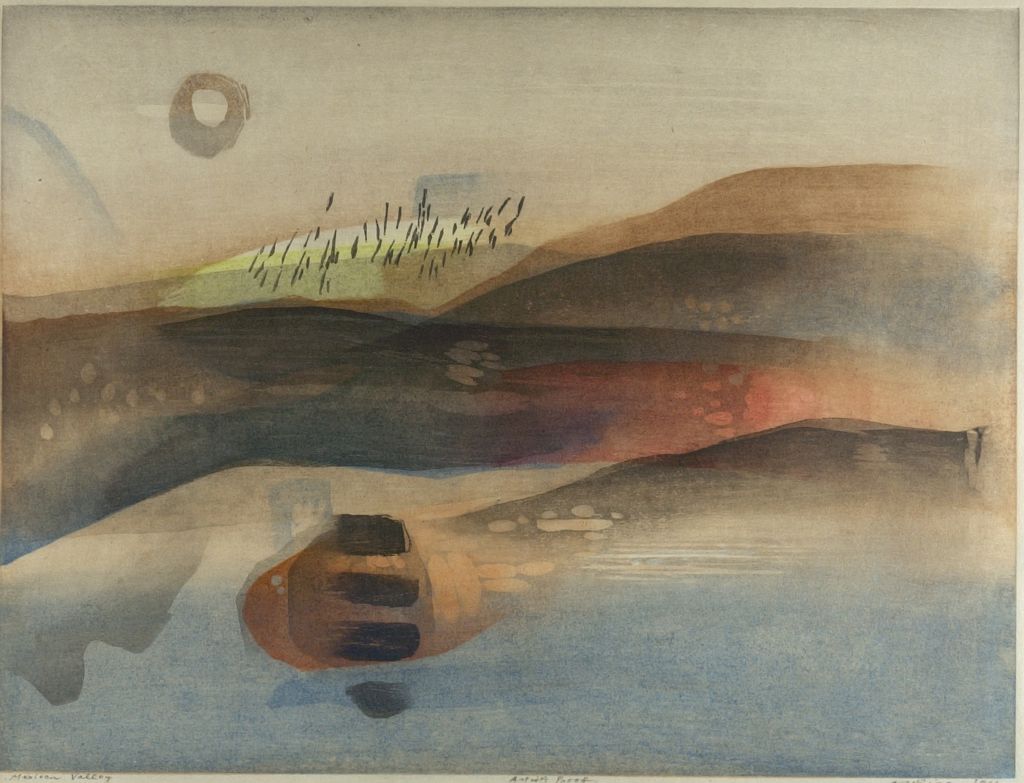
Mexican Valley (Artist's Proof), Shôwa period, 1966
by Ansei Uchima
- Source:
- ukiyo-e.org
Description
Mexican Valley, an artist's proof dated 1966 and held by the Harvard Art Museums, captures Ansei Uchima at a moment when his sosaku-hanga practice had begun absorbing landscapes far beyond the traditional Japanese subjects associated with the woodblock tradition. The print reflects Uchima's experience as a Japanese-American woodblock artist whose biography moved between continents: born in Stockton, California in 1921, he spent his formative years in Tokyo studying architecture, returned to the United States after the war, and traveled extensively from his New York base during the 1960s. A trip to Mexico provided the source material for this composition, in which the vast geometry of an arid valley is reduced to broad bands of overprinted color, the grain of the wood visible beneath layered impressions. Mexican Valley demonstrates how thoroughly Uchima had internalized the modernist vocabulary of his American contemporaries while continuing to work within the technical framework of Japanese woodblock printing. The piece belongs to the sosaku-hanga (creative print) movement, in which the artist carries out every stage of production himself, departing from the publisher-driven model of earlier ukiyo-e and shin-hanga. Uchima's wife Toshiko Uchima was likewise an artist, and the couple's New York studio became a meeting point for Japanese and American printmakers throughout this period, contributing to the cross-pollination evident in works like this one. By titling the print Mexican Valley rather than referencing a specific named location, Uchima invites the viewer to read the image less as topography and more as a meditation on light, scale, and the layered geology of an unfamiliar landscape filtered through a Japanese printmaker's eye. As an artist's proof, this impression preserves the working state Uchima used to judge color balance and registration before approving the full edition, and its survival in the Harvard Art Museums collection underscores the continuing institutional interest in his postwar contribution to Japanese-American woodblock art.
More Prints by Ansei Uchima

Featured in Collections
Curated cross-cuts that include this print.
Frequently Asked Questions
Mexican Valley (Artist's Proof), Shôwa period, 1966 was created by Ansei Uchima (内間安瑆).