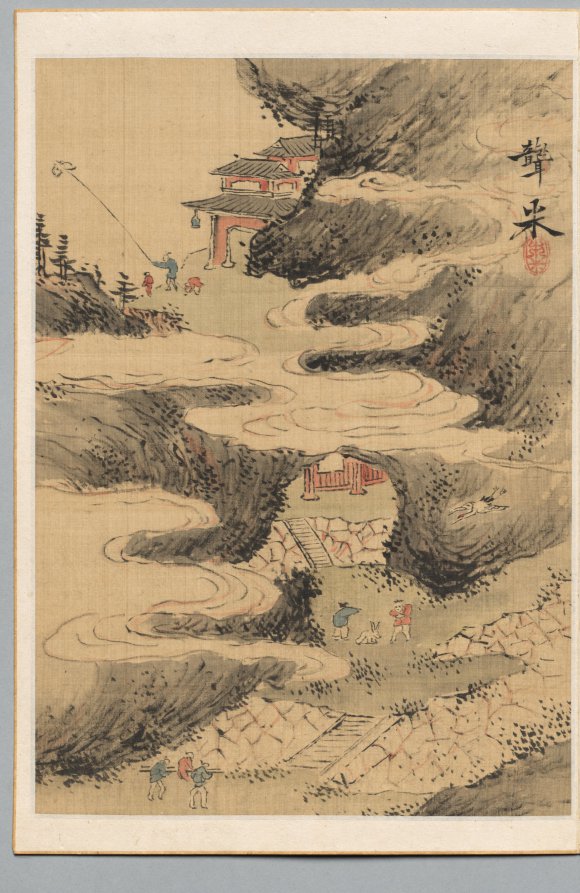
Children
by Aoki Mokubei
- Date:
- late 1700s–early 1800s
- Medium:
- Leaf from a pair of folding albums; ink and light color on paper
- Source:
- Cleveland Museum of Art
Description
Children, dated 1800, is an early painting by Aoki Mokubei (青木木米, 1767-1833), held by the Cleveland Museum of Art (accession recorded at https://www.clevelandart.org/art/1972.117.2.8). The 1800 date places the sheet in Mokubei's early thirties, well before the landscapes of the 1820s on which much of his modern reputation as a painter rests and during the period in which he was still consolidating both his self-taught literati brush idiom and his independent ceramic practice. The subject of children — at play, at study, or in attendance — belongs to a strand of Chinese figure painting in which a gentle vernacular humor sits comfortably within the broader literati repertoire. From the Song period onward, paintings of children (baizi tu — pictures of a hundred sons) had carried auspicious associations of fertility and family continuance, and Ming and Qing scholar-painters had elaborated more intimate, observed treatments of children at games and seasonal activities that influenced Edo bunjin and ukiyo-e alike. Earlier Japanese literati such as Yosa Buson (1716-1784) had shown how the scholar-painter's brush could be turned toward affectionately observed everyday subjects without compromising literati dignity, and Mokubei worked within that capacious bunjinga sensibility. As a polymath — potter, painter, scholar of imported Chinese books on ceramics and on painting — he built his early painting style from the imported scrolls and Chinese painting manuals that reached Kyoto through Nagasaki, and his early figural work shows the deliberately untutored brush the literati tradition prized as the mark of the cultivated amateur. The Cleveland source provides the firm attribution and the 1800 date.
More Prints by Aoki Mokubei
More Children Prints
Frequently Asked Questions
Children was created by Aoki Mokubei (青木木米) in late 1700s–early 1800s.
Children depicts children.