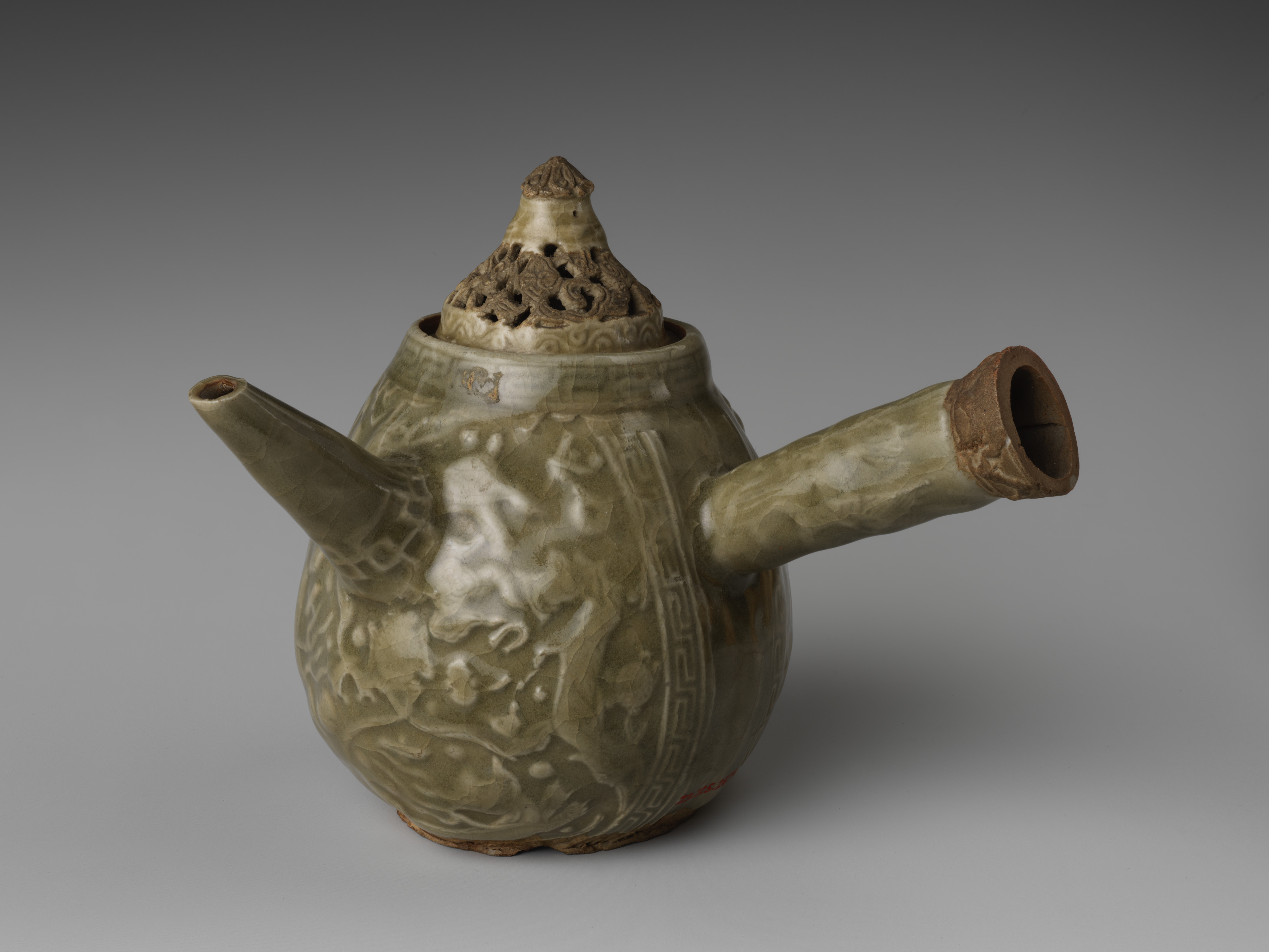
Sencha Teapot (Kyūsu) with Jewel-Chasing Dragons
by Aoki Mokubei
- Date:
- early 19th century
- Medium:
- Stoneware with underglaze blue and red enamel decoration
- Source:
- Metropolitan Museum of Art
Description
Sencha Teapot (Kyūsu) with Jewel-Chasing Dragons, dated 1820, is a porcelain teapot by Aoki Mokubei (青木木米, 1767-1833), held in the collection of the Metropolitan Museum of Art (accession recorded at https://www.metmuseum.org/art/collection/search/47250). The vessel exemplifies the Kyoto literati ceramicist's central practical contribution to Edo bunjin culture: the production of refined kyūsu — small side-handled teapots — for the Chinese-style sencha (steeped-leaf tea) practice that Kyoto and Edo bunjin circles had adopted from the late seventeenth century onward as a deliberately scholarly alternative to the chanoyu of powdered matcha. Sencha was understood as a Chinese literati pursuit; its implements were modeled on Ming and Qing precedents and frequently decorated with motifs drawn from Chinese scholarly iconography. The jewel-chasing dragon (yi long xi zhu) is one of the most familiar of those motifs, a canonical subject of Chinese decorative art in which paired dragons pursue a flaming pearl through clouds, signifying cosmic vitality. Mokubei was the foremost sencha potter of his generation and a deeply learned scholar of imported Chinese ceramic books; he reproduced and adapted Chinese stylistic models with the same kind of citational seriousness that animated literati painting practice, where 'in the manner of' an admired Chinese master was an act of declared lineage. The 1820 date places the kyūsu at the height of his ceramic authority, the period in which his painting also matured. Although in a different medium, the teapot belongs to the same Kyoto bunjin world as his hanging scrolls: an object made to equip the scholarly tea gathering at which both painting and poetry were shared. The Metropolitan source provides the firm attribution and date.
More Prints by Aoki Mokubei
Frequently Asked Questions
Sencha Teapot (Kyūsu) with Jewel-Chasing Dragons was created by Aoki Mokubei (青木木米) in early 19th century.