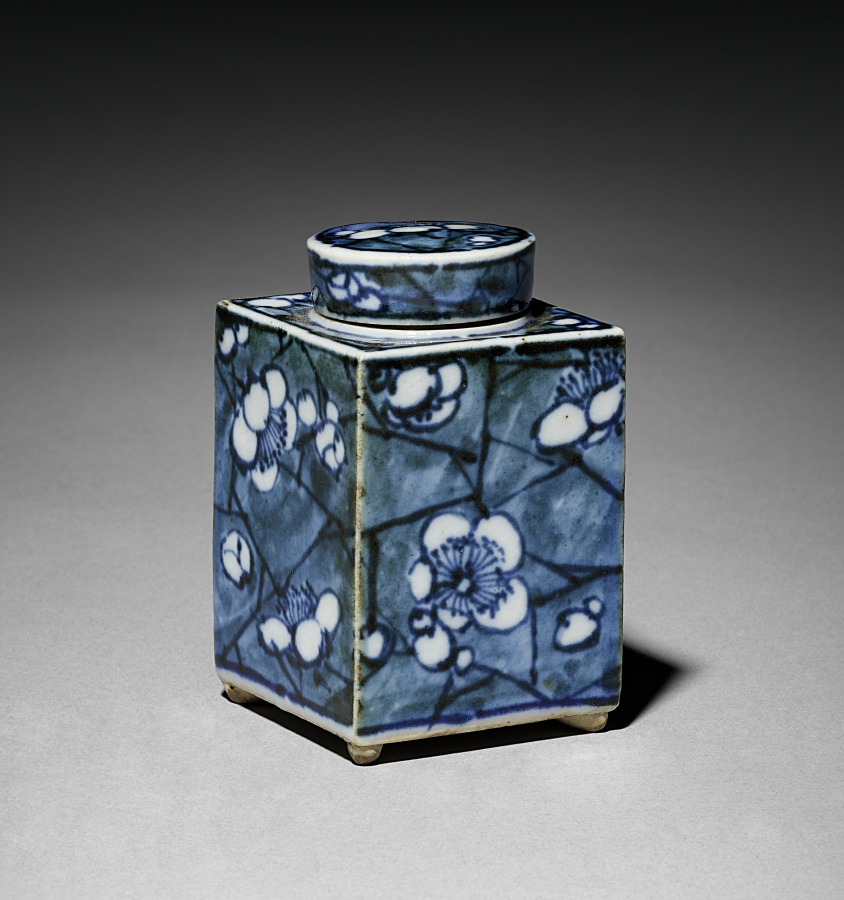
Tea Container with Plum Blossom
by Aoki Mokubei
- Date:
- early 1800s
- Medium:
- Porcelain with underglaze blue
- Source:
- Cleveland Museum of Art
Description
Tea Container with Plum Blossom, dated 1815, is a ceramic tea vessel by Aoki Mokubei (青木木米, 1767-1833), held by the Cleveland Museum of Art (accession recorded at https://www.clevelandart.org/art/1989.265.2). Tea containers — small jars holding tea leaves or, in their other form, powdered tea — were among the most refined and personally chosen utensils of the Edo tea gathering, and a Mokubei container belongs at the heart of the Kyoto literati world that had embraced the Chinese-style sencha steeped-leaf tea practice as a scholarly pursuit. The plum-blossom decoration draws on one of the most enduring of literati emblems: plum, one of the canonical Four Gentlemen of Chinese ink painting (along with orchid, bamboo, and chrysanthemum), is celebrated above all for its capacity to flower out of bare wood in the cold of early spring and thus to figure the resilience of the noble cultivated character. From the Song period onward, ink plum had been elevated by scholar-painters such as Yang Wujiu and the Yuan master Wang Mian into a touchstone literati subject, and by the Ming and Qing period plum decoration on ceramics had become one of the canonical pairings of literati iconography with porcelain. As the foremost Kyoto literati potter of his generation — a self-trained painter, a learned scholar of imported Chinese ceramic books, and a friend of Uragami Gyokudō and Tanomura Chikuden among the central nanga painters of his time — Mokubei brought to his vessels the same citational seriousness that animated literati painting. The 1815 date places the container in his mature ceramic production. The Cleveland source provides the firm attribution and date.
More Prints by Aoki Mokubei
Frequently Asked Questions
Tea Container with Plum Blossom was created by Aoki Mokubei (青木木米) in early 1800s.