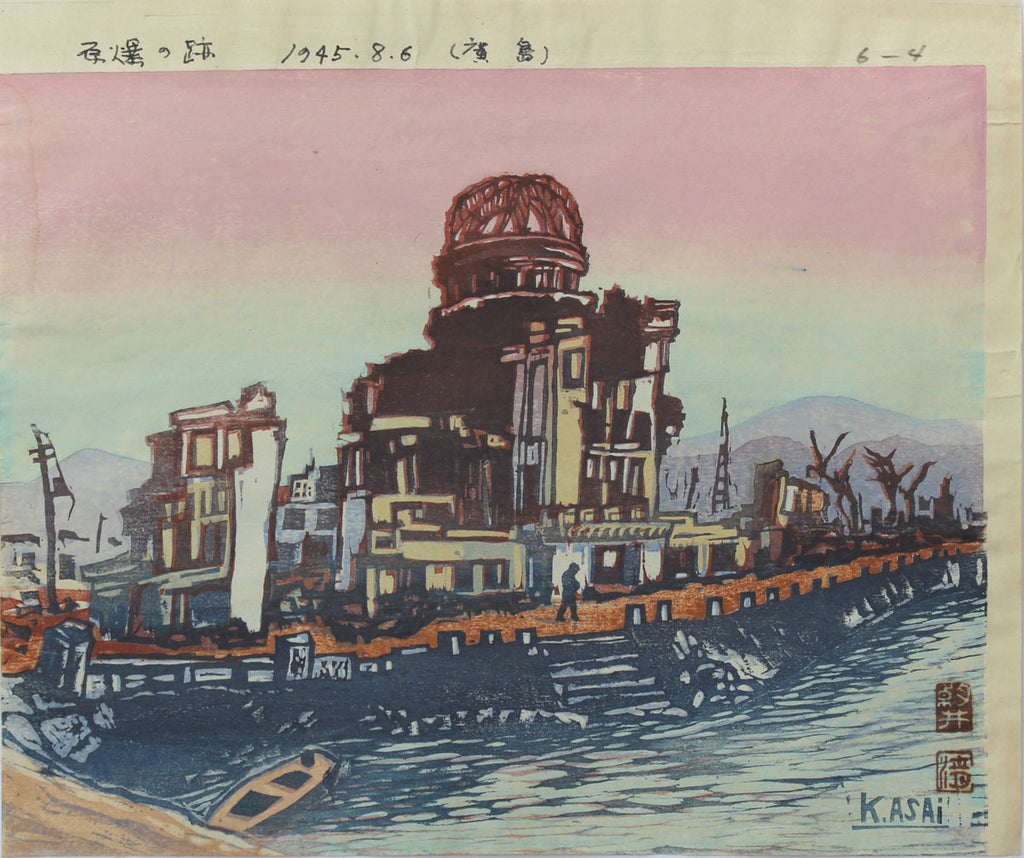
Atomic Bomb Ruins (Hiroshima)
原爆の跡(廣島)
by Asai Kiyoshi
- Date:
- 1945 (composed after August 6, 1945)
- Medium:
- Woodblock print on paper
- Source:
- Saru Gallery
Description
Asai Kiyoshi's Atomic Bomb Ruins (Hiroshima) is among the earliest direct visual responses to the bombing of 6 August 1945 by a Japanese woodblock artist with personal ties to Hiroshima prefecture. The image centres on the skeletal dome and exposed metal armature of the former Hiroshima Prefectural Industrial Promotion Hall — the structure now preserved as the Genbaku Dome at the heart of the Hiroshima Peace Memorial Park. Asai cuts the architectural remains with the disciplined, controlled line he brought from his Western-style (yōga) training under Saitō Yori and Nakazawa Hiromitsu, but renders the sky and ground in dense, scarred black that converts the building's ruin into a kind of negative architecture — a memorial drawn from what is missing. The block is signed 'K. Asai' carved directly into the matrix at the lower right, with two impressed seals reading 'Asai' and 'Kiyoshi' beside the signature; a pencil notation '6-4' on the recorded impression suggests an edition of only six prints, and the work is correspondingly exceedingly rare on the market. Coming from an artist whose post-war studio practice in the bombed city is documented by the Atomic Bomb Casualty Commission's 1948–50 photographs, the print sits at the seam of personal witness and the sōsaku-hanga movement's principle of self-drawn, self-carved, self-printed work.
More Prints by Asai Kiyoshi
Featured in Collections
Curated cross-cuts that include this print.
Frequently Asked Questions
Atomic Bomb Ruins (Hiroshima) (原爆の跡(廣島)) was created by Asai Kiyoshi (朝井清) in 1945 (composed after August 6, 1945).