
Pavilion at Gorka
- Medium:
- Woodcut
- Dimensions:
- 95 × 94 cm
- Image courtesy of
- Gallery No.85
Description
Gorkha, in central Nepal, is the historic seat of the Shah dynasty and home to the hilltop Gorkha Durbar, a palace-temple complex of stepped courtyards and tiered pavilions. Summers' subject is most likely one of the wooden pavilions of this complex, framed against the surrounding hillsides. The composition would isolate the pavilion's silhouette — overhanging eaves, carved timber struts, a tiered roofline — against broad fields of colour standing for sky and slope, with internal detail kept to a minimum. Summers worked from cut plywood blocks inked and laid face-up, the paper pressed by hand and finished by spraying solvent through the sheet so that pigment migrated outward in a soft halation around each shape. The effect renders architecture less as object than as silhouette held in atmospheric light. Pavilion at Gorka sits within the Nepalese cycle of the 1980s alongside Kali Gandaki and Tilicho Lake, the architectural counterpart to those landscape sheets, and demonstrates the way Summers used Himalayan travel as continuous subject matter for the latter half of his career rather than as a single concentrated body of work.
More Prints by Carol Summers


More Landscapes Prints

Lake Kugushi in Wakasa Province (Wakasa Kugushiko), from the series Souvenirs of Travel I (Tabi miyage dai isshu)"
Wakasa Kugushiko
1920
Color woodblock print; oban
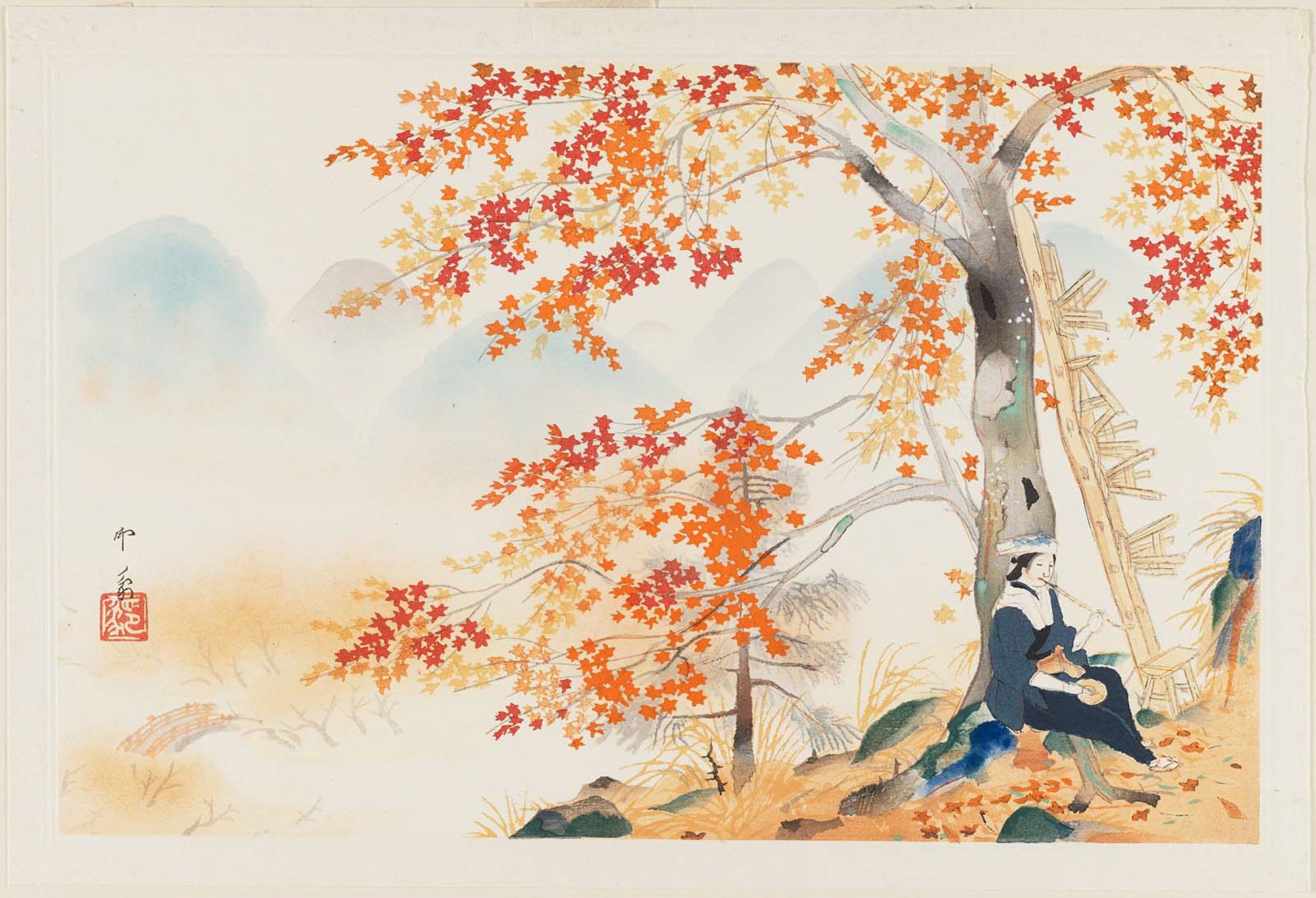
Autumn Maple Leaves at Takao, from the album Eight Views of Kyoto (Kyôto hakkei)
Woodblock print

The Beach at Kaiganji in Sanuki Province (Sanuki Kaiganji no hama), from the series "Collection of Views of Japan II, Kansai Edition (Nihon fukei shu II Kansai hen)"
1934
Color woodblock print; oban

Tea Kettle, section of a sheet from the series "Mirror of Stone Rubbings of Views of the Provinces" (Kohon meihitsu ishizuri kagami)
n.d.
Woodblock print; ishizuri-e, section of harimaze sheet
Featured in Collections
Curated cross-cuts that include this print.
Frequently Asked Questions
Pavilion at Gorka was created by Carol Summers.
Pavilion at Gorka depicts landscapes and architecture.
Pavilion at Gorka measures 95 × 94 cm.