
Rocky Mountains
- Medium:
- Woodcut
- Dimensions:
- 124 × 94 cm
- Image courtesy of
- Gallery No.85
Description
By the mid-1960s Summers had developed the printing method that defines his mature work, and Rocky Mountains is among the more direct demonstrations of it. Tall peaks, snow fields, and broad valley floors are reduced to interlocking color planes, each block printed by laying the dampened paper face-down on the inked surface and pressing pigment through from the reverse so that ink seeps outward into the fibers of the sheet. The technique produces the soft, glowing perimeter that became Summers's signature — ridges that read as vapor rather than incised line, snow that reads as light rather than absence. The American West was a recurring subject across his career, and Rocky Mountains belongs to the same conceptual family as the Sierras, Cascades, and later New Mexican prints, where the scale of Western geology is approached not as panorama but as color mass. The composition trades topographic ambition for atmosphere, an approach indebted in spirit, if not in tools, to the gradated bokashi effects of Edo-period landscape woodcuts he admired.
More Prints by Carol Summers


More Landscapes Prints

Lake Kugushi in Wakasa Province (Wakasa Kugushiko), from the series Souvenirs of Travel I (Tabi miyage dai isshu)"
Wakasa Kugushiko
1920
Color woodblock print; oban
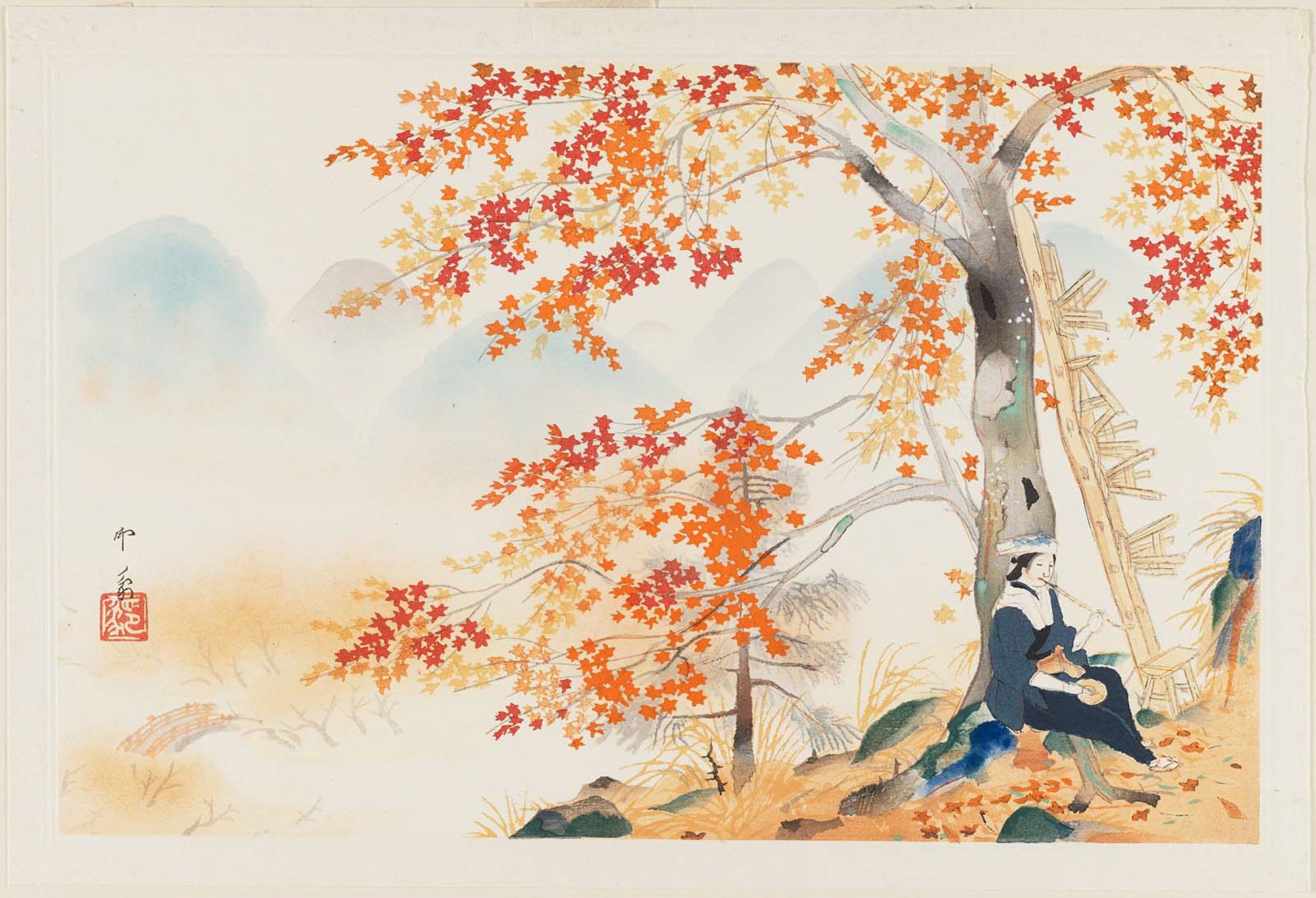
Autumn Maple Leaves at Takao, from the album Eight Views of Kyoto (Kyôto hakkei)
Woodblock print

The Beach at Kaiganji in Sanuki Province (Sanuki Kaiganji no hama), from the series "Collection of Views of Japan II, Kansai Edition (Nihon fukei shu II Kansai hen)"
1934
Color woodblock print; oban

Tea Kettle, section of a sheet from the series "Mirror of Stone Rubbings of Views of the Provinces" (Kohon meihitsu ishizuri kagami)
n.d.
Woodblock print; ishizuri-e, section of harimaze sheet
Featured in Collections
Curated cross-cuts that include this print.
Frequently Asked Questions
Rocky Mountains was created by Carol Summers.
Rocky Mountains depicts landscapes.
Rocky Mountains measures 124 × 94 cm.