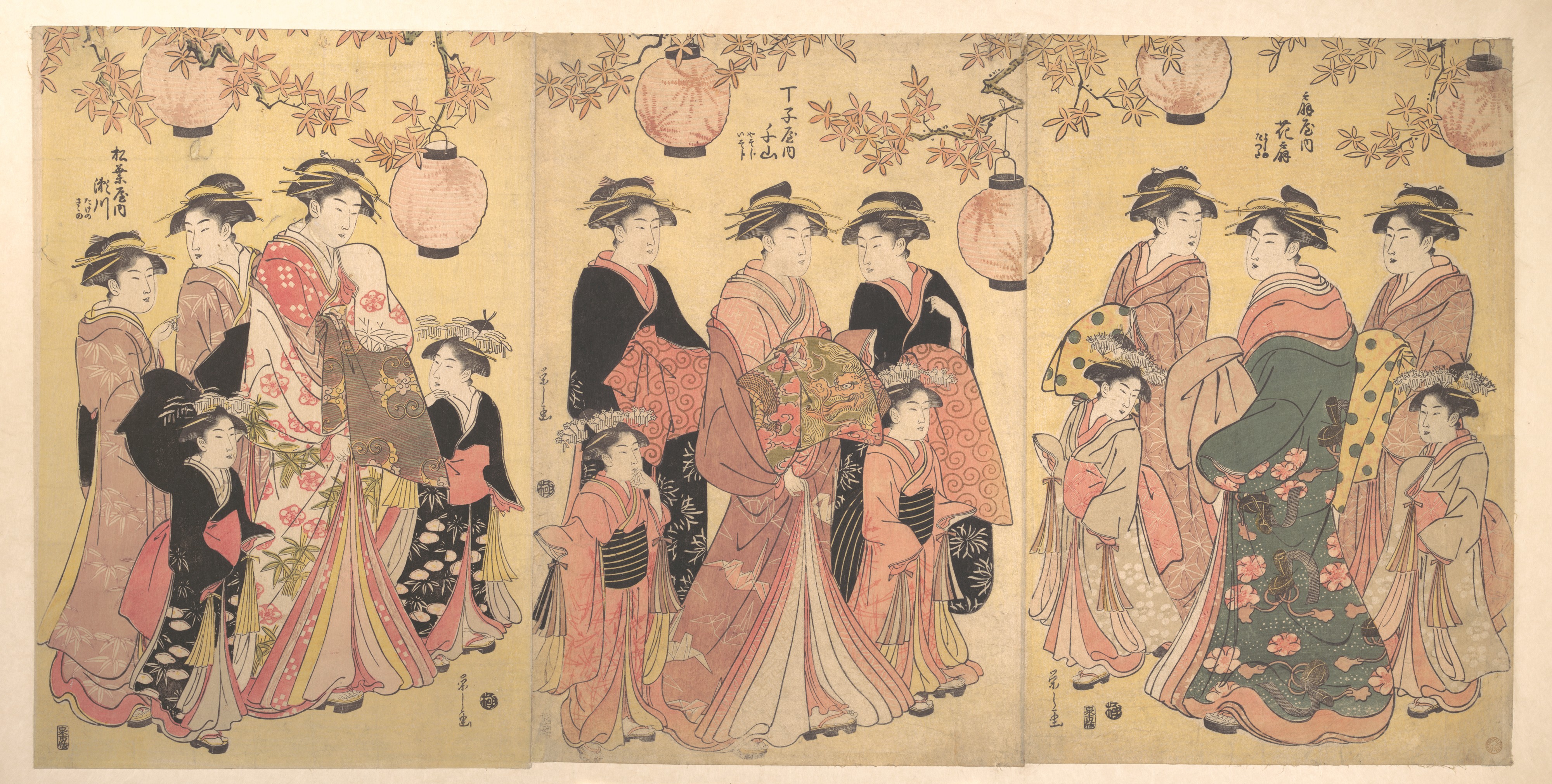
The Yoshiwara Parade in Autumn
- Date:
- ca. 1793
- Medium:
- Triptych of woodblock prints; ink and color on paper
- Source:
- Metropolitan Museum of Art
Description
The Yoshiwara Parade in Autumn is a richly populated composition that turns the seasonal cycle of the licensed quarter into a subject worthy of close artistic attention. Chobunsai Eishi captures a procession of courtesans, attendants, and onlookers along the main streets of the Yoshiwara at the moment when autumn touches the trees and lanterns of the district. The Metropolitan Museum of Art preserves this impression. The vertical arrangement of figures allows Eishi to display the towering robes and tall lacquered sandals of the leading oiran while still suggesting the bustle of the surrounding crowd, and the seasonal cue, signaled through subtle changes in robe patterns or autumnal motifs, places the scene at a specific moment in the calendar. As Edo bijin-ga, the parade subject afforded designers an opportunity to display fashion, hierarchy, and theatricality all at once, and Eishi takes full advantage of the format without losing his characteristic refinement. His Kano-trained ukiyo-e draftsmanship is evident in the disciplined linework that orders the procession's many overlapping bodies and in the carefully balanced palette that gives the scene its sense of stately rhythm. He uses the parade not merely as an occasion for visual spectacle but as a way of recording the Yoshiwara as a public institution with its own seasonal rituals. Chobunsai Eishi here demonstrates again why his prints attracted both popular audiences and elite collectors: he could orchestrate complex social scenes with the calm assurance of orthodox painting while remaining alert to the textures of contemporary life.
More Prints by Chōbunsai Eishi

Komurasaki of the Kadotamaya with Attendants Hatsune and Utano
c. 1790
Color woodblock print; oban

A Parody of the Tales of Ise
c. 1789/95
Color woodblock print; right sheet of oban triptych

Kiyomizu, from the series "Seven Komachi (Nana Komachi)"
c. 1791/92
Color woodblock print; chuban

A Woman's Poetry Party
c. 1793
Color woodblock print; oban triptych
More Autumn Foliage Prints

A Farmhouse in Autumn, Ayashi, Miyagi Prefecture (Noka no aki (Miyagi ken Ayashi)
Noka no aki (Miyagi ken Ayashi
1946
Color woodblock print
Yoro Waterfall in Mino Province (Mino no kuni Yoro no taki), from the series Tour of the Waterfalls in Various Provinces (Shokoku Takimeguri)
Woodblock print

Tengui Rock, Autumn in Shiobara (Shiobara no aki (Tenguiwa))
1950
Color woodblock print

Autumn at the Arayu Hot Spring, Shiobara
Autumn 1920
Woodblock print, ink and color on paper
Frequently Asked Questions
The Yoshiwara Parade in Autumn was created by Chōbunsai Eishi (鳥文斎栄之) in ca. 1793.
The Yoshiwara Parade in Autumn depicts autumn foliage.