
Matsushima Sailboats
- Source:
- ukiyo-e.org
Description
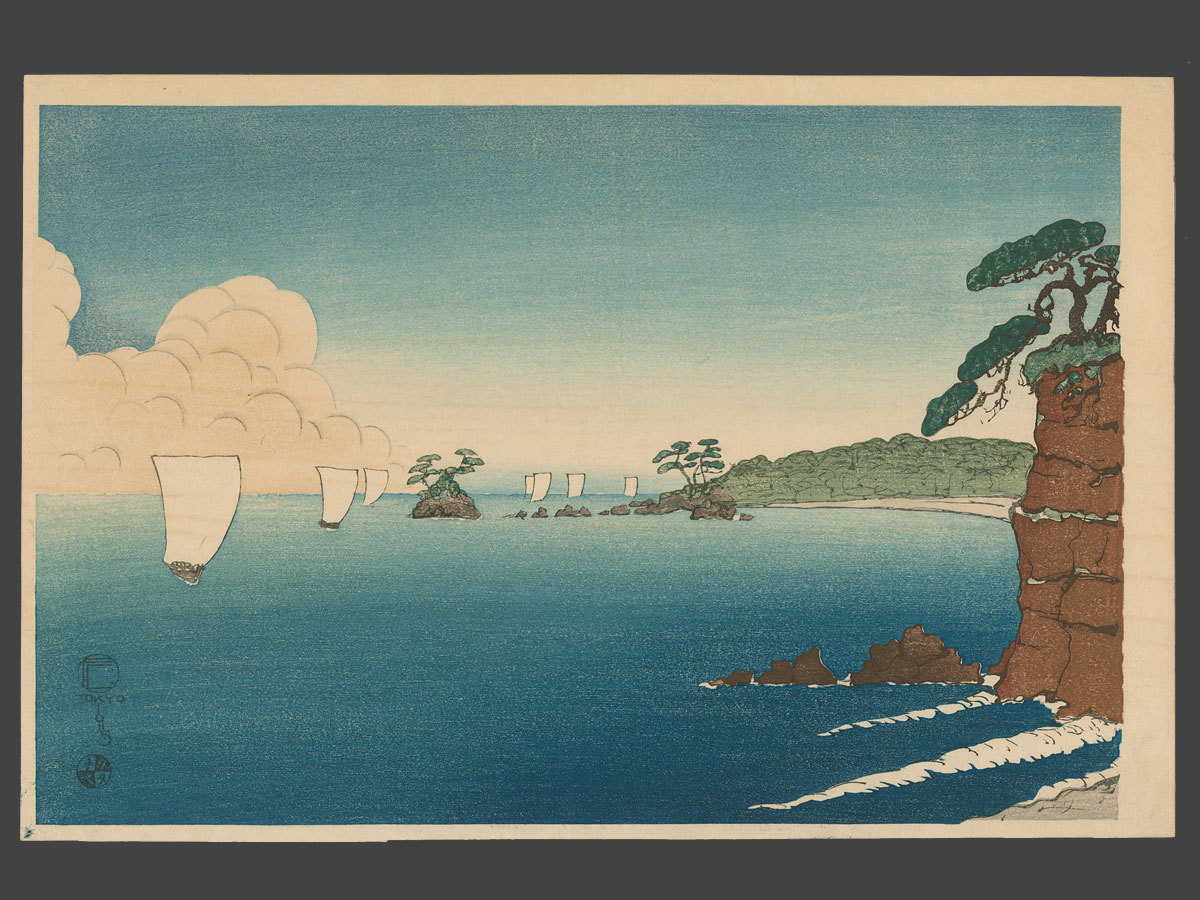
Matsushima Sailboats is a shin-hanga woodblock print designed by Fritz Capelari and published in Tokyo by Watanabe Shozaburo. The composition looks out across the famous bay of Matsushima in northeastern Japan, with its scatter of pine clad islets and the low, weathered sails of working boats crossing the calm water. Matsushima had been a celebrated motif in Japanese poetry and painting for centuries, and by choosing it Capelari placed himself in dialogue with a long tradition while approaching the scene as a European visitor responding directly to atmosphere, weather and light. Fritz Capelari was an Austrian painter active in Japan in the mid 1910s, and he became one of the earliest foreign collaborators in Watanabe Shozaburo's ambitious effort to revive the Japanese woodblock print as a vehicle for modern artistic expression. The prints he designed for Watanabe in 1915 are usually grouped with the foundational works of shin-hanga, the movement that would later flower in the landscapes of Kawase Hasui and Hiroshi Yoshida. In Matsushima Sailboats Capelari favors soft tonal washes over crisp outline, and the Watanabe workshop has translated these painterly qualities into broad inked areas and graduated bokashi printing that suggest haze, water and distance. The sails read as quiet, almost graphic shapes against the bay, and the islands recede in muted layers rather than as sharply defined silhouettes. This impression is documented through Scholten Japanese Art and recorded on ukiyo-e.org, which provides a searchable visual reference for the design. The print stands as an early example of how Watanabe Shozaburo paired foreign draftsmanship with Japanese block carving and printing technique to advance the shin-hanga idea.
More Prints by Fritz Capelari


Featured in Collections
Curated cross-cuts that include this print.
Frequently Asked Questions
Matsushima Sailboats was created by Fritz Capelari (フリッツ・カペラリ).