
Summer landscape
- Medium:
- Mokuhanga (Japanese woodblock)
- Image courtesy of
- Saru Gallery
Description
Summer landscape places Kitaoka's work within the seasonal cycle that has structured Japanese landscape art from yamato-e screen painting through ukiyo-e meisho-e to twentieth-century shin-hanga and sosaku-hanga. A summer treatment would call for a deeper green palette than his spring or autumn prints, with the absorbency of washi and the tonal range of bokashi gradation allowing distinctions between near and far foliage, sunlit field and shaded grove. Kitaoka's mid- and late-career landscapes tend to reduce topographic incident in favor of structural pattern: a planted rice paddy registering as a parallel ruled field, distant mountains as a flat band, summer vegetation as carved texture. Such compositions reflect his absorption of modernist abstraction during his Paris and New York years while retaining a recognizably Japanese subject and atmosphere. The work belongs to the postwar reformulation of meisho-e in which specific place gives way to seasonal type — summer in Japan rather than a particular locality — produced through the artist-led sosaku-hanga method of personal carving and printing.
More Prints by Fumio Kitaoka


More Summer Prints
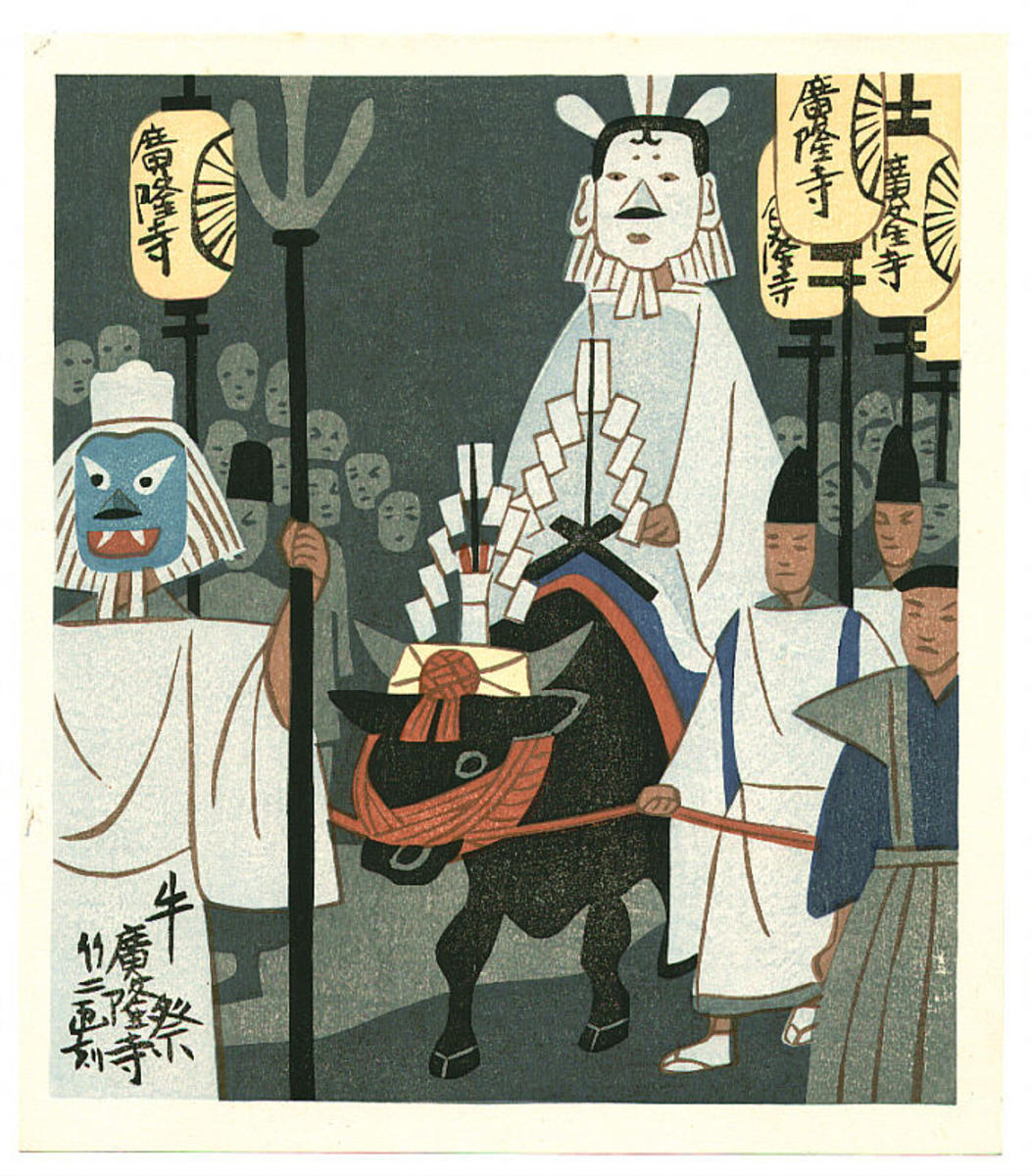
Bull Festival at Koryuji
広隆寺牛祭
Woodblock print
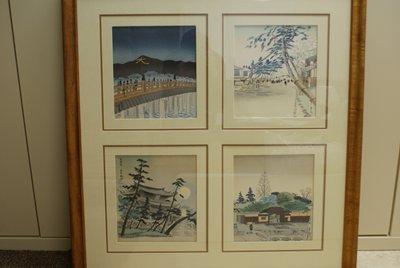
February (The Annual Festival of the Fushimi Inari)
二月 (伏見稲荷大社祭)
second half 20th century
Woodblock print, ink and color on paper

July (Gorgeous Procession of Yama-hoko or the Floats at the Gion Festival)
七月 (祇園祭山鉾巡行)
second half 20th century
Woodblock print, ink and color on paper

August (The Bonfire Festival of the Daimonji Hill Viewed from the Sanjo Bridge)
八月 (三条大橋より大文字)
second half 20th century
Woodblock print, ink and color on paper
Featured in Collections
Curated cross-cuts that include this print.
Frequently Asked Questions
Summer landscape was created by Fumio Kitaoka (北岡文雄).
Summer landscape depicts summer.