
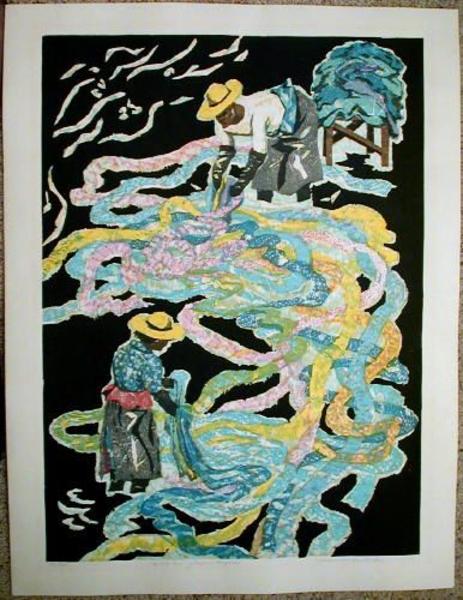
Washing lengths of dyed silk in the river
- Medium:
- Mokuhanga (Japanese woodblock)
- Image courtesy of
- Saru Gallery
Description
Two figures in wide-brimmed straw hats bend over long ribbons of dyed silk that snake across a black river, rendered in swirling bands of pink, yellow, blue, and pale green against white ripple patterns. A wooden rack piled with folded blue and purple fabric stands at upper right, while the water's dark surface is broken only by thin white line strokes suggesting current and foam. This is "Washing lengths of dyed silk in the river," a mokuhanga (Japanese woodblock print) by Fumio Kitaoka.
More Prints by Fumio Kitaoka


More Rivers & Lakes Prints

Lake Chuzenji, Nikko (Nikko Chuzenjiko)
Nikko Chuzenjiko
1930
Color woodblock print; oban

Lake Kugushi in Wakasa Province (Wakasa Kugushiko), from the series Souvenirs of Travel I (Tabi miyage dai isshu)"
Wakasa Kugushiko
1920
Color woodblock print; oban

Gosai Canal in Niigata (Niigata Gosaibori), from the series "Souvenirs of Travel, Second Series (Tabi miyage dai nishu)"
Niigata Gosaibori
1921
Color woodblock print; oban

The Hori River at Obama (Obama Horikawa), from the series "Souvenirs of Travel, First Series (Tabi miyage dai isshu)"
Obama Horikawa
1920
Color woodblock print; oban
Featured in Collections
Curated cross-cuts that include this print.
Frequently Asked Questions
Washing lengths of dyed silk in the river was created by Fumio Kitaoka (北岡文雄).
Washing lengths of dyed silk in the river depicts rivers & lakes.