
Abstract
- Medium:
- Mokuhanga (Japanese woodblock)
- Image courtesy of
- Saru Gallery
Description
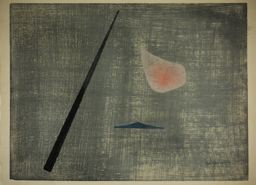
An abstract composition produced through the sosaku-hanga method of self-carved, self-printed mokuhanga, this print exemplifies Yamaguchi's mature postwar practice in which representational subject matter dissolved into arrangements of shape, texture, and field. The slug reference to saru (monkey) suggests the work may retain a vestigial figural source — a stylized animal form abstracted into geometric or biomorphic elements — though the printed image reads as non-objective. Yamaguchi's abstract sheets typically rely on the tactile interaction between baren-burnished pigment and absorbent washi, with deliberate woodgrain impressions, scraped surfaces, and overprinted blocks producing material density rather than pictorial illusion. Bokashi gradations and rough-edged shapes function as compositional anchors. Works of this kind, made during the 1950s and 1960s when Yamaguchi was winning prizes at the São Paulo and Tokyo international biennials, helped establish creative printmaking as a vehicle for abstract expression equal to painting. The print belongs to the same investigative current as his contemporaries Onchi Kōshirō and Hagiwara Hideo, in which the woodblock medium itself — its grain, its resistance, its registration — became the principal subject.
More Prints by Gen Yamaguchi


More Abstract Prints

![[abstract composition with diagonal woodgrain] by Gen Yamaguchi](https://1.api.artsmia.org/800/135949.jpg)
Featured in Collections
Curated cross-cuts that include this print.
Frequently Asked Questions
Abstract was created by Gen Yamaguchi (山口源).
Abstract depicts abstract.