
Contraposition
- Medium:
- Mokuhanga (Japanese woodblock)
- Image courtesy of
- Saru Gallery
Description
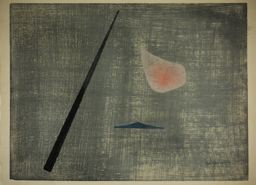
The title borrows from European art-historical vocabulary, where contraposto names the asymmetric weight distribution of standing figures, and applies it to the formal language of abstract composition: opposing masses, weights, or directions held in dynamic equilibrium. Yamaguchi's abstract prints from the late 1940s through the 1960s typically work through the placement of textured rectangular blocks, calligraphic linear elements, and modulated color fields against negative space, and a print with this title likely sets one compositional element against another in deliberate tension. He frequently incorporated unconventional materials --- coarse paper, sand, or heavily textured washi --- to register surface detail, and the cherry-block carving emphasizes gestural mark over descriptive line. Contraposition reflects Yamaguchi's broader concern, shared with Onchi Koshiro and other postwar sosaku-hanga abstractionists, with translating sumi-e principles of balance and ma (negative space) into a non-representational printmaking idiom.
More Prints by Gen Yamaguchi


Featured in Collections
Curated cross-cuts that include this print.
Frequently Asked Questions
Contraposition was created by Gen Yamaguchi (山口源).