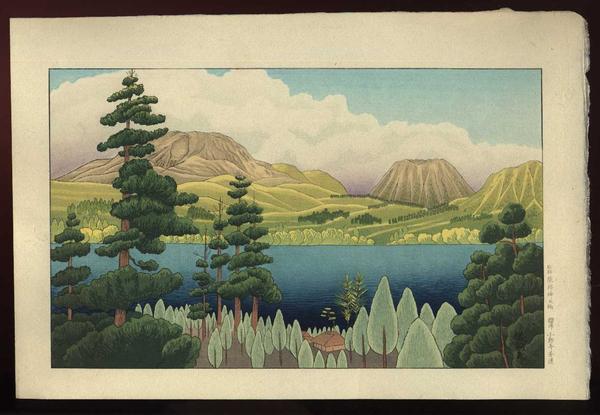
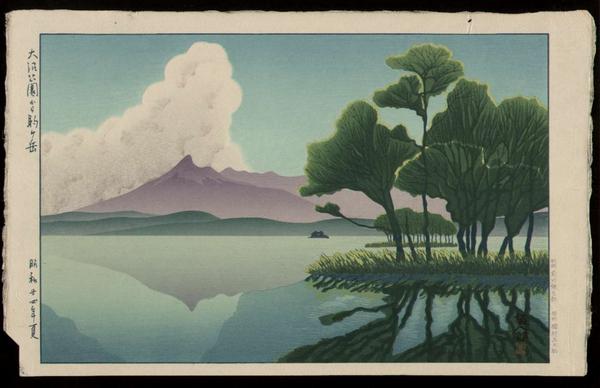
Mountain lake Hakone Ashinoko no Shinryoku
- Medium:
- Woodblock print
- Source:
- Japanese Art Open Database
Description
Mountain Lake Hakone: Ashinoko no Shinryoku (Fresh Green of Lake Ashi), an undated woodblock by Okuyama Gihachiro (1907-1981), takes one of the canonical scenic sites of central Japan and reworks it through the artist's distinctive sosaku-hanga (creative print) idiom. Lake Ashi, set in the volcanic caldera of Hakone, has been a celebrated viewing point since the Edo period, but Okuyama is uninterested in the topographic precision of the traditional meisho-e (famous-place picture) tradition. Instead, he organizes the sheet around the seasonal subject indicated by the Japanese subtitle - shinryoku, the fresh new green of late spring and early summer - and lets that chromatic event carry the entire composition. The lake is built from a saturated band of cool color held against a foreground and surrounding shore of more saturated greens, the whole sheet weighted toward the artist's characteristic bold, color-rich palette rather than tonal subtlety. A self-taught printmaker from Akita who remained one of the few Tohoku-region figures in the predominantly Tokyo-and-Kyoto sosaku-hanga scene, Okuyama designed, carved, and printed each impression himself, in keeping with the movement's foundational principle that the artist alone be responsible for every stage of production. The carved planes of color and the firmly inked passages on the surface bear direct evidence of his hand. The Japanese Art Open Database, through ukiyo-e.org, preserves this impression as part of a wider record of Okuyama's landscape output (https://ukiyo-e.org/image/jaodb/Gihachiro_Okuyama-No_Series-Mountain_lake_Hakone_Ashinoko_no_Shinryoku-00031294-030705-F06). For students of Okuyama Gihachiro, the Hakone print is a useful demonstration of how, working at a distance from the Tokyo movement center, he absorbed the canonical Japanese viewing tradition into a fully personal sosaku-hanga vocabulary, replacing topographic specificity with seasonal color and the disciplined gesture of carved wood.
More Prints by Gihachiro Okuyama
Featured in Collections
Curated cross-cuts that include this print.
Frequently Asked Questions
Mountain lake Hakone Ashinoko no Shinryoku was created by Gihachiro Okuyama (奥山儀八郎).