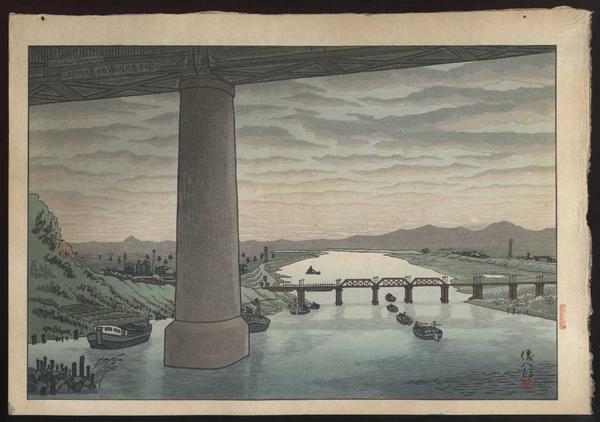
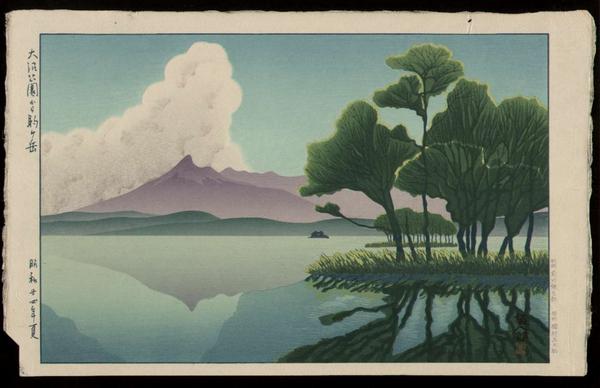
View of Edogawa from under the Ichikawa bridge
- Medium:
- Woodblock print
- Source:
- Japanese Art Open Database
Description
View of Edogawa from under the Ichikawa Bridge, an undated woodblock by Okuyama Gihachiro (1907-1981), demonstrates the artist's interest in the engineered modern landscapes that linked Tokyo to its surrounding country. The Edogawa, the river forming the boundary between Tokyo and Chiba, is crossed at Ichikawa by major rail and road infrastructure, and Okuyama's print exploits the dramatic perspective afforded by a viewer standing beneath the bridge looking out across the water. The composition organizes the sheet around the strong diagonal of the bridge's underside cutting across the upper register, with the river opening below in saturated planes of color. This insistent low-angle, framed-view structure is a signature of Okuyama's mature work, in which built infrastructure - bridges, station roofs, festival lanterns - supplies the geometric scaffolding for bold color massing. A self-taught printmaker from Akita who became one of the few Tohoku-region figures in the predominantly Tokyo-and-Kyoto sosaku-hanga (creative print) scene, Okuyama designed, carved, and printed each impression himself, in keeping with the movement's foundational principle that every stage of production carry individual authorship. The carved planes and firmly bounded color zones on the surface preserve direct evidence of his decisions about gouge and ink. The Japanese Art Open Database, through ukiyo-e.org, holds this impression as part of a broader record of Okuyama's landscape output (https://ukiyo-e.org/image/jaodb/Gihachiro_Okuyama-No_Series-View_of_Edogawa_from_under_the_Ichikawa_bridge-00032627-040414-F06). For students of Okuyama Gihachiro, the Ichikawa Bridge print is a strong demonstration of how he absorbed the modern bridged-river landscape into his bold-color, dramatic-perspective sosaku-hanga vocabulary, treating engineered space as a subject fully equal to the rural festivals and snow-bound farmhouses of his native Tohoku.
More Prints by Gihachiro Okuyama
Featured in Collections
Curated cross-cuts that include this print.
Frequently Asked Questions
View of Edogawa from under the Ichikawa bridge was created by Gihachiro Okuyama (奥山儀八郎).