
Chinese circus
- Medium:
- Mokuhanga (Japanese woodblock)
- Image courtesy of
- Saru Gallery
Description
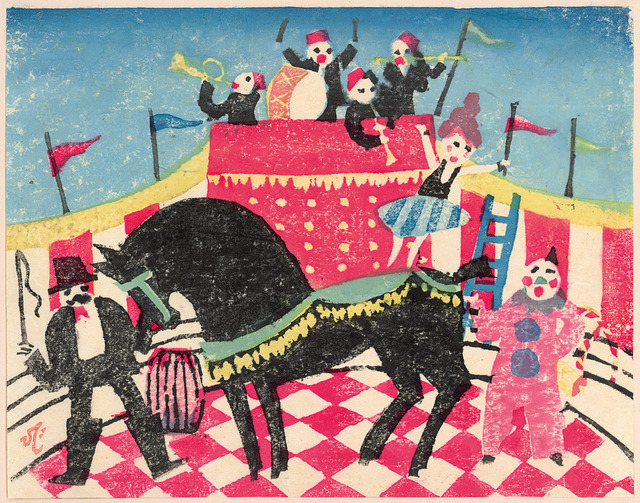
This print depicts a Chinese acrobatic troupe (zaji) — likely a performance of plate-spinning, pole-balancing, contortion, or chair stacking, the repertoire of touring Chinese acrobats who appeared in Japan's port cities throughout the Taisho and early Showa periods. For Kawanishi the subject was particularly proximate: Kobe's Chinatown (Nankin-machi) and its established Chinese community made Chinese performance a familiar rather than exotic sight. Compositionally, Chinese acrobatic acts lend themselves to vertical, stacked figures and bright costume color, both well suited to his flat-plane, high-saturation idiom. The print likely uses a few dominant colors — red, yellow, blue, black — blocked against a simplified ground, with figures defined by carved contour rather than gradient modeling. Within his oeuvre, the Chinese circus sits alongside the European-style circus prints and the Carmen book as evidence of how thoroughly Kawanishi pursued imported and cross-cultural subjects. The work is consistent with sosaku-hanga's interest in modern, secular, urban content, and it documents one strand of the cosmopolitan visual life of Kobe during the interwar decades.
More Prints by Hide Kawanishi
Featured in Collections
Curated cross-cuts that include this print.
Frequently Asked Questions
Chinese circus was created by Hide Kawanishi (川西英).