
Cryptomeria Avenue
- Date:
- 1937
- Medium:
- Color woodblock print
- Format:
- Oban
- Dimensions:
- 27.2 × 40.3 cm
- Publisher:
- Yoshida Studio
- Source:
- Art Institute of Chicago
Description
The cryptomeria — Japan's towering native cedar, sugi, planted in long formal avenues approaching shrines and along historic highways — provides the subject for this 1937 print, which captures the cathedral-like corridor of a cryptomeria avenue in full, mature growth. These trees, which can live for a thousand years and reach heights of fifty meters, create an almost architectural enclosure of trunk and canopy that Yoshida renders with dramatic recession into depth. The famous cryptomeria avenue at Nikko — planted in the seventeenth century to line the approach to the Toshogu Shrine — is a likely subject, though Yoshida depicted similar avenues at Takinoura and other sites. The verticality of the composition is rare in his landscape work.
More Prints by Hiroshi Yoshida
More Urban Scenes Prints
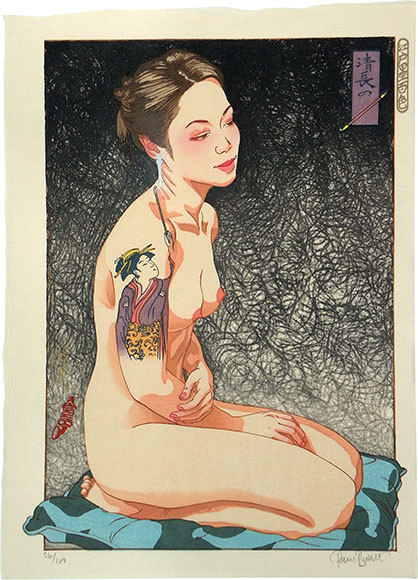
A Hundred Shades of Ink of Edo: Kiyonaga's Pipe (Edo zumi hyaku shoku: Kiyonaga no kiseru)
Woodblock print

View of Kabuki Theater from Matsuya (Ginza Matsuya yori Kabukiza), no. 3 from the series "Pictures of Ginza, First Series (Gashu Ginza dai isshu)"
1928
Color lithograph

Distant View of Mitsukoshi Movie Theater in Shinjuku from the Sixth Floor of Hoteiya (Hoteiya rokkai kara Shinjuku Mitsukoshi Musashi no kan enbo zu), no. 1 from the series "Scenery of Shinjuku (Gashu Shinjuku fukei)"
1930
Color lithograph
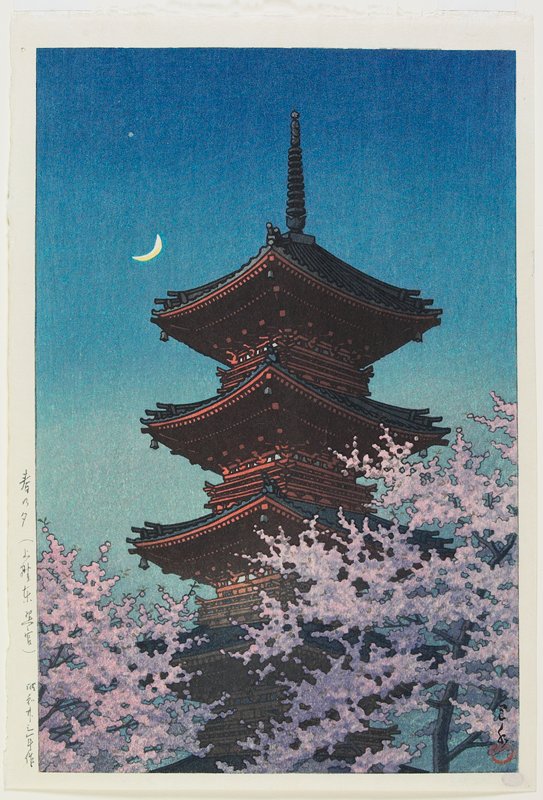
Spring Dusk at the Tōshō Shrine in Ueno
1948
Woodblock print, ink and color on paper
Featured in Collections
Curated cross-cuts that include this print.
Frequently Asked Questions
Cryptomeria Avenue was created by Hiroshi Yoshida (吉田博) in 1937.
Cryptomeria Avenue uses Bokashi, Nishiki-e, and Moku-hanga, on color woodblock print.
Cryptomeria Avenue was published by Yoshida Studio (1937).
Cryptomeria Avenue depicts urban scenes and trees.
Cryptomeria Avenue measures 27.2 × 40.3 cm (Oban format).