
Fujiyama from Okitsu
- Date:
- 1928
- Medium:
- Color woodblock print
- Format:
- Oban
- Dimensions:
- 40.5 × 27.1 cm
- Publisher:
- Yoshida Studio
- Source:
- Art Institute of Chicago
Description
Mount Fuji rises snow-capped against a pink-and-blue gradated sky, its slopes tinted rose at the summit, with a tree-covered rocky bluff at the left edge framing the view. In the middle distance a purple-blue mountain ridge stretches across the composition, with a small boat visible near the shore and a strip of blue sea at right; in the foreground, tidal pools and mudflats reflect the mountain and sky in muted lavender and cream tones. Hiroshi Yoshida's 1928 color woodblock print "Fujiyama from Okitsu" uses a hazy, low-saturation palette to render this coastal view toward the peak.
More Prints by Hiroshi Yoshida
More Mount Fuji Prints
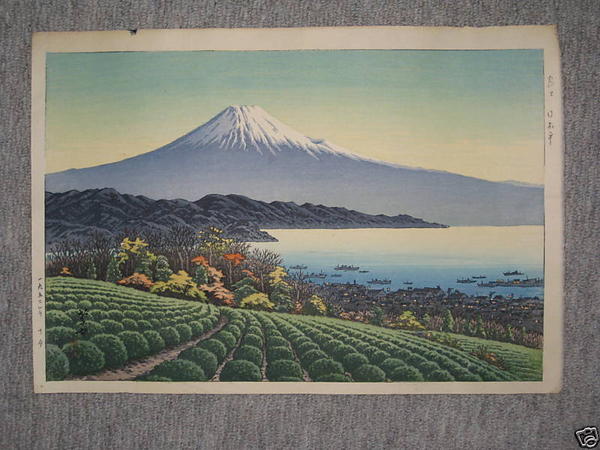
Fuji from tea farm
Woodblock print

Akasaka, Fujikawa, Okazaki, Chiryu, and Narumi, from the series "Famous Places on the Fifty-three Stations of the Tokaido, Five Stations (Tokaido gojusan eki goshuku meisho)"
c. 1830/35
Color woodblock print; oban
![Mount Fuji on a Moonlit Night, Kawai Bridge (Tsukiyo no Fuji [Kawaibashi]), from the series "Selection of Views of the Tokaido (Tokaido fukei senshu)" by Kawase Hasui](https://www.artic.edu/iiif/2/d0960668-1e73-339a-b182-fb995a54bff0/full/843,/0/default.jpg)
Mount Fuji on a Moonlit Night, Kawai Bridge (Tsukiyo no Fuji [Kawaibashi]), from the series "Selection of Views of the Tokaido (Tokaido fukei senshu)"
1947
Color woodblock print; oban

Mt. Fuji in Rain (Ame no Fuji)
n.d.
Color woodblock print
Featured in Collections
Curated cross-cuts that include this print.
Frequently Asked Questions
Fujiyama from Okitsu was created by Hiroshi Yoshida (吉田博) in 1928.
Fujiyama from Okitsu uses Bokashi, Nishiki-e, and Moku-hanga, on color woodblock print.
Fujiyama from Okitsu was published by Yoshida Studio (1928).
Fujiyama from Okitsu depicts mount fuji, set at Mount Fuji.
Fujiyama from Okitsu measures 40.5 × 27.1 cm (Oban format).