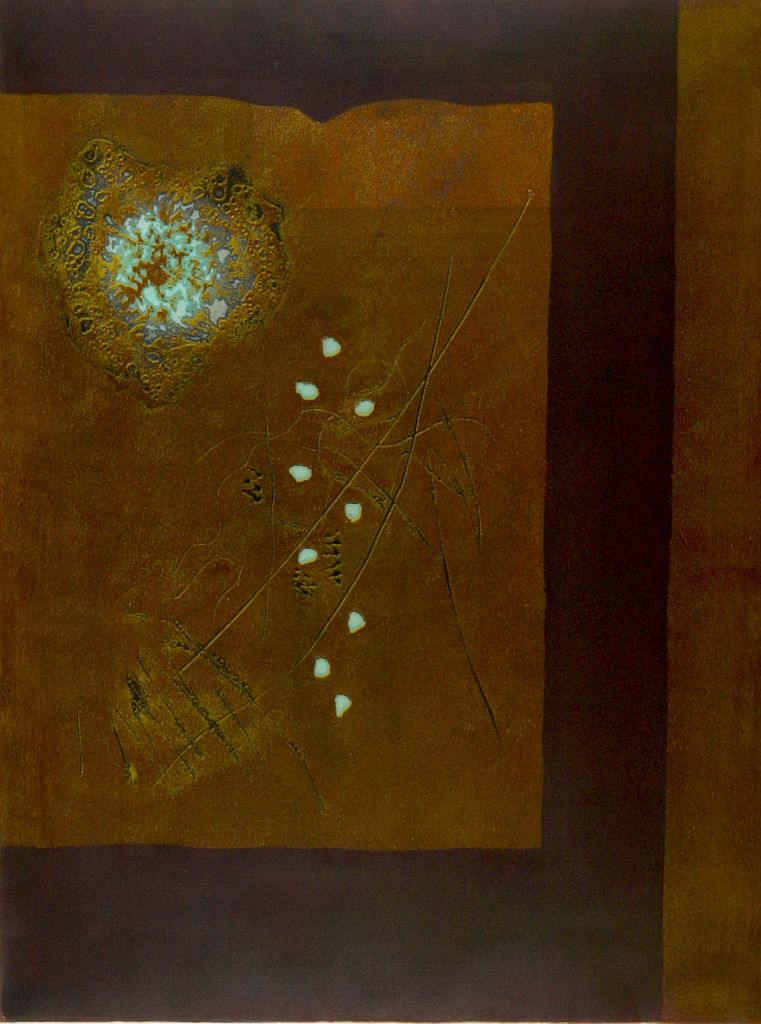
Brown Wall, Shôwa period, dated 1971
- Medium:
- Woodblock print
- Source:
- Harvard Art Museum
- Image courtesy of
- Harvard Art Museum
Description
Brown Wall presents an abstract field composition in which earth-toned ochres and deep umbers are built up across the picture plane through successive woodblock impressions, evoking the weathered, layered surface of a plaster or earthen wall. Tajima exploits the absorbent qualities of washi to allow ink to sink unevenly into the fibers, producing subtle gradations and surface irregularities that mimic the organic patina of aged material rather than a manufactured finish. The composition emphasizes flatness and weight rather than spatial recession, consistent with Tajima's mature sosaku-hanga practice, in which the paper itself is treated as a structural collaborator. Printed in 1971 during a period when he was consolidating his international reputation, the work reflects broader postwar abstract tendencies in Japanese creative printmaking while remaining rooted in the material specificity of the woodblock medium. The restrained palette focuses attention on tonal modulation and textural incident across the brown register.
More Prints by Hiroyuki Tajima
More Architecture Prints


Featured in Collections
Curated cross-cuts that include this print.
Frequently Asked Questions
Brown Wall, Shôwa period, dated 1971 was created by Hiroyuki Tajima (田島博之).
Brown Wall, Shôwa period, dated 1971 depicts architecture and abstract.