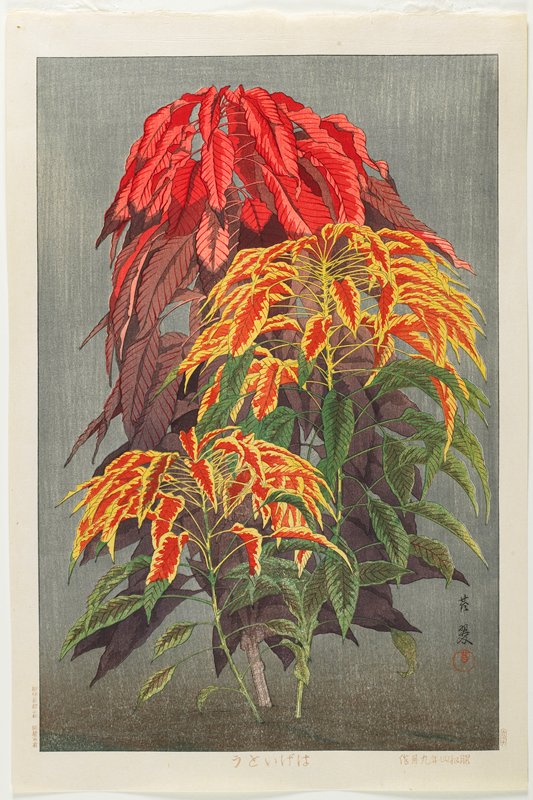
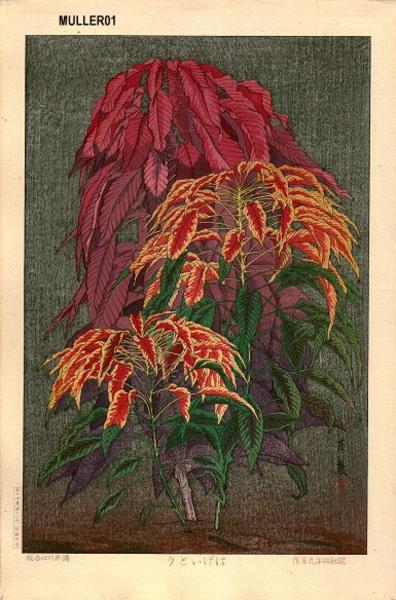
Amaranthus tricolor
- Date:
- September 1929
- Medium:
- Woodblock print, ink and color on paper
- Dimensions:
- 40.3 × 26.6 cm
- Source:
- Minneapolis Institute of Art
Description
Amaranthus tricolor, known in Japanese as hagebito or Joseph's coat, is an ornamental plant prized for its brilliantly colored leaves that shift between crimson, gold, and green. Inuzuka Taisui rendered this subject in September 1929, using ink and color on paper in the woodblock medium. The print captures the plant's bushy, upright form with its vividly streaked foliage, each leaf layered in tones that required precise registration across multiple carved blocks. Unlike the flowers that dominate most kacho-e prints, amaranthus draws attention to foliage rather than blossoms, making it an unusual and visually striking choice. Taisui's decision to feature this plant reflects the shin-hanga movement's interest in expanding the traditional botanical repertoire beyond cherry blossoms and chrysanthemums. The September publication date aligns with the plant's peak coloring in late summer, when the leaves develop their most intense pigmentation.
More Prints by Inuzuka Taisui
More Birds & Flowers Prints
Featured in Collections
Curated cross-cuts that include this print.
Frequently Asked Questions
Amaranthus tricolor was created by Inuzuka Taisui (犬塚泰水) in September 1929.
Amaranthus tricolor depicts birds & flowers and still life.
Amaranthus tricolor measures 40.3 × 26.6 cm.