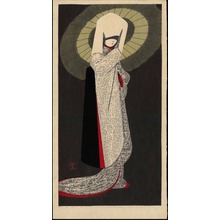
Dancing Figure (Sagimusume) - 鷲娘
by Kaoru Kawano
- Medium:
- Woodblock print
- Source:
- Ohmi Gallery
- Image courtesy of
- Ohmi Gallery
Description
Sagimusume — commonly translated as Heron Maiden — is one of the most celebrated dances in the Nagauta kabuki repertoire, depicting a heron spirit that takes the form of a beautiful young woman before being consumed by the torment of unrequited love. The subject has deep roots in Japanese visual culture, having inspired prints by earlier [ukiyo-e](/glossary/ukiyo-e) artists including Kunisada and Toyokuni III. Kawano's version situates this classical subject within the [sosaku-hanga](/glossary/sosaku-hanga) framework: the figure is self-carved and self-printed by the artist rather than produced through the collaborative studio system of Edo-period publishing. The dancer traditionally appears in a white furisode with long, flowing sleeves suggesting wing-like extension, and Kawano's bold outlining style would lend these garments a sculptural weight. The kanji rendered in the title — 鷲娘 — uses the character for eagle rather than the standard heron (鷺), a possible variant title, alternate reading, or intentional reinterpretation that shifts the avian metaphor while preserving the narrative framework of a bird-woman transformation.