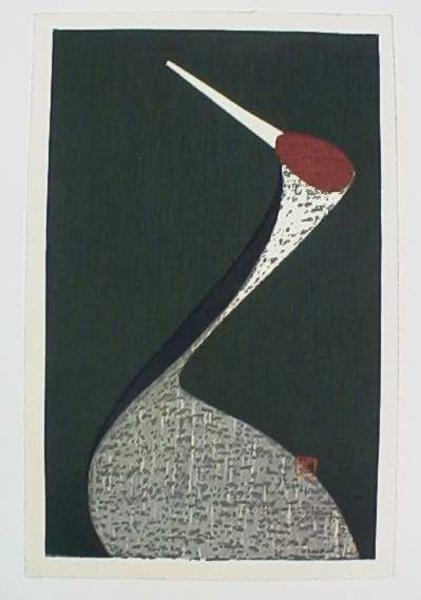
Sacred Crane
by Kaoru Kawano
- Medium:
- Woodblock print
- Source:
- Japanese Art Open Database
- Image courtesy of
- Japanese Art Open Database
Description
The crane — tsuru in Japanese — carries associations of longevity, fidelity, and auspicious occasion, making it a recurring subject across centuries of Japanese visual art from folding screens to Edo-period woodblock prints. In Kawano's hands, the motif shifts from the refined kacho-e tradition into the bolder register of sosaku-hanga. His carving style favors thick, decisive lines that define the bird's silhouette with graphic clarity, while areas of uncarved block or layered pigment suggest the white plumage characteristic of the red-crowned crane (Grus japonensis). Kawano likely organized the composition around the crane's outstretched wings or upright neck against a minimal ground, allowing the bird's form to read with monumental simplicity. The absence of a letter or color designation suggests this may be an early state or the primary version from which the lettered variants in the series derive. It represents Kawano working in the kacho-e mode — bird-and-flower prints — adapted to the expressive vocabulary of the postwar creative print movement.
More Prints by Kaoru Kawano

More Birds & Flowers Prints
Featured in Collections
Curated cross-cuts that include this print.
Frequently Asked Questions
Sacred Crane was created by Kaoru Kawano (川野薫).
Sacred Crane depicts birds & flowers.