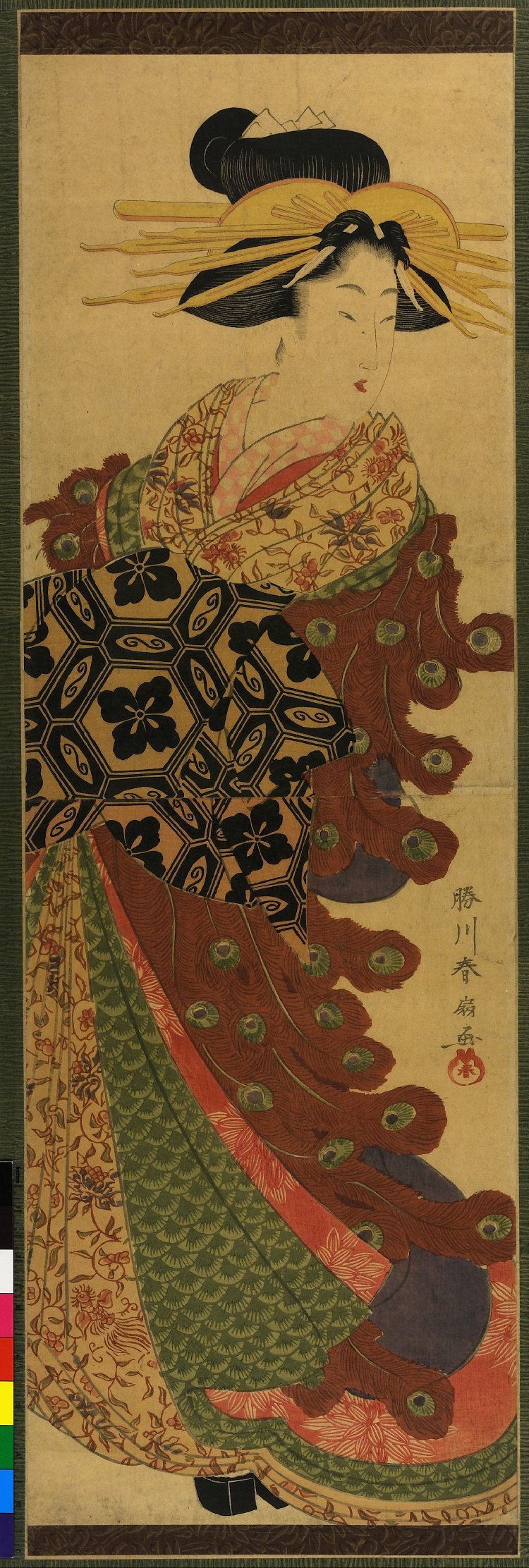
Courtesan Parading in a Peacock-Feather Robe
- Date:
- c. 1810-1820
- Medium:
- Color woodblock print; bijinga
- Source:
- British Museum
Description
Held by the British Museum under accession number 1906,1220.0.198 and attributed to Katsukawa Shunsen (1762–c. 1830), this color woodblock bijinga print depicts a courtesan (oiran) parading in an outer kimono decorated with peacock-feather pattern. The oiran was the highest rank of courtesan within the Edo Yoshiwara licensed pleasure quarter — a hierarchy of trained entertainers and sex workers whose visual display, kimono fashion, and elaborate hair ornaments were a major subject of Edo bijin-ga from the late seventeenth century onward. The oiran's parade — the dōchū, in which the courtesan and her attendants processed through the streets of the quarter — was one of the recognizable visual subjects of bijin-ga, presenting the courtesan in her most lavish outer kimono (uchikake) over multiple under-robes. The peacock-feather pattern of this work places the print within the rich textile vocabulary of Edo Yoshiwara fashion, in which auspicious motifs (peacock, dragon, phoenix, crane) were used to convey wealth and aesthetic distinction. Shunsen worked in the Bunka era (1804–1818), a period in which the bijin-ga had developed into a heavily worked color format with dense pattern and bold pigmentation, and his courtesan prints can be read as the Katsukawa-school inheritance of the eighteenth-century bijin tradition adapted to the new commercial and aesthetic conditions of the early nineteenth century. The British Museum's example is one of several Shunsen bijinga in the museum's holdings.
More Prints by Katsukawa Shunsen


Frequently Asked Questions
Courtesan Parading in a Peacock-Feather Robe was created by Katsukawa Shunsen (勝川春扇) in c. 1810-1820.