Biography
Katsukawa Shunsen (勝川春扇, 1762–c. 1830) was a late-Edo ukiyo-e designer of bijin-ga (images of beautiful women) and yakusha-e (kabuki actor prints) who worked principally in the Bunka era (1804–1818) and the early Bunsei years that followed. He is also recorded in the literature as Shunkō II, the name he took in 1820 when he succeeded to the Katsukawa Shunkō line, and his active period as a print designer ran from about 1805 to about 1821. Surviving examples are held in major international collections, including the Art Institute of Chicago and the British Museum, where he is catalogued as "Katsukawa Shunsen (Shunkō II)" to distinguish him from the several other Katsukawa designers whose names begin with the shared first syllable Shun-.
Shunsen first trained in classical Japanese-style painting under Tsutsumi Tōrin III, an artist of the Rinpa tradition. In 1806 or 1807 he entered the Katsukawa school as a pupil of Katsukawa Shun'ei (1762–1819), one of the leading actor-print designers of the late eighteenth century and a senior figure in the lineage descended from the school's founder, Katsukawa Shunshō; it was on joining Shun'ei that he adopted the Katsukawa name, changing his signature from Kojimachi Shunsen to Katsukawa Shunsen. This grounding in both painterly and print traditions set him apart from many of his Katsukawa fellows, whose work remained almost exclusively confined to the commercial print format. By the time Shunsen was designing prints in the first decades of the nineteenth century, the Katsukawa school had passed its eighteenth-century peak and was operating in an Edo print market increasingly dominated by the Utagawa school under Toyokuni and his pupils. Shunsen's career belongs to this later moment, when the standard Katsukawa formulas — the hosoban actor portrait, the diptych confrontation scene — were being adapted to the new tastes of the Bunka era, with its larger sheet sizes, more elaborate color work, and renewed interest in fashionable bijin subjects.
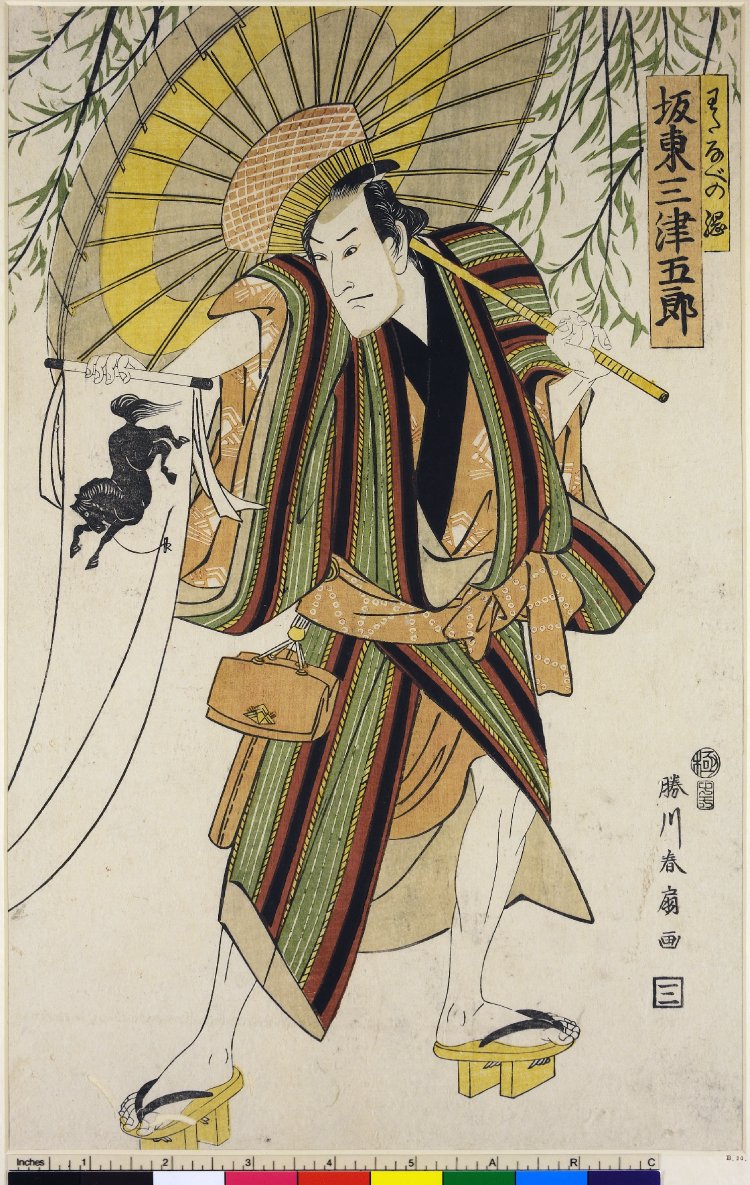
In the Bunka period Shunsen produced a substantial body of full-color woodblock prints across the standard ukiyo-e genres. His bijin-ga depict courtesans of the licensed Yoshiwara quarter in elaborate parading kimono, the figure typically isolated against a plain ground with the patterned robe rendered in deeply pigmented colors; the British Museum is among the collections holding examples of this type. His actor prints adopt the larger multi-sheet compositions that had become standard for kabuki publishers by the Bunka era, with two or three sheets combining to form an extended scene of multiple performers and stage business. Beyond bijin and yakusha-e, Shunsen also worked in landscape and travel subjects.
Shunsen's style combines the careful Katsukawa-school draftsmanship he had absorbed from Shun'ei with the bolder coloration that the Bunka-era market demanded. His outline drawing remains restrained — thin, deliberate keylines — but the color blocks are dense and the patterns rich with detail, registering the textile virtuosity that distinguished the best bijin prints of the period.
In the late 1820s Shunsen is reported to have left printmaking to devote himself to the decoration of ceramics, following a tradition of woodblock designers turning to other surfaces later in their careers; the reasons for the change are not documented. His death date is uncertain but is conventionally given as circa 1830. For collectors, Shunsen represents the late Katsukawa-school tradition in transition: a designer trained in the eighteenth-century actor-print formulas of Shun'ei but working through a period in which those formulas were being absorbed into the very different visual culture of the early nineteenth century. His surviving prints are comparatively scarce and remain a useful documentary record of the Bunka-era Edo theater and the bijin-ga of the licensed pleasure quarters.
Key Facts
- Active Period
- 1762–1830
- Nationality
- 🇯🇵Japan
- Movement
- Ukiyo-e
- Subjects
- Birds & FlowersWinter
- Works Indexed
- 9
Frequently Asked Questions
Katsukawa Shunsen (勝川春扇, 1762–c. 1830) was a late-Edo ukiyo-e designer of bijin-ga (images of beautiful women) and yakusha-e (kabuki actor prints) who worked principally in the Bunka era (1804–1818) and the early Bunsei years that followed. He is also recorded in the literature as Shunkō II, the name he took in 1820 when he succeeded to the Katsukawa Shunkō line, and his active period as a print designer ran from about 1805 to about 1821. Surviving examples are held in major international collections, including the Art Institute of Chicago and the British Museum, where he is catalogued as "Katsukawa Shunsen (Shunkō II)" to distinguish him from the several other Katsukawa designers whose names begin with the shared first syllable Shun-.
Katsukawa Shunsen was active from 1762 to 1830. They were associated with the Ukiyo-e movement.
Katsukawa Shunsen's work was shaped by the Ukiyo-e tradition in Japanese woodblock printmaking. Ukiyo-e: ## What is ukiyo-e? Ukiyo-e ([浮世絵](/glossary/ukiyo-e)) — literally "pictures of the floating world" — is the Edo-period Japanese print and painting tradition that flourished from roughly 1660 to 1868, depicting the pleasures of urban life in Edo (modern Tokyo): courtesans, kabuki actors, sumo wrestlers, famous landscapes, and seasonal beauties.
Katsukawa Shunsen's prints frequently feature birds & flowers, winter.
Original prints by Katsukawa Shunsen can be found in collections including Art Institute of Chicago, British Museum, Museum of Fine Arts, Boston.
Woodblock Prints by Katsukawa Shunsen (9)
Kabuki Actors (Triptych)
1805
Color woodblock print; oban triptych

Kabuki Actors (Triptych)
1806
Color woodblock print; oban triptych
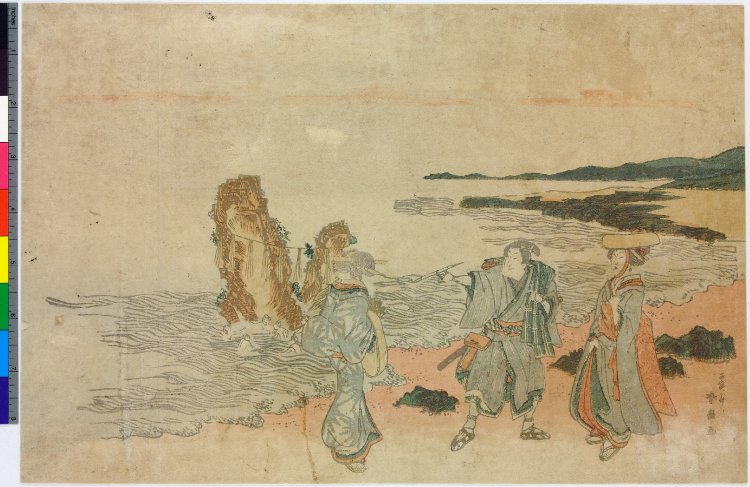
Travellers on the Coast of Futami
c. 1810-1820
Color woodblock print

Flower (Hana)
early 19th century
Color woodblock print; oban

Travelers in Snow
early 19th century
Color woodblock print
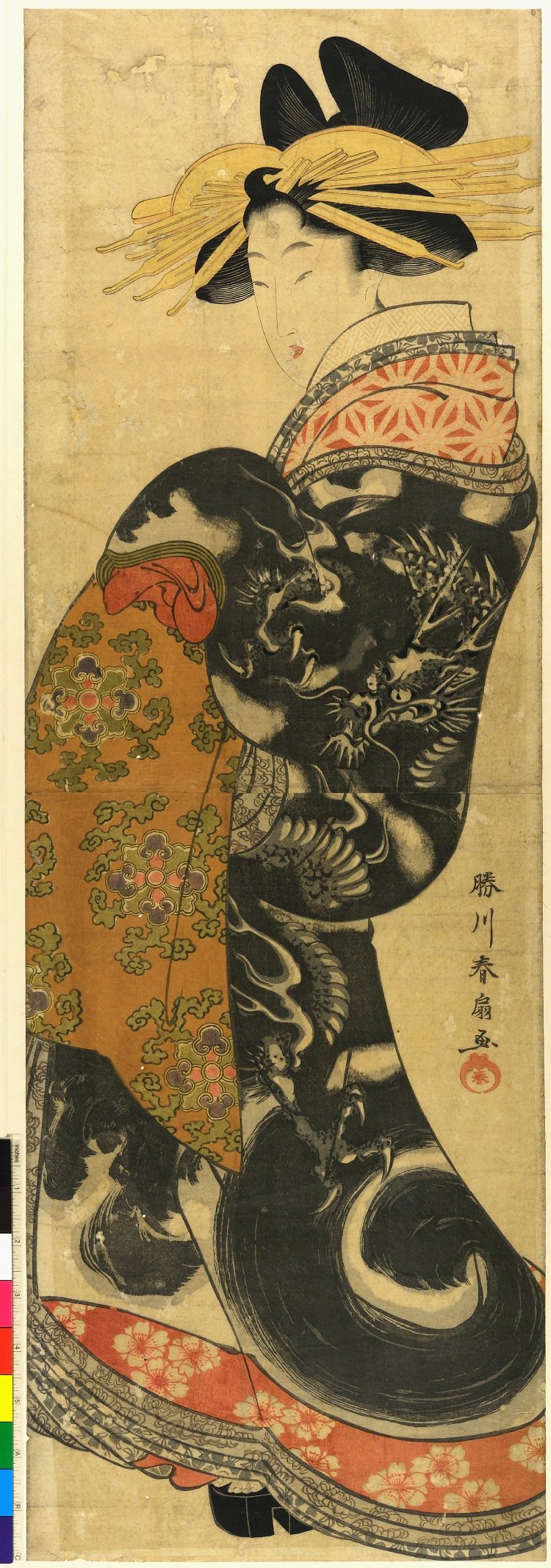
Courtesan Parading in a Storm-Dragon Robe
c. 1810-1820
Color woodblock print; bijinga
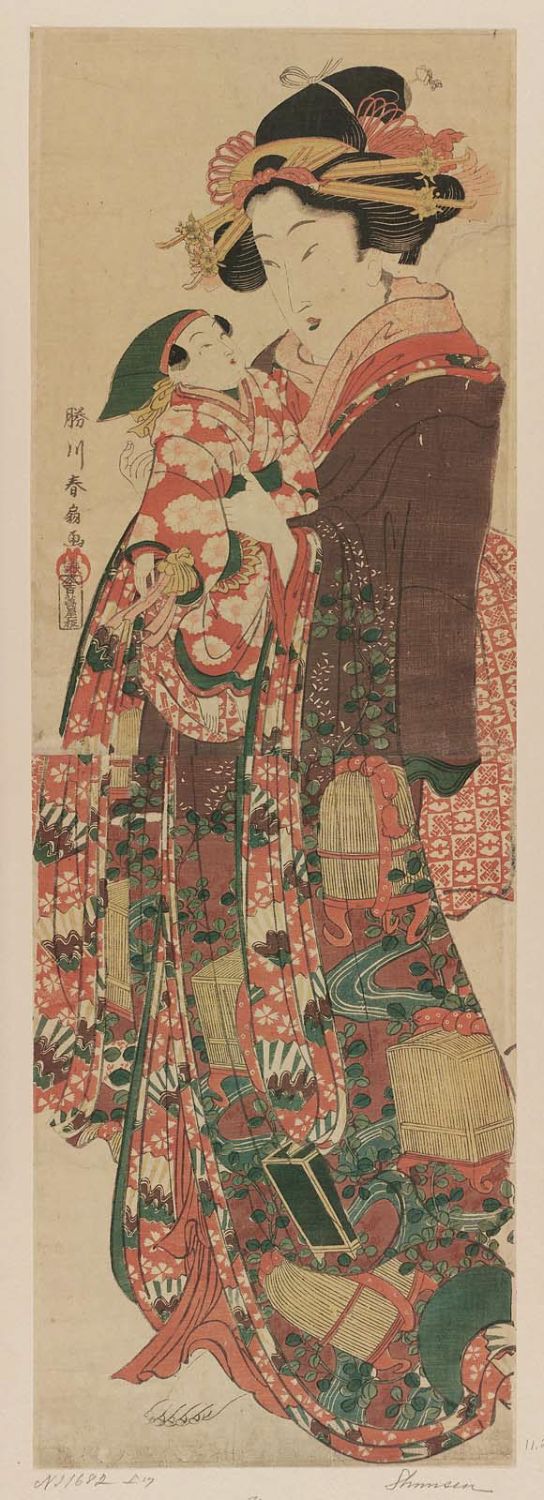
Standing Beauty Holding a Doll
early 19th century
Color woodblock print; bijinga
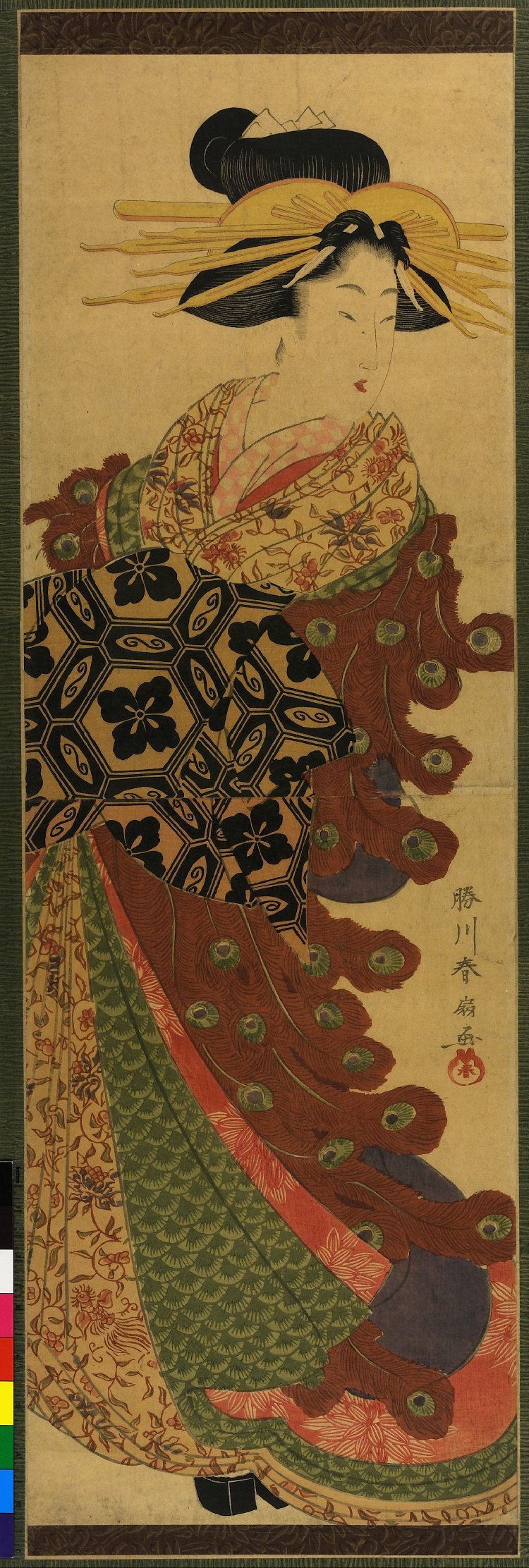
Courtesan Parading in a Peacock-Feather Robe
c. 1810-1820
Color woodblock print; bijinga

Kabuki Actors at the Nakamura-za, First Month, 1811 (Triptych)
1811
Color woodblock print; oban triptych