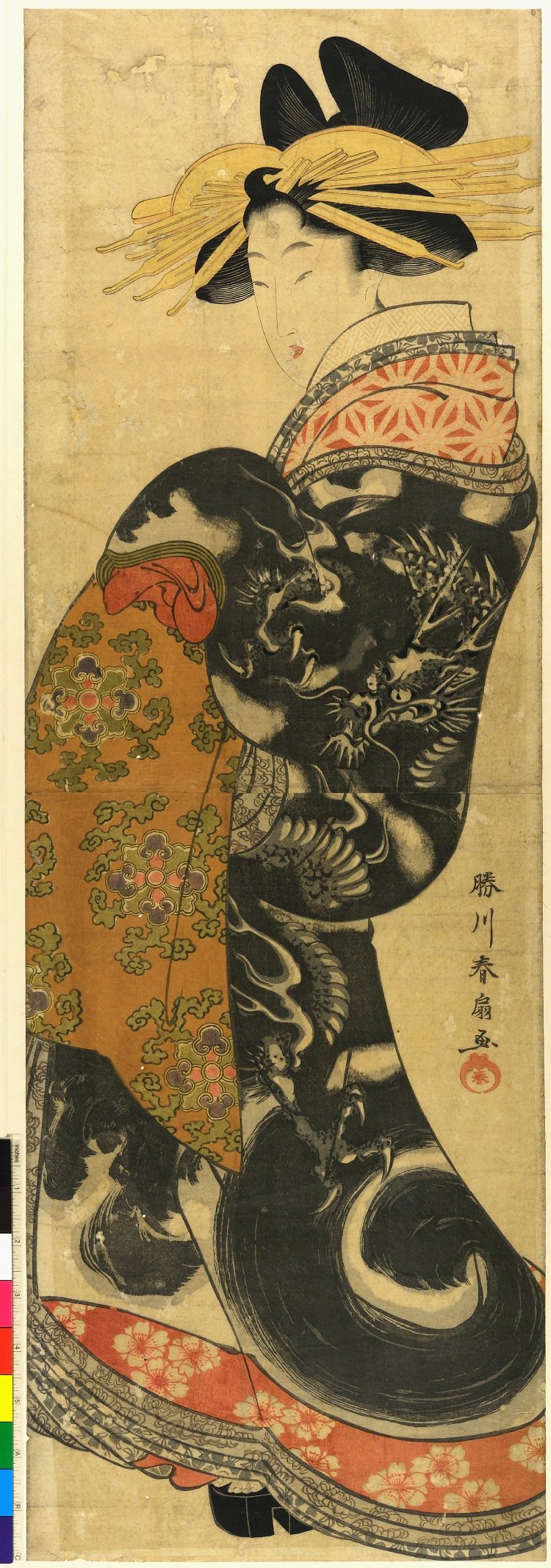
Courtesan Parading in a Storm-Dragon Robe
- Date:
- c. 1810-1820
- Medium:
- Color woodblock print; bijinga
- Source:
- British Museum
Description
Held by the British Museum under accession number 1906,1220.0.295 and attributed to Katsukawa Shunsen (1762–c. 1830), this color woodblock bijinga print depicts a courtesan (oiran) parading in an outer kimono decorated with a storm-dragon pattern. The print belongs to the same Bunka-era bijin-ga register as the museum's peacock-feather-robe courtesan, and the two works together exemplify Shunsen's contribution to the early-nineteenth-century Yoshiwara fashion print, in which the courtesan's elaborate uchikake (outer kimono) and identifying textile patterns are the central visual interest of the composition. The storm-dragon motif — a dragon writhing among clouds and rain — carries a long iconographic tradition in East Asian textile and decorative art, associated with water, weather, and dynamic power. As a kimono pattern in Edo Yoshiwara dress it would have read as a bold and even theatrical choice, contrasting with the more conventional auspicious symbols (cranes, pines, plum blossoms) that characterized everyday textile decoration. The kakemono-e format of these works — taller than the standard ōban — was developed in the late eighteenth and early nineteenth centuries specifically for the single-figure bijin print, allowing the full vertical display of a standing courtesan with her entire elaborate costume legible from headdress to hem. Shunsen's courtesan prints belong to this format tradition and document the late-Katsukawa engagement with a bijin subject category that had been pioneered by his eighteenth-century predecessors and reshaped by the Utagawa-school designers active alongside him.
More Prints by Katsukawa Shunsen


Frequently Asked Questions
Courtesan Parading in a Storm-Dragon Robe was created by Katsukawa Shunsen (勝川春扇) in c. 1810-1820.