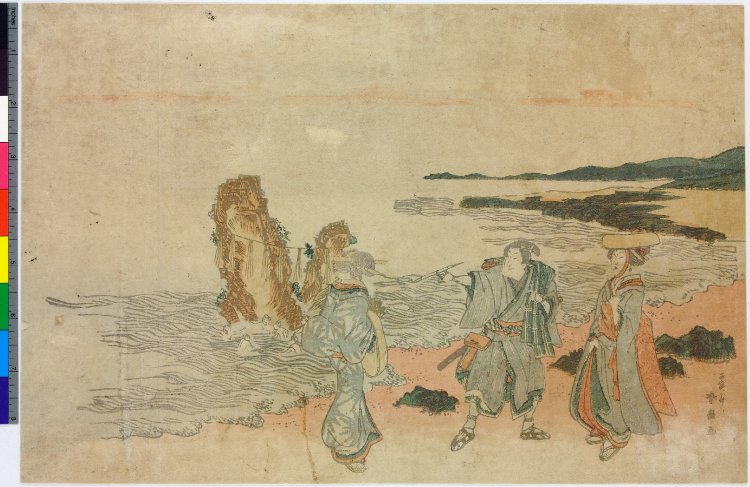
Travellers on the Coast of Futami
- Date:
- c. 1810-1820
- Medium:
- Color woodblock print
- Source:
- British Museum
Description
Held by the British Museum under accession number 1907,0531.0.59 and attributed to Katsukawa Shunsen (1762–c. 1830), this color woodblock print depicts travelers on the coast at Futami in Ise Province. Futami-ga-ura, the bay at Futami on the Pacific coast of present-day Mie Prefecture, was one of the most famous travel destinations of Edo-period Japan, celebrated above all for the Meoto Iwa or Wedded Rocks — two adjacent offshore rocks bound together by a heavy shimenawa (sacred straw rope) and traditionally regarded as a representation of the creator deities Izanagi and Izanami. The site held particular significance for the New Year sunrise: the gap between the two rocks frames the rising sun at the summer solstice, and pilgrims travelled to Futami in connection with visits to the nearby Ise Grand Shrine. Such famous-place travel imagery — meisho-e — became an increasingly important commercial print subject in the Bunka and Bunsei eras (1804–1830), and Shunsen's print belongs to this expanding market for landscape and travel material that anticipated the great landscape series of Hokusai and Hiroshige in the 1830s. The British Museum's example contributes to the relatively small body of documented Shunsen landscape prints — a category in which the artist worked alongside his better-attested bijin-ga and yakusha-e — and is a useful witness to the late-Katsukawa-school engagement with the new landscape-and-travel genre that was reshaping Edo ukiyo-e in the early nineteenth century.
More Prints by Katsukawa Shunsen


Frequently Asked Questions
Travellers on the Coast of Futami was created by Katsukawa Shunsen (勝川春扇) in c. 1810-1820.